
The Professional Artist’s Guide to Packaging and Crating Materials
Choose Art Packing Supplies That Protect the Artwork First
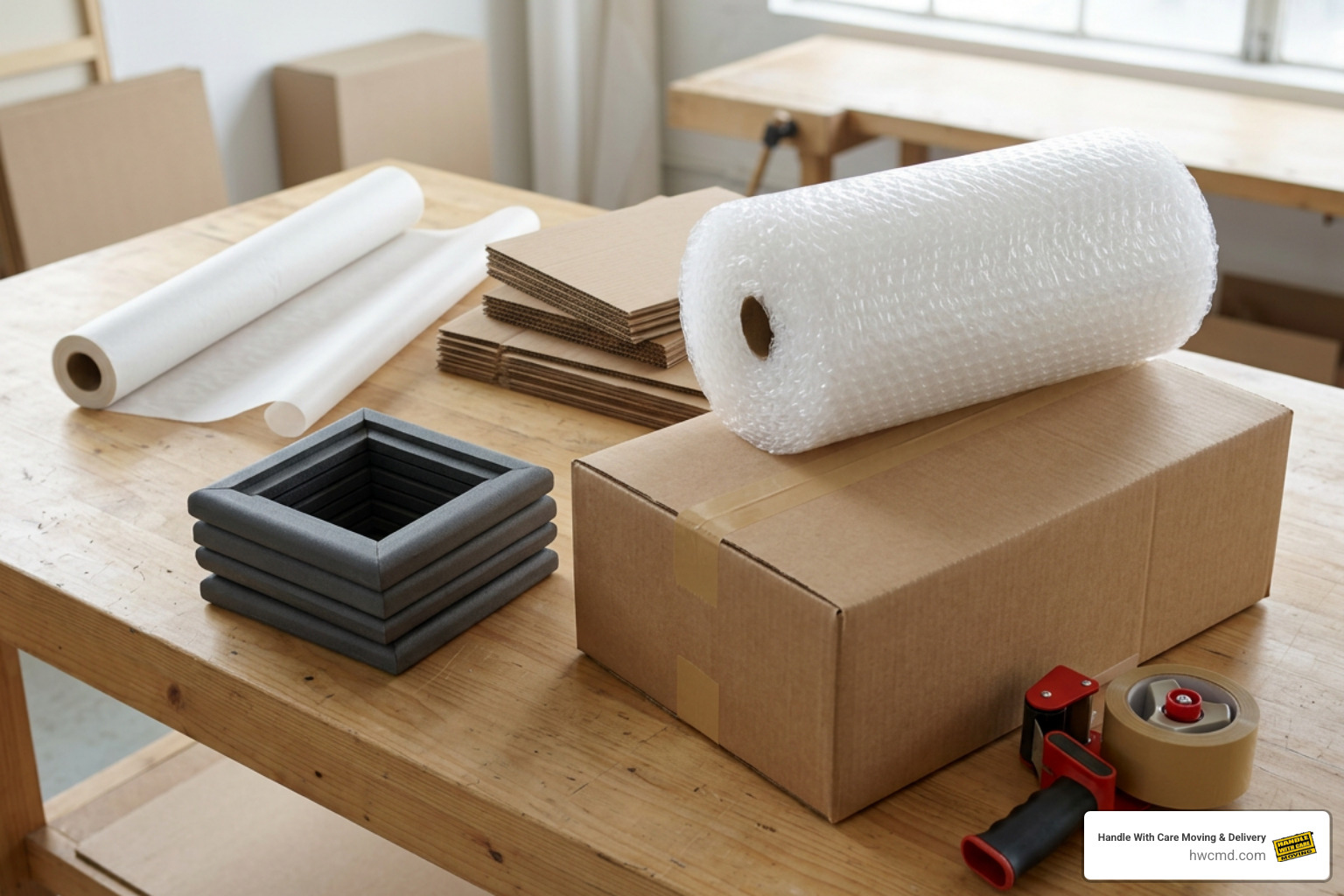
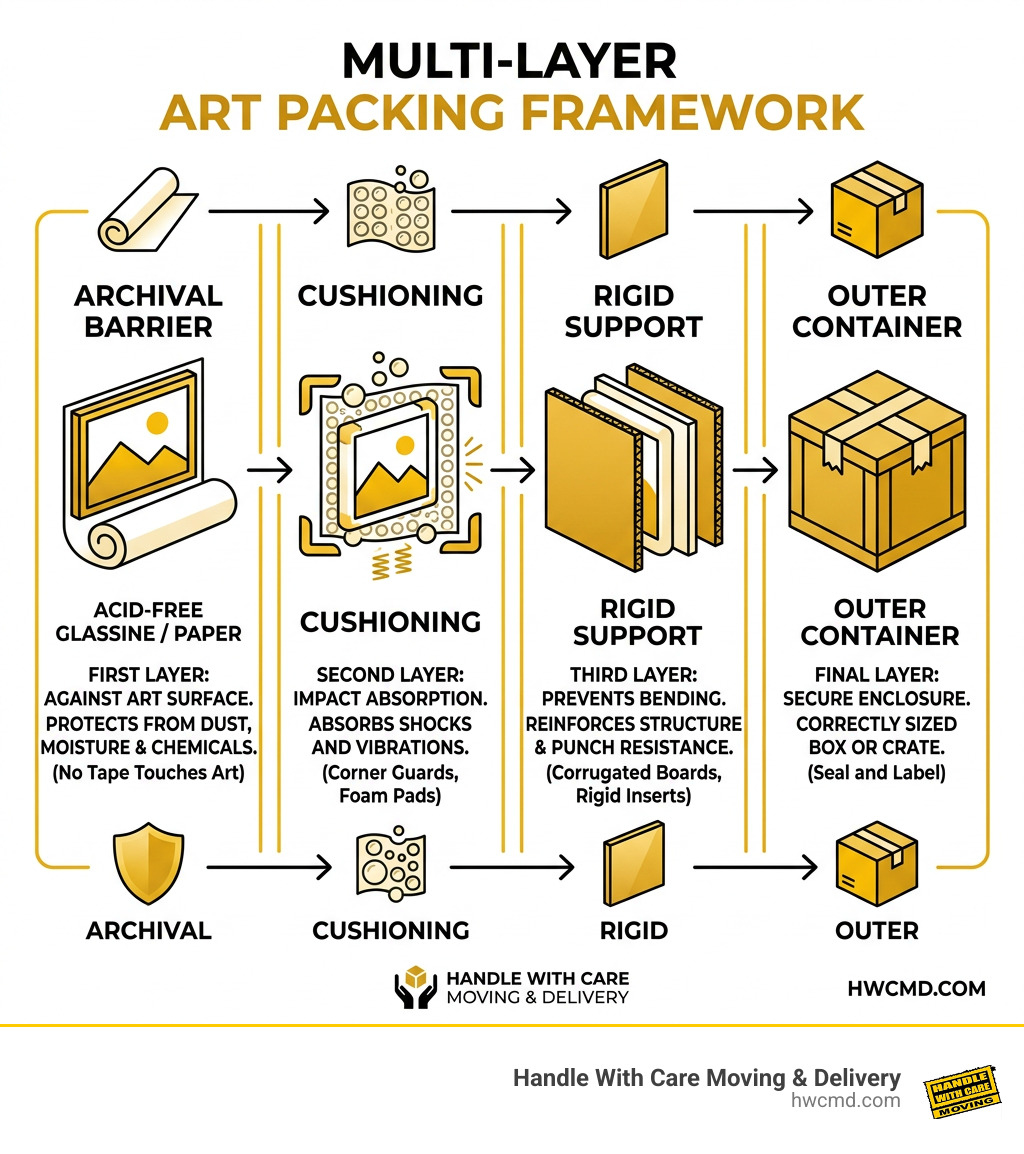
The right art packing supplies create layers of protection: a clean archival barrier against the surface, rigid support against bending or punctures, cushioning against impact, and a correctly sized outer box or crate. For most local moves, start with acid-free glassine or paper, corner guards, foam or corrugated pads, and a sturdy box with no empty space around the piece.
For valuable or fragile work, do not let bubble wrap, tape, or standard moving paper touch the art directly. Use an archival layer first, then add cushioning and a rigid container. Paintings under glass, oversized frames, and sculptures may need reinforced shipping boxes or custom crating to prevent shock, shifting, and puncture damage.
The goal is simple: the artwork should not rub, flex, rattle, or absorb moisture while it is being handled and moved. The sections ahead explain what to use for prints, framed paintings, and three-dimensional pieces, plus when reusable art bags, specialty boxes, or wooden crates make financial sense.
I am Anthony Denha, President of Handle With Care Moving & Delivery. I work with crews that plan each move around careful wrapping, secure loading, and the right art packing supplies for the item and trip ahead.
Key art packing supplies vocabulary:
Essential Art Packing Supplies for Every Medium
Selecting the right packaging requires understanding how fine art interacts with physical forces, humidity, and chemical environments. When we prepare artwork for transit or storage, we evaluate four defensive layers: surface preservation, thermal and moisture regulation, shock absorption, and structural containment.
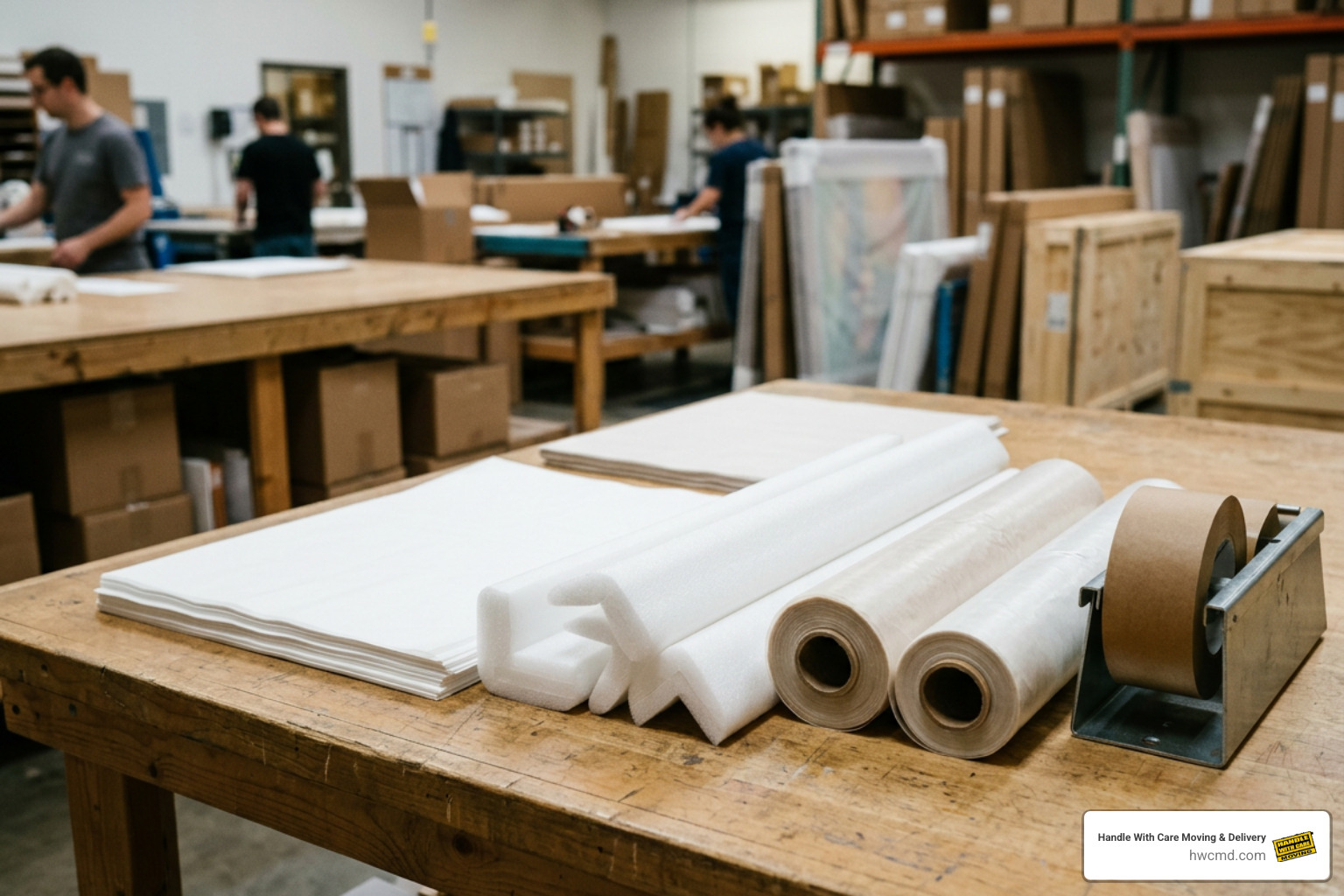
Every successful packaging workflow relies on an organized toolkit of purpose-built supplies. Before tackling any project, consult our comprehensive guide to suitable packing materials to match specific protective grades with your inventory.
Here is the essential checklist:
- Direct Surface Contact: Acid-free glassine paper, unbuffered archival tissue, or non-woven spunbond polypropylene textiles (such as Tyvek).
- Corner & Edge Defense: Heavy-duty foam corner channels, folded rigid corrugated corner protectors, or dense polyethylene foam edge blocks.
- Cushioning & Shock Dissipation: Large-bubble polyethylene wrap, multi-layer convoluted (egg-crate) foam sheets, or die-cut expanding honeycomb paper.
- Structural Rigidity: Archival backing boards, 3/16″ to 1/2″ foam core boards, and custom corrugated pads (28pt to 36pt rigidity).
- Outer Containment: Heavy-duty double-wall corrugated telescoping picture boxes, heavy mailing tubes, or reusable transit cases.
- Secure Fastening: High-shear acrylic packing tape, water-activated reinforced paper tape, and removable low-tack artist tape.
Archival Art Packing Supplies vs. Standard Moving Materials
The primary danger when storing or moving fine art is chemical contamination from non-archival supplies. Standard cardboard boxes, newspapers, and cheap utility wraps contain high levels of lignin and acidic compounds. Over time—or under elevated heat and humidity—these materials off-gas volatile organic compounds (VOCs) that cause yellowing, foxing, and canvas embrittlement.
For delicate pieces, we review practical options for packing services materials to maintain museum standards:
- pH Neutrality: Archival materials are acid-free and neutral (pH 7.0 or slightly buffered up to pH 8.5 for cellulose-based media). Glassine paper resists grease and moisture while offering a non-abrasive barrier that prevents direct friction against varnished oil or delicate pastels.
- Moisture Permeability: Unlike common plastic trash bags, archival barrier films prevent liquid water penetration while balancing interior relative humidity (RH).
- Non-Abrasive Formulations: Standard newsprint contains rough wood pulp fibers that cause microscopic abrasions on high-gloss acrylic emulsions. Archival tissue utilizes smooth, long-fiber virgin cotton or alpha-cellulose pulp to protect delicate finishes.
Reusable Art Packing Supplies and Specialty Bags
If you are an active gallery manager, exhibition coordinator, or working artist traveling the fair circuit, single-use materials generate unnecessary waste and ongoing expense. Reusable art packaging solutions offer durable multi-layer defense, quick turnarounds, and superior environmental performance.
Specialized options include ArtPak heavy-duty bags, which utilize a multi-layer design featuring dual air-cushion layers and reflective barrier films with Class A fire ratings. These bags secure quickly with heavy-duty hook-and-loop flap systems, drastically reducing setup times at exhibition spaces.
Another standard in art logistics is the ArtPakk reusable shock-absorbing sleeve. These multi-layer sleeves combine an acid-free lining, high-density shock-absorbing mid-layer, and water-repellent outer shell capable of absorbing ambient moisture up to an 80% test threshold. They accommodate framed items up to 50 kg without requiring single-use wraps:
- For small prints and intimate canvases, a compact ArtPakk Blue Size 1 (32cm x 40cm) delivers targeted cushioning.
- Mid-sized square gallery pieces benefit from a square profile like the ArtPakk Grey Size 6 (112cm x 112cm).
- Large museum works require oversized protection, such as the ArtPakk Blue Size 22 (200cm x 200cm).
- Outfitting an entire gallery inventory is simplified with an ArtPakk Grey Starter Pack, providing an assortment of sizes for diverse collections.
Step-by-Step Packaging Protocols: From Unframed Prints to 3D Sculptures
Different artistic media require specific handling techniques. Below is a structural comparison of packaging steps across the three primary artwork formats:
| Artwork Format | Primary Surface Layer | Structural Rigidity Layer | Impact Cushioning | Outer Container |
|---|---|---|---|---|
| Unframed Prints / Works on Paper | Acid-free glassine paper or archival polyester sleeve | Dual 4-ply archival mount boards / 36pt corrugated pads | Rigid flat mailer or reinforced heavy-duty tube | Flat-pack telescoping mailer or crush-resistant tube |
| Framed Paintings / Stretched Canvas | Glassine barrier + low-tack glass masking film | Rigid foam core face shield + molded corner protectors | 2-3 layers of large-bubble wrap or convoluted foam | Double-wall telescoping picture box or custom crate |
| 3D Sculptures / Mixed Media | Non-abrasive spunbond tissue or barrier wrap | High-density polyethylene foam base mount | Custom-cut foam cavity blocking + floating void fill | Double-walled nested box system or timber crate |
Unframed Prints, Canvases, and Works on Paper
Flat, paper-based media are vulnerable to corner creasing, humidity ripples, and fingerprint oils.
- Handling: Always wear clean, white cotton gloves to prevent skin oils from transferring onto the paper fibers.
- Interleaving: Place archival glassine sheets between stacked prints, or slide individual items into crystal-clear archival polyester envelopes with pH-neutral backing boards.
- Rigid Sandwiching: Sandwich the sleeved print between two pieces of 36pt corrugated backing boards or acid-free foam boards. Ensure these outer boards extend at least 1 to 2 inches beyond the artwork’s edges on all sides.
- Final Enclosure: Secure the perimeter using low-tack tape (never letting tape touch the artwork) and insert the rigid sandwich into a tab-lock rigid paper mailer or an adjustable One-Piece Folder (OPF) box. For oversized rolled prints, wrap the piece in glassine with a 2-inch overhang, roll loosely around an inner support core, and insert into a heavy-gauge postal mailing tube with sealed end caps.
Framed Paintings and Glazed Works
Framed artworks carry higher transit risks due to frame miter joints, fragile glass, and delicate surface varnishes.
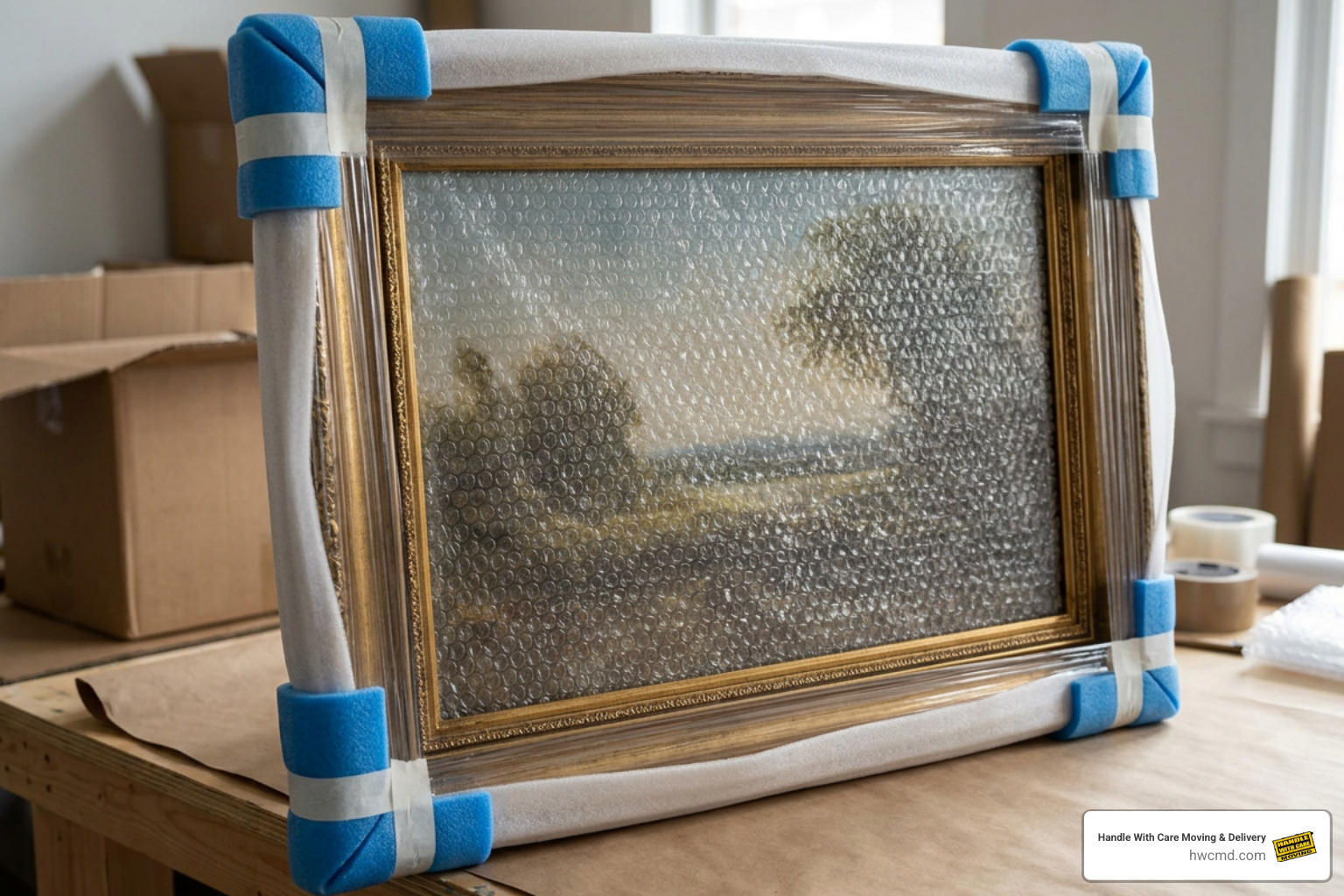
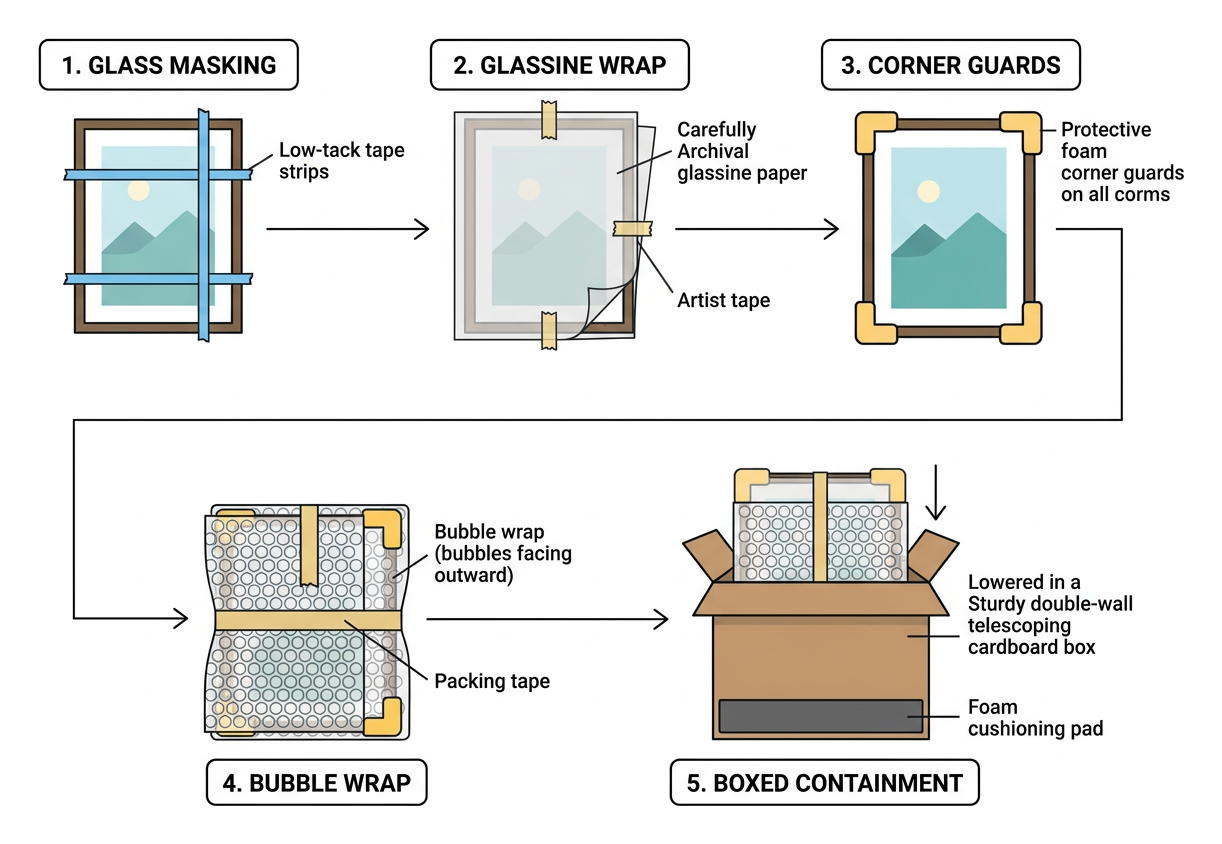
- Glass Protection: If the frame is glazed with standard picture glass (not acrylic/Plexiglas), apply low-tack glass protection film in smooth, edge-to-edge strips. If the glass breaks during an impact, the adhesive film holds the sharp shards in place, preventing them from puncturing the canvas below. Note: Avoid applying adhesive films directly to acrylic or museum anti-reflective glass, as it may damage specialized optical coatings.
- Archival Wrap: Wrap the entire frame in archival glassine paper, securing the seams with artist tape.
- Corner Guards: Slide dense foam or heavy-duty scored cardboard corner protectors over all four frame corners.
- Shock Cushioning: Wrap the frame in multiple layers of bubble wrap (bubbles facing outward to avoid pressure imprints), sealing edges with packing tape to create a secure, water-resistant bundle.
- Boxing: Slide the wrapped painting into a double-wall telescoping box lined with a base cushion of 2-inch foam. Ensure zero internal movement once the telescoping halves are taped firmly together.
Three-Dimensional Sculptures and Mixed Media
Three-dimensional sculptures possess irregular weight centers, delicate protrusions, and fragile structural joins. Packing these pieces requires careful isolation from kinetic shock, starting with the fundamentals of packing fragile items.
- Surface Isolation: Wrap delicate features, patina surfaces, or unsealed stone in non-abrasive, unbuffered archival tissue paper.
- Component Immobilization: Secure articulating components or removable bases separately. Double-wrap individual components in small-bubble wrap.
- Cavity Foam Blocking: Using dense polyethylene (PE) or polyurethane (PU) foam planks, carve custom cavity cutouts that cradle the exact contours of the sculpture. The base must support the majority of the object’s mass to eliminate strain on smaller extremities.
- The Double-Box Method (Box-in-Box):
- Place the foam-blocked sculpture inside an inner double-wall corrugated carton.
- Line a larger outer shipping box with at least 3 inches of high-density cushioning (foam planks or tightly consolidated packing materials).
- Center the inner box inside the outer box, filling all surrounding voids completely.
- Seal with heavy-duty water-activated tape. If you are preparing delicate household items or kitchenware alongside your art collection, our guide on how to pack dishes for shipping safely details similar double-containment strategies.
Engineered Art Shipping Boxes vs. Custom Wooden Crating
Selecting between a heavy-duty engineered shipping carton and a fully built timber crate depends on the artwork’s financial value, physical fragility, destination, and shipping mode.
For valuable collections, exploring how custom crating services protect valuable investments offers insight into maximizing structural protection during transit.
Heavy-Duty Corrugated Shippers and Puncture-Resistant Boxes
Specialized art shipping cartons (such as Airfloat StrongBox systems) bridge the gap between basic corrugated boxes and heavy wooden crates.
- Puncture Guard Liners: Top-tier engineered boxes incorporate high-impact ABS plastic sheets bonded between double-wall corrugated boards. This design provides puncture resistance comparable to 3/8″ plywood while reducing total package weight.
- Suspension Foam Technology: Multi-layered convoluted foam sandwiches the artwork, holding the frame suspended in the center of the box to disperse kinetic energy away from pressure points.
- Reusability and Efficiency: Weighing between 3 and 55 lbs depending on size, these containers lower ground courier costs compared to wooden crates. They are approved by major domestic couriers and can be reused across dozens of domestic shipments.
Museum-Grade Wooden Crating for Fragile Freight
When shipping high-value original works, oversized canvases, heavy marble sculptures, or items destined for international sea/air freight, wooden crates provide the ultimate level of protection. If you are coordinating specialized logistics for an upcoming move or gallery show, pairing proper crating with specialty packing and delivery solutions ensures secure transit from pickup to installation.
When constructing or commissioning fine art crates, ensure they meet these professional standards:
- ISPM-15 Compliance: Crates designed for international export must use heat-treated, certified lumber stamped with the official bug-stamp (IPPC mark) to pass international customs checkpoints without quarantine delays.
- Perimeter Framing and Plywood Sheathing: Minimum 3/4″ exterior-grade plywood walls backed by solid 1×4 or 2×4 spruce/fir framing.
- Environmental Seals: Closed-cell neoprene or EPDM perimeter gaskets line the crate lid, forming an airtight, water-resistant barrier against ambient relative humidity shifts in cargo holds.
- Internal Floating Foam Cradles: Neoprene or ester foam interior linings cut to standard thicknesses (typically 2″ to 4″) isolate the internal payload from high-amplitude drops and transport vibrations.
Critical Mistakes to Avoid When Shipping High-Value Art
Packing fine art requires attention to detail. A single oversight can damage a fragile medium. Here are the most common packing mistakes and how to prevent them:
- Placing Bubble Wrap or Polyethylene Directly Against Unvarnished Paint: Direct plastic contact creates surface ferrotyping (permanent smooth, shiny spots on matte paint surfaces) and traps moisture against curing oils. Always place a breathable layer of archival glassine paper between the artwork and cushioning wraps.
- Securing Tape Directly to Artwork or Frame Finishes: Standard adhesives transfer residue, lift gold leafing, or peel delicate paper fibers. Secure wrapping layers to themselves using tape-to-paper techniques, or use low-tack artist tape that removes cleanly.
- Allowing Internal Movement Inside the Outer Carton: If an artwork can shift even a fraction of an inch inside its container, handling vibrations will cause structural fatigue and corner scuffs. Fill all internal voids with foam inserts or paper pads until the piece remains stationary during a gentle shake test. Similar principles apply when packing fragile ceramics—see our tips on how to pack dishes for storage without damage for void-fill techniques.
- Failing to Acclimate Cold Artwork Before Unpacking: Art transported in cold freight conditions develops condensation when brought rapidly into a warm, humid room. Allow sealed crates or boxes to rest unopened inside the destination climate for 24 hours to acclimate gradually.
- Ignoring Package Orientation and Handling Indicators: Always mark outer crates and boxes with clear “FRAGILE,” “THIS SIDE UP,” and balance indicators. For high-value shipments, attach visual drop sensors (such as ShockWatch) and tilt indicators to detect and document rough handling.
Frequently Asked Questions About Art Packing
How do I calculate the correct box or bag size for framed artwork?
To find the required internal dimensions for your box or reusable bag, measure your artwork’s height, width, and frame depth. Use this formula:
- Minimum Bag Width = Artwork Width + (2 × Frame Depth) + 2″ clearance allowance
- Minimum Bag Length = Artwork Height + (2 × Frame Depth) + 2″ clearance allowance
- Minimum Rigid Box Interior = Add 3″ to 4″ across all outer dimensions (height, width, depth) to accommodate a minimum of 1.5″ to 2″ of continuous foam cushioning around all six sides.
Can I use standard bubble wrap directly against an oil or acrylic painting?
No. Standard bubble wrap should never make direct contact with an oil, acrylic, watercolor, or encaustic surface. The plastic bubbles can leave permanent circular indentations or chemical impressions on acrylic emulsions and oil glazes. Always wrap the piece in an archival, pH-neutral barrier—such as glassine paper or unbuffered acid-free tissue—before applying bubble wrap or outer foam layers.
What eco-friendly alternatives exist for traditional foam and bubble wrap?
Several sustainable materials provide reliable transit cushioning:
- Die-Cut Expanding Honeycomb Paper: Brands like GreenWrap provide moldable, interlocking shock cushioning using 100% recycled, curbside-recyclable kraft paper.
- Molded Corrugated and Pulp Pads: Rigid corner supports made from post-consumer recycled cardboard waste replace traditional polystyrene foam blocks.
- Multi-Use Transit Bags: Reusable multi-layer sleeves eliminate single-use plastic waste across multi-city exhibitions and art fair runs.
- Starch-Based Void Fill: Biodegradable packing peanuts made from non-GMO cornstarch dissolve harmlessly in water without leaving synthetic chemical residues.
Conclusion
Every piece of art represents a unique balance of creative expression, financial value, and material sensitivity. Protecting artwork throughout transit requires selecting quality materials, maintaining clean archival contact layers, providing rigid corner protection, and using properly engineered outer containers.
Whether you are preparing a single print for a regional gallery or moving an entire private collection, planning your packaging preserves the structural and visual integrity of every medium. If you are coordinating a large-scale relocation or moving delicate household treasures alongside your art, our guides on how to pack dishes for a move and local packing services provide helpful packing strategies.
When moving heavy collections, delicate framed originals, or oversized sculptures, working with experienced professionals ensures everything is safely transported. Discover how full service packers and trained movers who pack for you protect your most delicate items.
For professional handling, climate-conscious moving, and museum-grade protective packaging in the Ann Arbor region, explore our dedicated professional packing services and materials. Our experienced team at Handle With Care Moving & Delivery provides clear 15-minute billing increments, complimentary protective wrapping supplies, and attentive handling for every piece in your collection.