
How Custom Crating Services Protect Your Most Valuable Items
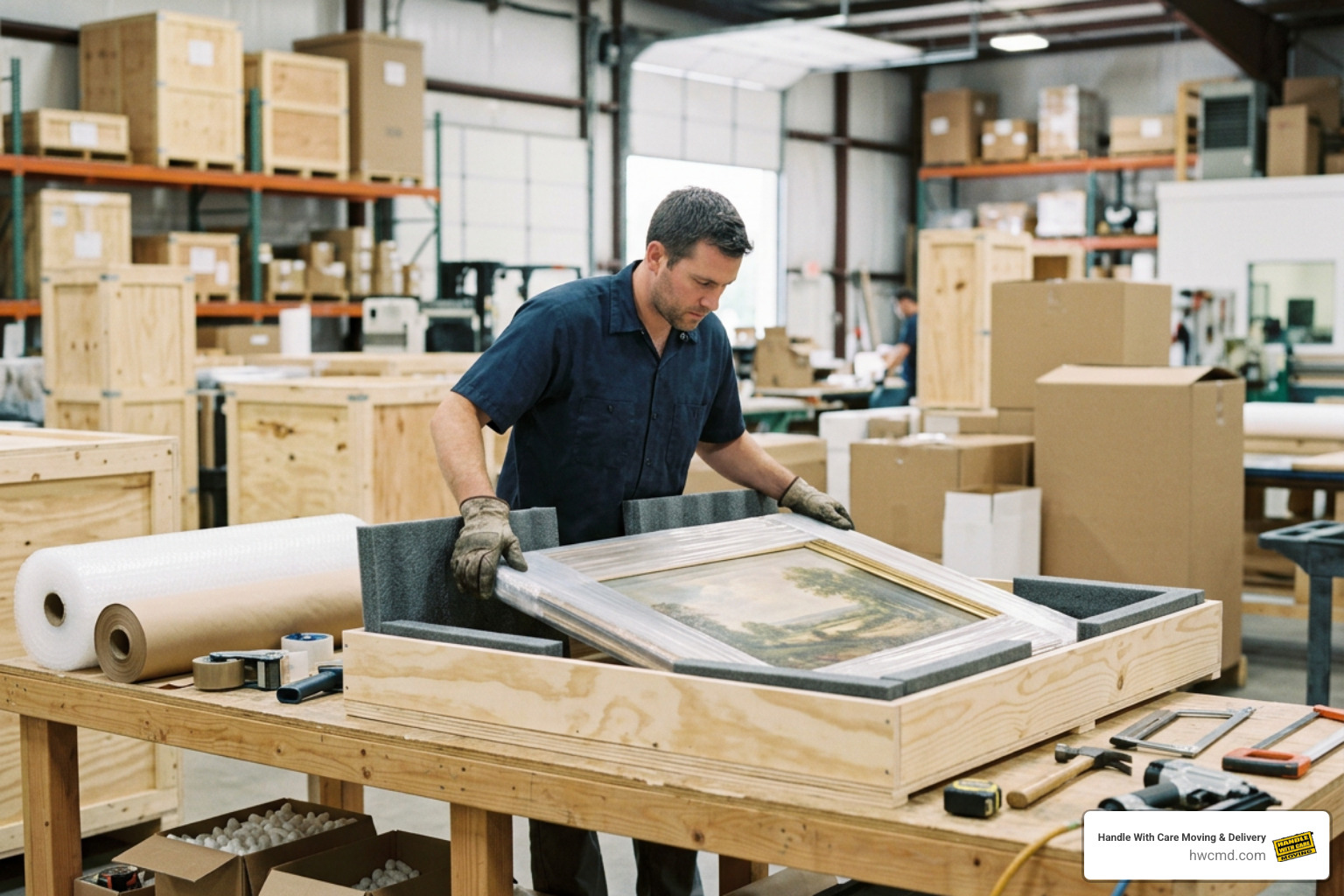
Why a Packing and Crating Service Matters for Valuable Items
A packing and crating service prepares fragile, valuable, heavy, or unusually shaped items for safer moving and shipping. It combines protective packing materials with a custom-built crate, pallet, or wrap system designed around the item’s size, weight, and weak points.
This added protection is often a smart choice for items such as artwork, antiques, glass furniture, electronics, medical equipment, and machinery. A properly prepared crate helps limit movement, vibration, impact, moisture exposure, and handling damage from pickup through delivery.
For a local or short-distance Michigan move, custom crating can be especially useful when replacing an item would cost far more than protecting it. The goal is simple: give the item a stable outer structure and enough internal support that it stays secure while crews lift, load, transport, and unload it.
I am Anthony Denha, President of Handle With Care Moving & Delivery, and I work with crews who focus on the small details that protect belongings during a move. In this guide, I will explain how a packing and crating service works and what to consider before choosing one.
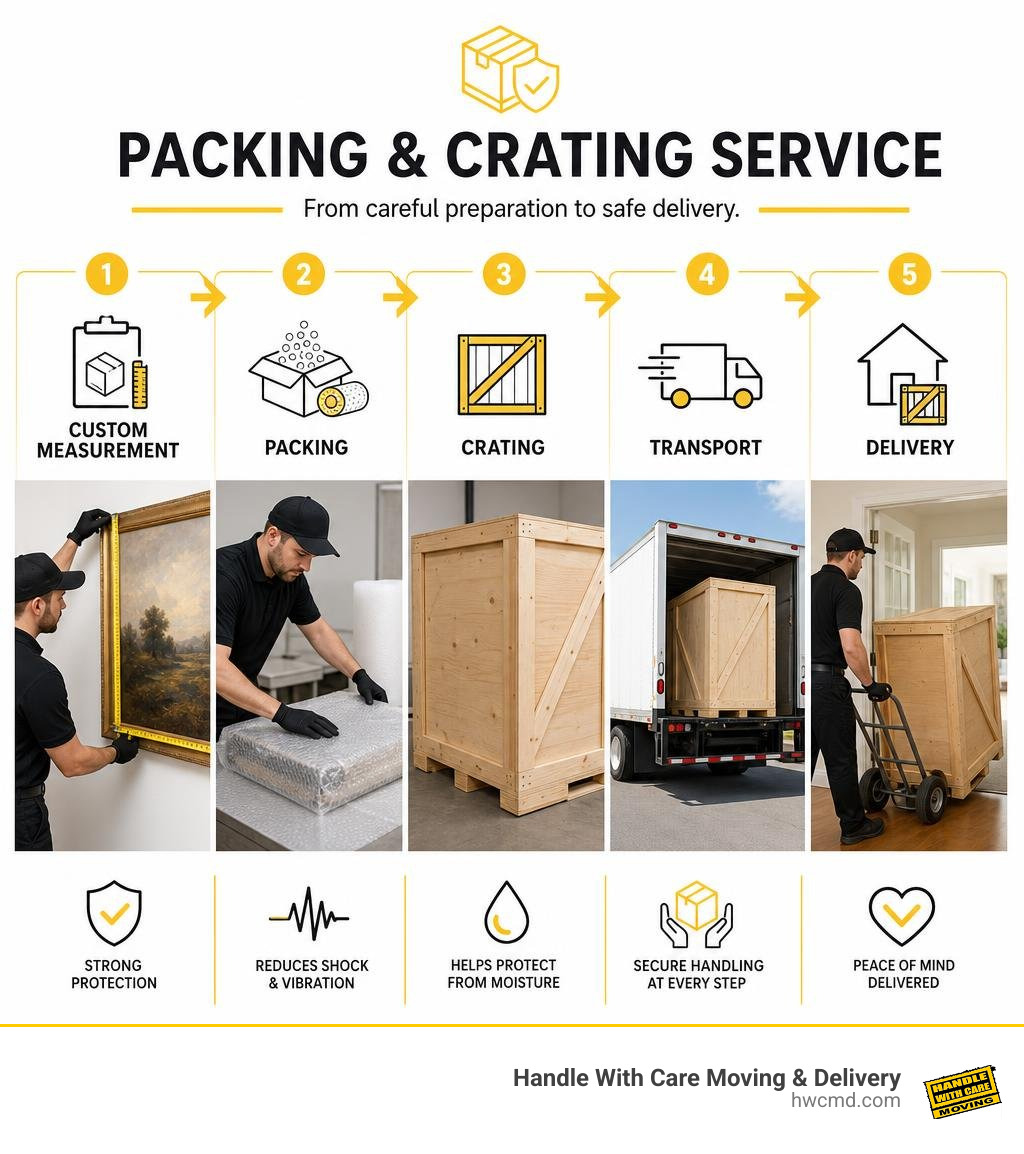
What Is a Packing and Crating Service and Which Items Need It?
When standard corrugated boxes and bubble wrap simply won’t cut it, a professional packing and crating service steps in to fill the gap. At its core, custom crating is the engineering and fabrication of tailored wooden or fiberboard enclosures built specifically around an object’s exact dimensions, weight distribution, and structural vulnerabilities. Unlike off-the-shelf cardboard boxes that can flex, crush, or buckle under weight, custom timber structures provide continuous exterior rigidity and structural freight stabilization during transit.
When cargo moves—whether across town in Ann Arbor or across oceans via international container lines—it experiences multidirectional forces. Trucks bounce over potholes, cargo ships roll across open swells, and forklifts transfer cargo between terminals. Without adequate stabilization, items inside a truck or container shift, collide, and suffer vibration fatigue. Professional crating acts as an armored exoskeleton, absorbing external forces while keeping the cargo immobilized inside.
To master the basics of standard box packing before moving on to heavy-duty crating, check out our helpful guide on Packing 101.
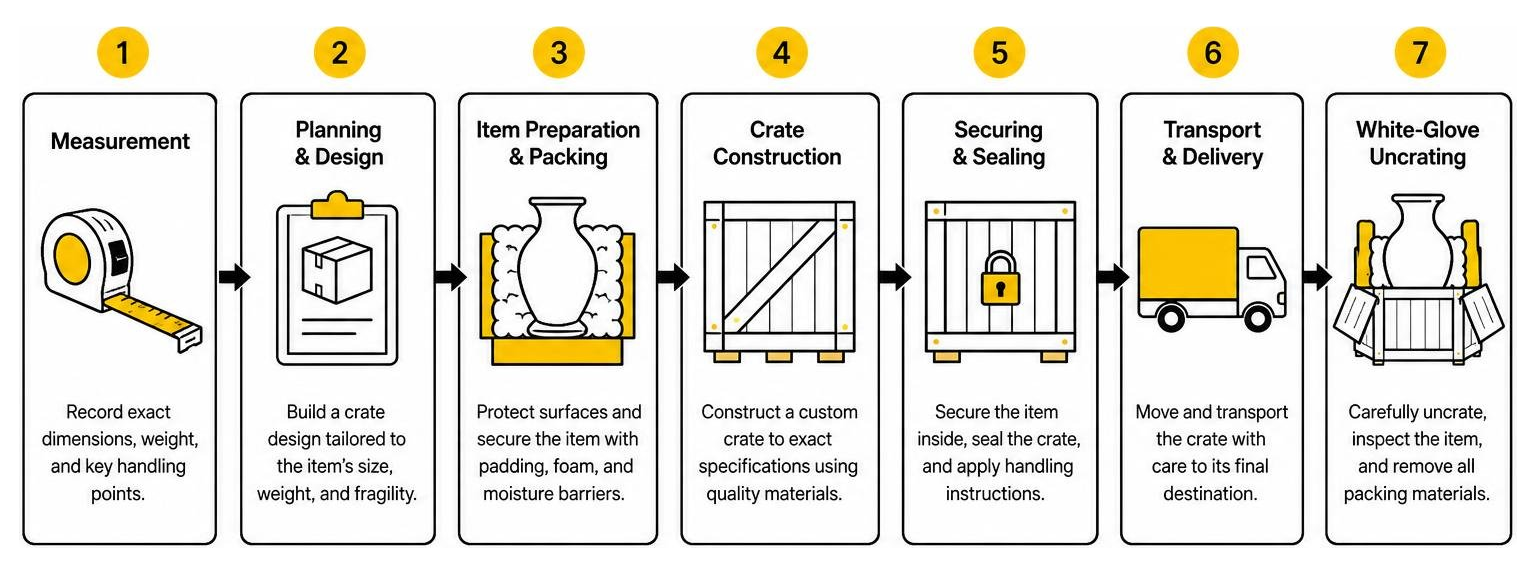
High-Value, Fragile, and Heavy Cargo Categories
Not every household or commercial item requires a heavy timber container. However, specific categories of goods face extreme risks when transported without specialized packaging. The primary items requiring a custom packing and crating service include:
- Fine Art and Antiques: Delicate oil paintings, marble sculptures, grandfather clocks, and irreplaceable family heirlooms require custom wood enclosures lined with acid-free barriers and tailored foam cutouts to prevent surface contact and environmental damage.
- Medical and Laboratory Equipment: High-precision diagnostic equipment, MRI components, and delicate lab devices contain sensitive optical and mechanical calibrators that can be ruined by minor road vibrations.
- IT Hardware and Server Racks: Enterprise server racks, circuit arrays, and delicate computer systems demand shock-mounted timber crates that absorb kinetic energy during loading and unloading.
- Industrial Machinery and Automotive Components: Oversized, dense items like CNC routers, transaxles, robotics, and manufacturing equipment require heavy-duty timber bases, blocking, and bracing to support loads exceeding thousands of pounds.
- Glassware and Architectural Fixtures: Oversized glass tabletop panels, crystal chandeliers, and delicate stained-glass windows demand custom-slotted wood crates that prevent twisting and pressure points.
Choosing a Professional Packing and Crating Service vs. DIY Packaging
It can be tempting to grab some 2×4 lumber, a hand saw, and a box of screws to build a DIY crate in the driveway. However, proper wooden crating is far more than hitting wood with a hammer. Professional crating relies on precise dimensional measurement, structural weight load calculations, and specialized shock absorption techniques.
| Packaging Consideration | DIY Wood Packaging | Professional Packing & Crating Service |
|---|---|---|
| Dimensional Accuracy | Approximated; high risk of internal movement | Custom-engineered to exact millimeter tolerances |
| Internal Cushioning | Standard foam or bubble wrap; prone to compression | Density-matched polyurethane/polyethylene vibration dampening |
| Structural Integrity | Butt joints prone to splitting under load stress | Reinforced corner posts, heavy-duty skids, and diagonal bracing |
| Compliance | Non-compliant wood risks international customs rejection | Certified ISPM-15 heat-treated lumber for global clearance |
| Claim Ratios & Risk | Higher risk of transit damage and denied claims | Drastically reduced claim ratios and fully insurable transit |
When a commercial business or homeowner attempts DIY crating, small mistakes—such as using improper wood thickness or placing padding in the wrong spot—can result in catastrophic structural failure. Furthermore, insurance providers often deny claims for self-packed items if improper structural support caused the damage. To better understand how coverage applies during a move, read our breakdown on Understanding Liability and Claim.
Working with certified packaging professionals ensures that high-value assets remain protected against structural strain, helping to lower damage rates significantly below standard moving industry averages.
Custom Crating Types, Materials, and Damage Prevention Standards

Every valuable item presents unique engineering challenges. A delicate 18th-century canvas painting demands completely different packaging materials than a 10,000-pound metal lathe. A quality packing and crating service selects specific wood grades, structural designs, and internal barrier liners based on the precise demands of the cargo.
Custom Wood Crates, Palletizing, and Shrink Wrapping Options
Professional craters utilize several distinct structural configurations depending on the transit method, weight, and fragility of the shipment:
- Fully Enclosed Custom Wood Crates: Constructed from solid lumber frames and heavy plywood sheathing, fully enclosed crates offer 360-degree protection against impacts, debris, stacking loads, and weather exposure.
- Open Craters or Slatted Wooden Framework: Used for durable yet awkwardly shaped items, open slatted crates provide robust perimeter defense and lifting points while keeping the overall package weight lower.
- Palletizing and Standard Skids: Securing freight directly to heavy-duty wooden pallets (typically measuring 48″ x 40″ for standard shipping) or custom-built runner skids allows forklifts and pallet jacks to safely lift and maneuver cargo without risking direct contact with the item itself.
- Double-Corrugated and Fiberboard Containers: For items that require rigid protection without the added weight of heavy timber, heavy-duty double-wall corrugated containers mounted on wooden skid bases provide an ideal lightweight alternative.
- Heavy-Duty Over-Wrapping and Shrink Wrap: Heavy industrial plastic film is heat-shrunk over the crated or palletized assembly to protect against dust, rain, and road splatter during flatbed transport.
When bundling multiple boxes onto a single pallet base, logistics experts refer to the combined assembly as a single “handling unit.” Unifying freight into solid handling units prevents individual boxes from being lost or mishandled during transport transfers.
Advanced Protective Materials and ISPM-15 International Compliance
Constructing a solid outer wood box is only half the battle; internal load securing and atmospheric defense are equally vital. To protect sensitive equipment during ocean shipping or cross-country transit, advanced crating relies on several specialized internal materials:
- Vibration-Absorbing Foam Cushioning: Open-cell and closed-cell custom foam inserts absorb road shocks and engine vibrations before kinetic energy reaches the item.
- Blocking and Bracing: Heavy timber blocks are bolted to the crate base around the cargo to keep heavy items from sliding or tipping during sudden truck stops.
- Moisture Barriers and Desiccant Sachets: When ocean freight or long-term storage exposes metal equipment to high humidity, moisture-barrier bags combined with silica desiccant sachets draw moisture away, preventing rust and electrical short circuits.
- Vapor Corrosion Inhibitors (VCI): Specialized VCI plastic film releases protective vapor molecules that shield raw steel and electronic components from surface oxidation.
For international export shipments, compliance with ISPM-15 (International Standards for Phytosanitary Measures No. 15) is mandatory. Raw, untreated lumber can transport invasive wood-boring insects across international borders. To prevent ecological contamination, international regulations mandate that all raw wood packaging materials exceeding 6mm in thickness undergo heat treatment (HT) until the core temperature reaches 56°C (132°F) for at least 30 minutes. Once certified, the lumber receives an official IPPC wheat-stamp logo. Without this stamp, foreign customs agents will reject or destroy the shipment at the border.
Leading global packaging providers like Crating Services & Shipping Preparation | Creopack specialize in applying these advanced moisture barriers, custom bracing, and ISPM-15 export certifications for complex industrial machinery and international freight.
Crating Costs, Logistics Steps, and Choosing a Provider
Understanding how a packing and crating service calculates total costs allows homeowners and business managers to budget accurately for upcoming moves or freight shipments.

| Shipping & Cost Factor | Standard Corrugated Packaging | Custom Wooden Crating & Palletization |
|---|---|---|
| Material Base Cost | Low upfront box cost | Higher custom timber and fabrication cost |
| Tare Weight Added | Minimal weight (1–5 lbs) | Substantial added weight (often 100+ lbs) |
| Dimensional Volume | Compact standard box sizes | Expanded exterior footprint |
| NMFC Freight Class | Higher risk class (e.g., Class 150–300) | Lower risk class (e.g., Class 70–100) |
| Damage Protection | Basic impact resistance | Maximum structural, shock, and puncture protection |
Factors Influencing Freight Rates and Budgeting
When calculating total freight charges, freight carriers look at overall gross weight and physical dimensions. Adding a custom wooden crate and pallet can easily add 100+ pounds to a shipment’s total weight. However, this added weight does not automatically mean higher shipping costs.
In the motor freight industry, shipping rates depend heavily on National Motor Freight Classification (NMFC) classes. Freight class is determined by density, stowability, handling ease, and liability/fragility risk. Dense, highly durable crated items qualify for lower freight classes (such as Class 70 or 85), whereas fragile, loosely packed items fall into high freight classes (such as Class 250 or 300) that command higher shipping rates per pound. By securely encasing an item inside an easily stackable, damage-proof wooden crate, you often lower the shipment’s overall freight class, which helps offset the added weight on long-distance hauls.
Accurate documentation on the Bill of Lading (BOL) is critical. The BOL must reflect both the net weight of the item and the final crated gross weight, as well as exact exterior dimensions. Inaccurate BOL measurements can trigger carrier re-weigh adjustments and billing penalties.
Whether shipping via Less-Than-Truckload (LTL) for single crated units or dedicated Full Truckload (FTL) for large commercial relocations, proper planning makes all the difference. For practical moving tips to streamline your moving preparations, explore our list of 10 Great Moving Tips to Make Your Move Efficient and Easy.
Essential Questions to Ask Before Hiring a Packing and Crating Service
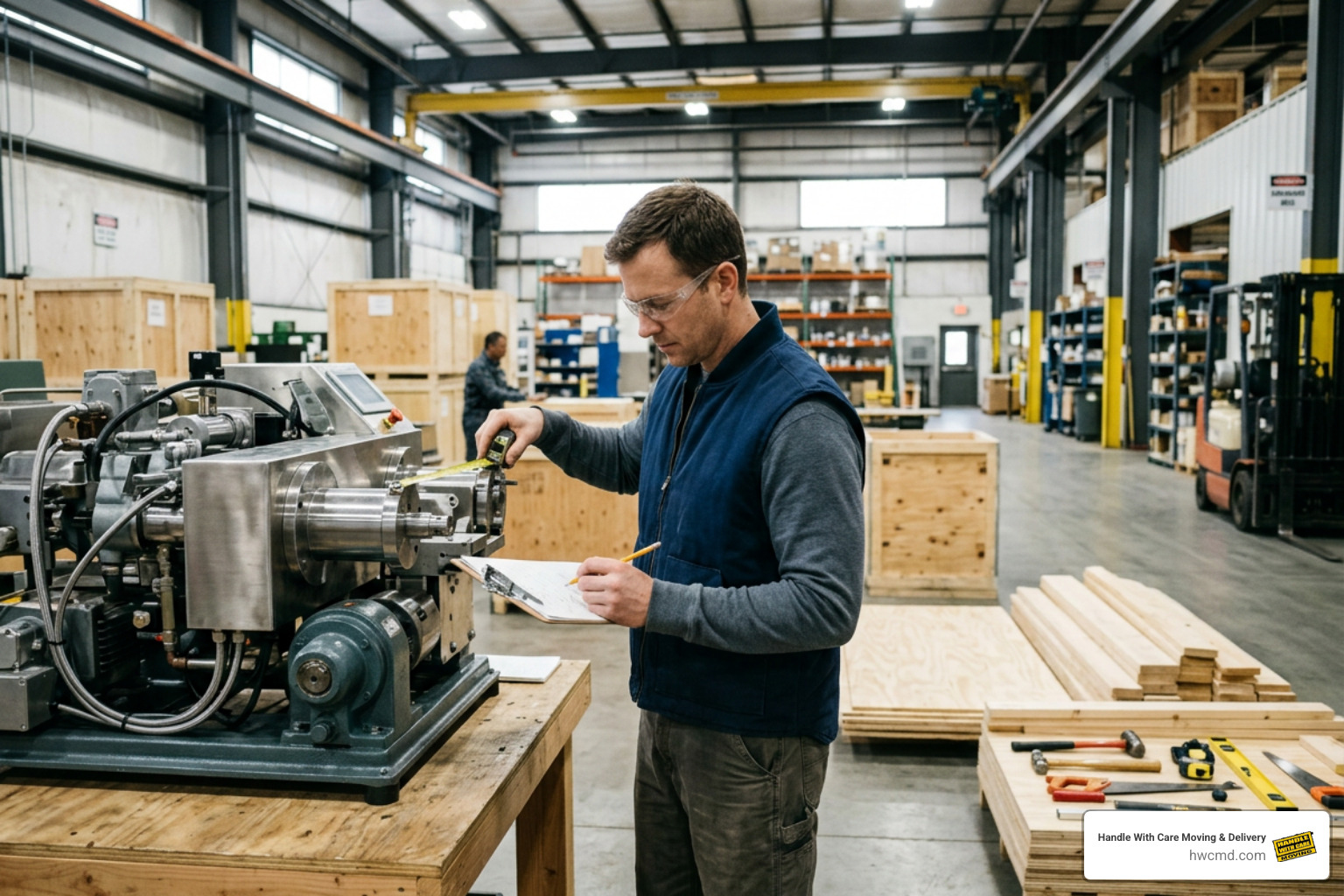
Before hiring a packing and crating service, take time to vet the company’s capabilities, licensing, and track record. Key questions to ask include:
- Do you manufacture custom crates tailored specifically to my item, or do you use prefabricated box sizes?
- Are your wooden crates certified ISPM-15 compliant for international export shipping?
- What internal cushioning materials (foam density, VCI film, blocking, moisture barriers) do you recommend for my item’s specific vulnerability?
- What level of transit insurance and valuation coverage do you offer during loading, transport, and uncrating?
- Do you offer on-site mobile crating services at my home or facility, or must the item be transported unpackaged to your warehouse?
- Are your transport crews licensed and bonded with official DOT credentials?
For specialized regional relocations, working with established crating specialists provides decades of specialty experience when handling delicate art, antiques, and heavy commercial cargo across complex urban corridors.
Value-Added Logistics: White-Glove Care, On-Site Packing, and Network Coverage
For high-value items, high-end residential moves, or sensitive laboratory relocations, standard curb drop-off delivery falls far short of expectations. Premium packing and crating service providers offer comprehensive white-glove delivery and specialized logistics options that handle every detail from start to finish.
White-glove service goes beyond simple transportation, offering a seamless, end-to-end relocation experience:
- Detailed Site Surveys: Technicians visit your facility or home prior to moving day to inspect doorways, stairwells, elevator weight limits, and hallway turning radiuses to ensure the crated cargo can navigate tight spaces safely.
- Mock Deliveries: For high-value, oversized architectural or industrial pieces, crews perform practice runs using exact physical templates to identify tight bottlenecks before handling the real item.
- On-Site Mobile Crating: When extremely fragile art pieces, server racks, or heavy machinery cannot be safely moved unpackaged, mobile crating teams bring raw timber, power tools, and specialized foam directly to your home or office to build the crate on-site.
- Floor and Property Protection: White-glove teams install temporary neoprene floor runners, wall guards, and door-jamb protectors to prevent scratches, gouges, or carpet dirt during crate maneuvers.
- Inside Uncrating, Assembly, and Restoration: Upon arrival at the final destination, white-glove technicians unbolt the timber crates, unseal protective barriers, place the item inside its exact designated spot, assemble components, and make minor touch-up adjustments.
- Debris Removal: Crews dismantle all wooden timber framing, foam inserts, and wrapping materials, removing all waste from your property so you don’t have to clean up.
- Climate-Controlled Storage: If destination sites are not ready for immediate installation, crated items can be transferred into secure, climate-monitored warehouse facilities to protect wood joinery and internal electronics from humidity fluctuations.
For cross-country relocations or international freight moves, partnering with a provider that maintains a national network ensures that white-glove standards remain consistent from origin to destination, safely delivering household goods, artwork, and heavy machinery across state lines and international boundaries. To learn more about our specialized handling capabilities and moving options, visit our comprehensive page on Moving Information.
Frequently Asked Questions About Custom Crating
Does custom wooden crating increase overall freight shipping costs?
While custom wooden crating increases the initial total weight and physical outer footprint of a shipment—which can raise raw transportation charges—it often reduces total net shipping costs in two distinct ways:
- Freight Class Reductions: Properly crated and palletized items qualify for lower National Motor Freight Classification (NMFC) classes compared to loose or fragile items, lowering the base rate charged per hundred pounds.
- Damage Prevention ROI: The financial cost of repairing or replacing an irreplaceable antique, medical device, or industrial component far exceeds the investment in a custom wood crate. A single avoided shipping claim pays for the crating service many times over.
What is ISPM-15 certification and why is it required for international export?
ISPM-15 is an international environmental regulation established by the International Plant Protection Convention (IPPC). It mandates that all raw wood packaging materials (such as timber pallets, skids, and custom crates) used in cross-border ocean or air freight must be heat-treated to destroy wood-boring pests. Certified wood receives a permanent heat-treatment stamp (HT stamp). Without this official stamp, foreign customs authorities will deny clearance, resulting in costly border delays, forced return shipments, or destruction of the packaging at the owner’s expense.
What is included in white-glove delivery for crated cargo?
White-glove delivery provides total, stress-free assistance at your final destination. A complete white-glove service includes:
- Unloading the crated shipment from the delivery truck using liftgates and padded equipment.
- Moving the crate safely inside your home, gallery, or office space.
- Laying down floor, stair, and wall protection materials prior to uncrating.
- Unbolting timber panels, unsealing protective barrier films, and carefully lifting the item out.
- Placing the item in its exact final room location and performing basic reassembly.
- Hauling away all wood crates, pallets, foam inserts, and packing debris for responsible recycling.
If you are preparing for an upcoming move in Ann Arbor or Southeast Michigan and want to discuss custom packaging solutions for your high-value items, request a personalized, commitment-free estimate through our Free Quote page.
Conclusion
Whether you are relocating delicate fine art, shipping sensitive medical devices, or moving heavy commercial equipment across the country, choosing a professional packing and crating service gives you complete peace of mind. Custom wood crates, combined with density-matched foam cushioning, moisture barriers, and heavy-duty pallet bases, shield your most valuable belongings against shock, vibration, weather, and rough transit handling.
At Handle With Care Moving & Delivery, we know that every item we handle represents a significant financial or personal investment. Operating throughout Ann Arbor, Michigan, we pride ourselves on careful handling and customer-first service:
- Complimentary Protective Materials: We provide free pad and shrink wrapping on every job to keep furniture surfaces spotless.
- Transparent Pricing: We bill in transparent 15-minute increments with no minimum labor hour requirements, ensuring you only pay for the exact time spent working.
- Specialized Savings: We proudly offer dedicated discounts for students, seniors, and military veterans.
When your valuable items require professional packing, sturdy custom timber protection, and attentive white-glove handling, trust a team that lives up to its name. Explore our specialized packaging options today on our Packing Services Materials page, or contact us today to build the ideal moving and crating solution for your next move!