
The Stress-Free Moving Out of State Checklist for Long-Distance Relocation

Start Your Moving Out of State Check List 8 Weeks Before Move Day
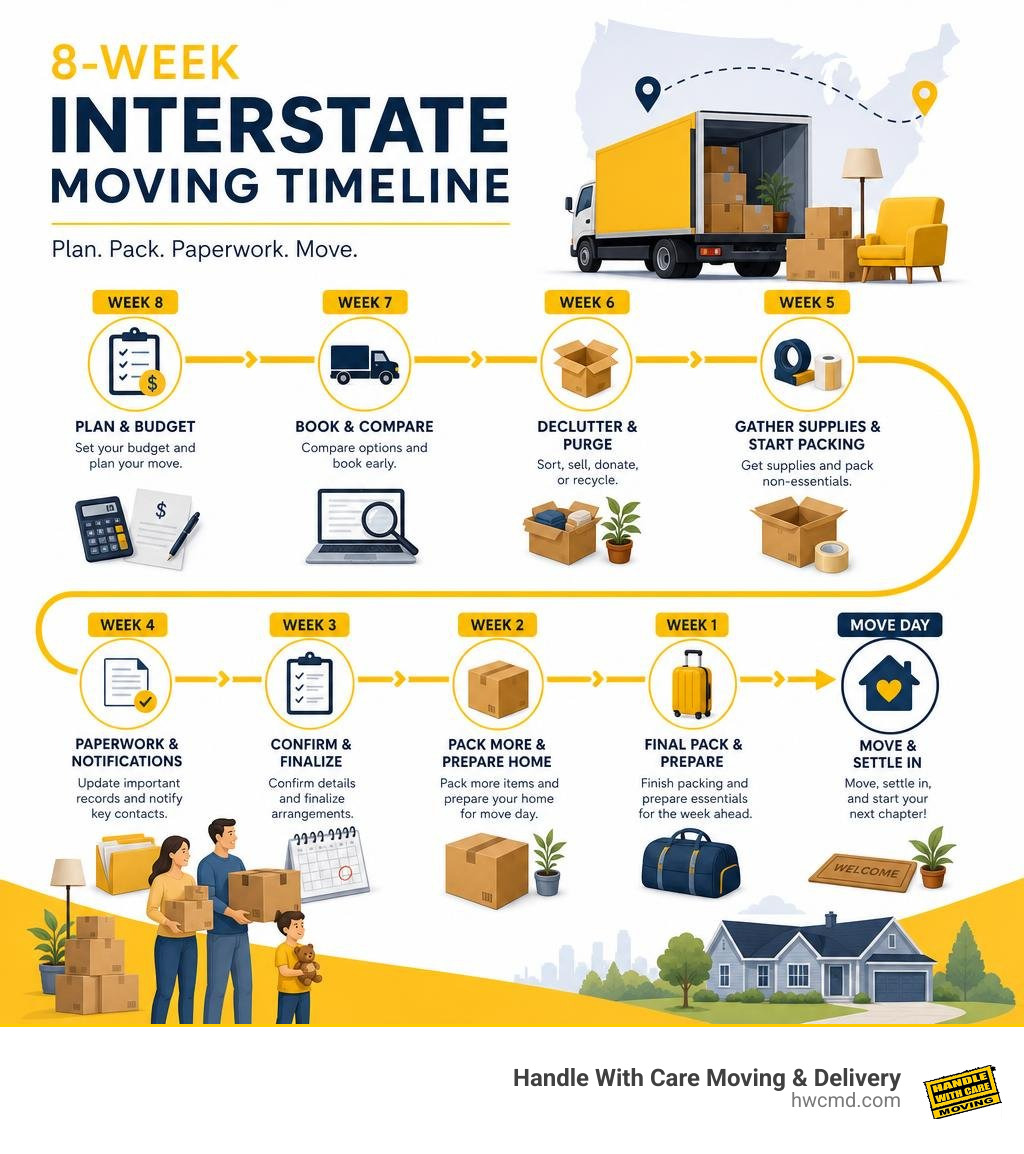
A solid moving out of state check list starts about eight weeks before moving day. Begin by setting a realistic budget, choosing how you will move, getting written estimates, and making a file for contracts, receipts, records, and state deadlines.
Your first priorities are:
- Set your budget. Include moving services, fuel or travel, packing supplies, deposits, storage, cleaning, and an emergency cushion.
- Compare move methods. Full-service movers save labor; rental trucks cost less but require more work; containers offer a middle ground.
- Book early. Moving companies, trucks, and containers can cost less outside the busy summer season.
- Put state tasks on a calendar. Driver’s license, vehicle registration, insurance, tax, school, and voter-registration rules can have short deadlines after arrival.
- Declutter before packing. Long-distance moving costs often rise with shipment weight, so sell, donate, or recycle items that cost more to move than replace.
An interstate move is not only about getting boxes from one address to another. It is also about arriving with your records organized, services ready, and a clear plan for establishing residency in your new state.
I am Anthony Denha, President of Handle With Care Moving & Delivery, and I have helped lead teams that manage the packing, planning, and careful handling behind a practical moving out of state check list. The sections below break the process into clear steps, from your first quote to your first week in a new home.
Comprehensive Moving Out of State Check List: Timeline and Logistics

Relocating across state borders requires careful timing. When you break your tasks into clear chronological phases, you prevent last-minute emergencies and keep your entire household organized.
8 to 6 Weeks Out: Budgeting, Quotes, and the Moving Out of State Check List Setup
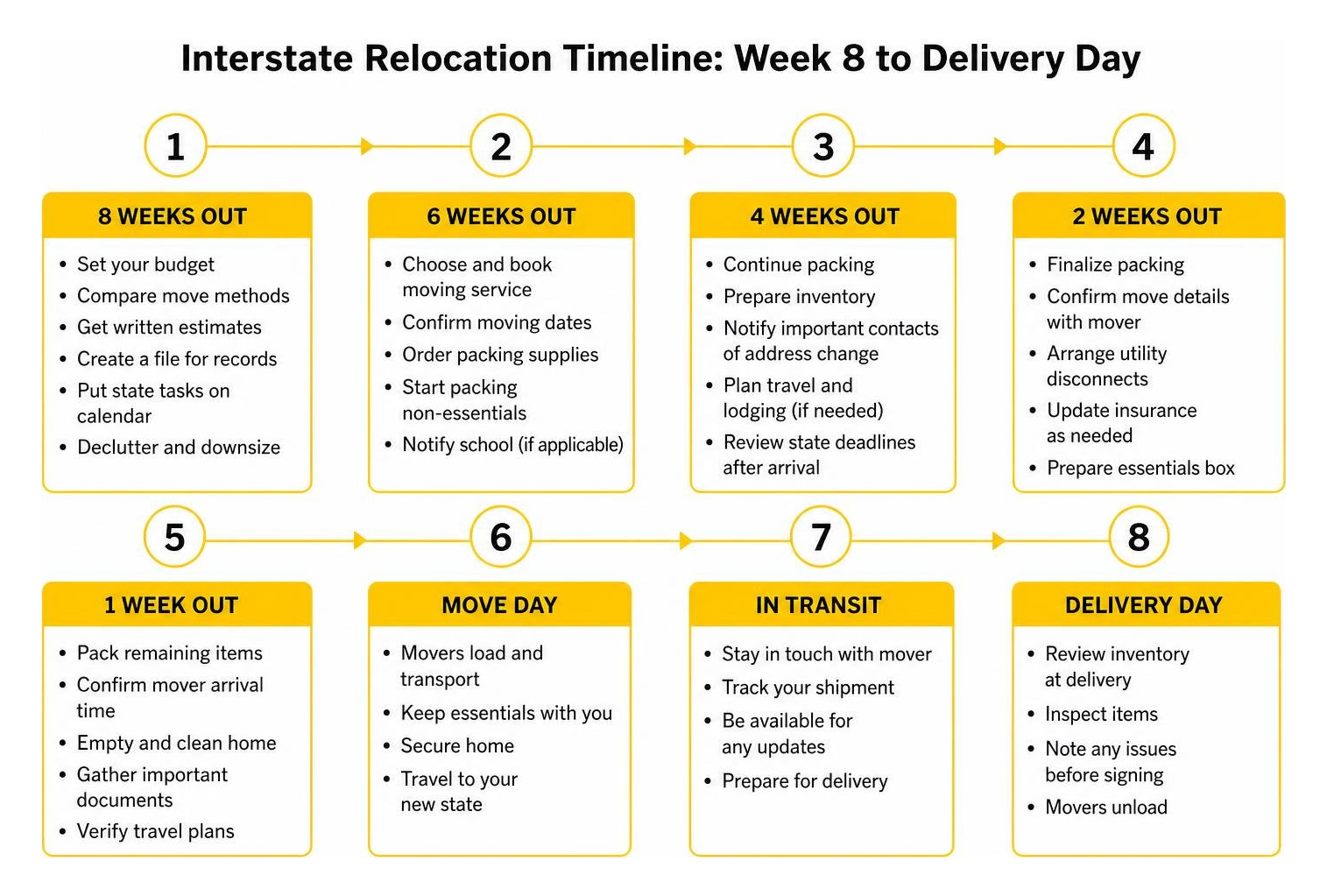
Eight weeks before your move date, your primary goal is establishing your logistical framework. Create a dedicated moving binder or cloud storage folder to hold all contracts, estimates, receipts, and inventory sheets.
Start by building a realistic relocation budget. An interstate move typically costs between $4,000 and $10,000 for a standard household, while cross-country relocations can reach $7,000 to $15,000 depending on weight, volume, and distance. If you are comparing tools and templates to map out state requirements, reference the Moving Out of State Checklist 2026 (State-Specific + PDF) to track your progress alongside our team’s guidance.
Next, research moving companies and schedule in-home visual surveys or detailed virtual walkthroughs. Never accept a binding quote based solely on a rough phone conversation. For those coordinating departures out of Southeast Michigan, our specialists at Long Distance Movers in Ann Arbor: Cross-Country Relocation Made Easy ensure transparent, written estimates with no hidden travel fees.
During this window, focus on the following milestones:
- Neighborhood Reconnaissance: Use tools like Google Street View, Walk Score, and local community forums to assess traffic patterns, proximity to grocery stores, and local amenities in your new city.
- Housing Arrangements: Finalize your lease or home purchase closing dates. If possible, plan a brief scouting trip to inspect your target neighborhood in person.
- Travel Logistics: If you are flying, book airline tickets 6 to 8 weeks in advance to secure the best pricing. If you are driving, plan your daily driving limits, book pet-friendly hotels along the route, and reserve any necessary auto transport.
4 to 2 Weeks Out: Utilities, Records, and Packing Preparations
With four weeks remaining, pivot toward active preparation and administrative handoffs. Review these 10 Great Moving Tips to Make Your Move Efficient and Easy to keep daily household routines steady while staging packed boxes.
If you are packing on your own, review fundamental techniques in our Packing 101 guide. For busy households, hiring professional Movers Who Pack for You: Everything You Need to Know helps eliminate the physical strain and ensures fragile heirlooms are professionally padded.
Key action items during this four-to-two-week stretch include:
- Utility Transfers: Contact your current utility providers (electricity, gas, water, municipal trash) to schedule disconnection for the day after your departure. Schedule new service hookups at your destination 24 to 48 hours before you arrive.
- Internet Service Provider (ISP) Setup: Internet installations often require a 5- to 14-day booking lead time. Secure your installation window now, particularly if you work remotely.
- Prescriptions and Medical Records: Request 90-day medication refills from your current physicians and obtain digital copies of immunization and treatment files for every family member.
- Packing Strategy: Pack least-used rooms first—such as basements, attics, and formal dining areas. Keep heavy items like books in small boxes under 30 pounds, and use double-walled dish-pack boxes with vertical dividers to safely transport dinnerware.
1 Week Out to Moving Day: Essentials Box and Final Logistics
The final week is all about packing your immediate personal essentials and preparing your physical home for turnover. Sourcing quality Packing Services & Materials ensures your furniture receives proper surface padding and stretch-wrapping before being loaded onto the truck.
Execute these final moving logistics step-by-step:
- Prepare Your First-Night Essentials Box: Pack a dedicated suitcase or bin that travels directly inside your personal vehicle. Include clean bedding, towels, basic toiletries, a first aid kit, tool sets, phone chargers, disposable plates, and 2 to 3 changes of clothing per person.
- Defrost Appliances: Empty, unplug, and defrost your refrigerator and freezer at least 24 to 48 hours prior to moving day to prevent mold and water leakage in transit.
- Drain Power Equipment: Federal safety regulations prohibit movers from transporting hazardous combustibles. Drain all gasoline and oil from lawnmowers, weed trimmers, and snowblowers.
- Final Walkthrough and Meter Check: Once the moving crew finishes loading, walk through every closet, cabinet, and storage crawlspace. Take timestamped photos of utility meters and verify the Bill of Lading alongside your comprehensive inventory sheet.
- Mover Gratuity: If you plan to tip your movers for exceptional service, prepare small cash bills in advance.
Legal, Tax, and Administrative Checklist for Interstate Relocation

Moving across state lines introduces legal, statutory, and administrative tasks that standard local relocations do not require. Overlooking these steps can result in unexpected fees, suspended licenses, or surprise tax liabilities.
DMV Deadlines for Driver’s Licenses and Vehicle Registration
Every state sets its own statutory grace period within which new residents must update their driver’s licenses and register their motor vehicles. Some states, like California, allow as few as 10 days to update your driver’s license, while others, such as Texas and South Carolina, provide up to 90 days. Most states enforce a standard 30-to-60-day window.
To ensure compliance:
- Check State DMV Rules: Confirm whether your destination state requires you to surrender your previous license, take a vision screening, or pass a written rules-of-the-road test.
- Gather REAL ID Documents: Bring your certified birth certificate or valid U.S. passport, Social Security card, and two unique proofs of in-state physical residency (such as a signed lease, mortgage statement, or utility bill).
- Vehicle Titles and Inspections: Many states require physical vehicle identification number (VIN) verifications, safety inspections, or emissions/smog checks before issuing new license plates and title documents. Ensure your auto insurance policy is updated to meet your destination state’s minimum mandatory liability limits before visiting the DMV.
State Tax Implications, Domicile, and Address Updates
Relocating during the calendar year often requires you to file part-year resident tax returns in both your former and new home states. Income earned while living in each jurisdiction must be calculated and allocated accurately.
Keep the following tax and legal steps in mind:
- Establishing Legal Domicile: If you are moving from a state with a high income tax to one of the nine states without personal wage taxes (such as Florida, Texas, Washington, or Tennessee), clearly establish your new domicile by registering to vote, obtaining your local driver’s license, and closing residential ties to your prior state.
- IRS Address Notification: File official IRS Form 8822 to notify the federal government of your address change so critical tax correspondence reaches you safely.
- USPS Mail Forwarding: Submit an official Change of Address with the United States Postal Service online or at your local post office approximately one week before departure. This activates 12 months of standard First-Class mail forwarding.
- Financial Institutions: Update your billing address on credit cards, bank accounts, investment portfolios, and retirement accounts immediately to prevent fraud flags on routine purchases.
School Transfers, Medical Records, and Pet Documentation
Enrolling children in a new school system and transferring veterinary records for your pets require early record gathering:
- Educational Records: Request official transcripts, standardized testing results, and individual education plans (IEPs) from your current school district. Check the destination school’s mandatory immunization schedule, as state public health standards vary.
- Medical Provider Transitions: Contact your current primary care physician, dentist, and specialists to obtain electronic medical records. If your health insurance plan is an HMO or regional network, request a qualifying life event change to enroll in a local healthcare plan.
- Interstate Pet Travel Documentation: Many states require an official Certificate of Veterinary Inspection (CVI) issued by an accredited veterinarian within 10 to 30 days of entry. Keep your pets’ up-to-date rabies vaccination certificates easily accessible in your vehicle’s glovebox during interstate travel.
Choosing Your Long-Distance Move Method: Full-Service vs. DIY vs. Containers
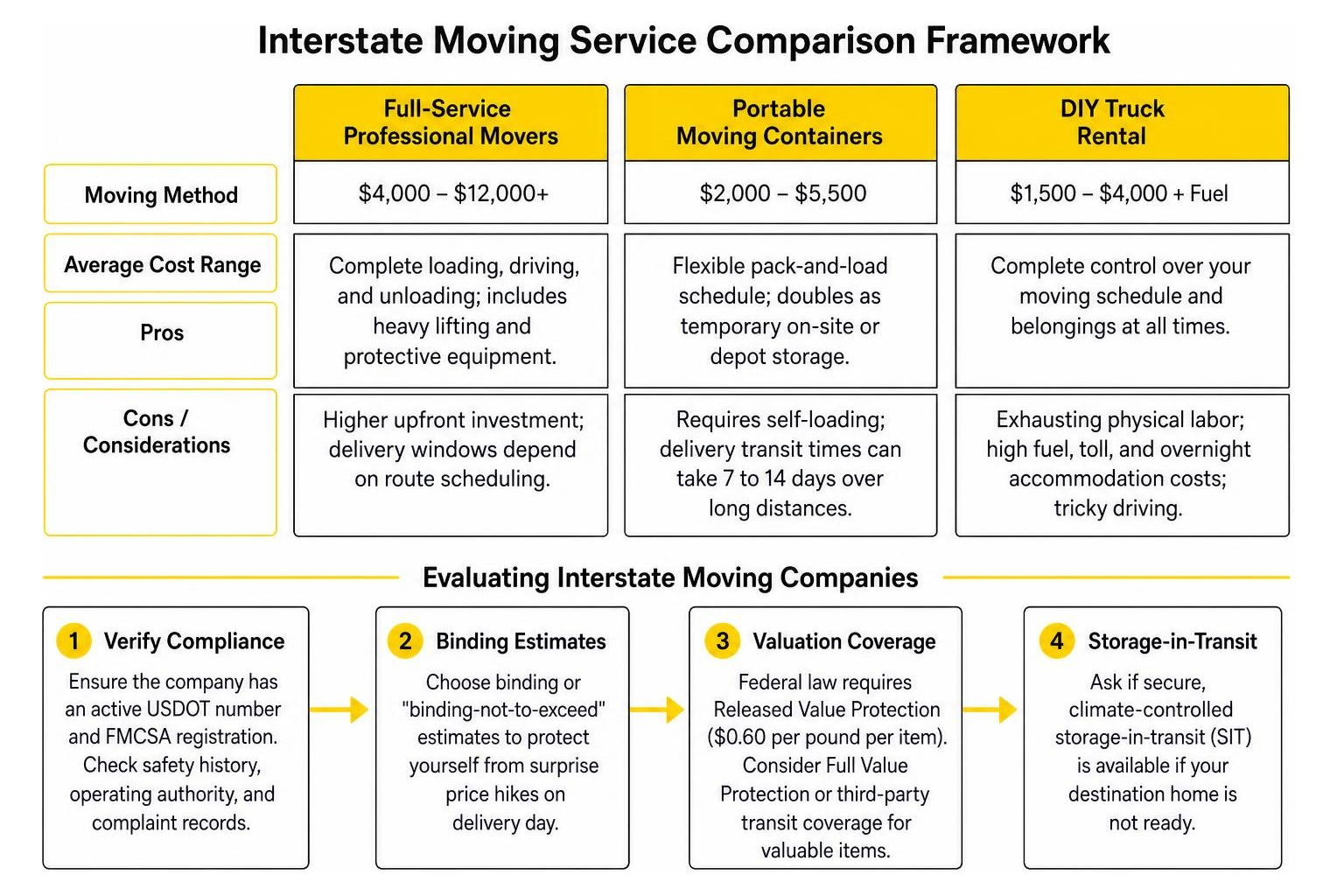
Selecting the right moving method depends on your budget, timeline, and physical capabilities. The table below outlines the trade-offs across common relocation options:
| Moving Method | Average Cost Range | Pros | Cons / Considerations |
|---|---|---|---|
| Full-Service Professional Movers | $4,000 – $12,000+ | Complete loading, driving, and unloading; includes heavy lifting and protective equipment. | Higher upfront investment; delivery windows depend on route scheduling. |
| Portable Moving Containers | $2,000 – $5,500 | Flexible pack-and-load schedule; doubles as temporary on-site or depot storage. | Requires self-loading; delivery transit times can take 7 to 14 days over long distances. |
| DIY Truck Rental | $1,500 – $4,000 + Fuel | Complete control over your moving schedule and belongings at all times. | Exhausting physical labor; high fuel, toll, and overnight accommodation costs; tricky driving. |
Evaluating Interstate Moving Companies and USDOT Compliance
Any moving company operating across state lines must hold active registration with the Federal Motor Carrier Safety Administration (FMCSA) and display a valid USDOT number. You can verify a carrier’s safety history, operating authority, and complaint records directly on the FMCSA database. If you want a deeper dive into cross-country logistics, explore the Cross Country Moving Checklist 2026: Free Tool + PDF.
When vetting long-distance moving partners, pay close attention to:
- Binding Estimates: Opt for binding or “binding-not-to-exceed” estimates to protect yourself from surprise price hikes on delivery day.
- Valuation Coverage: Federal law requires interstate carriers to provide standard Released Value Protection (which compensates at $0.60 per pound per item at no additional charge). For valuable electronics, antiques, and fine furniture, review our guide on Understanding Liability and Claim to decide whether Full Value Protection or third-party transit coverage is appropriate.
- Storage-in-Transit (SIT): If your destination home is not immediately ready for move-in, ask whether your moving company offers secure, climate-controlled Storage solutions to bridge the gap safely.
Downsizing and Cost-Saving Strategies on Your Moving Out of State Check List
Because long-distance moving rates are heavily tied to the total weight and cubic volume of your shipment, downsizing is the single most effective way to lower your final invoice. If you are operating on a strict budget, our guide on how you Can You Move for Under $200? A Practical Guide to Cheap Moving Solutions highlights creative ways to minimize minor expenses.
Alternatively, learning How Full Service Packers Can Save Your Sanity During a Move will help you evaluate if the time saved offsets the cost of labor.
To lower your total moving expenses:
- Liquidate Low-Value Furniture: Bulky, flat-pack particle board furniture is often cheaper to replace at your destination than to transport across state lines. Sell these items on local marketplaces to generate cash for travel expenses.
- Donate Remaining Household Goods: Schedule charitable donation pickups for usable clothing, kitchenware, and surplus items at least two weeks before your moving date.
- Move During the Off-Peak Season: If your timeline is flexible, schedule your interstate move between October and April. Moving rates can drop by 20% to 30% compared to peak summer months.
Post-Move Settlement: Establishing Residency and New Routines
Arriving at your new home is a major accomplishment, but settling in comfortably requires a systematic room-by-room approach.
First Week Priorities in Your New Home
Avoid the temptation to tear open random boxes on your first night. Focus instead on immediate comfort, hygiene, and household safety:
- Assemble Beds First: Unpack your mattresses, bed frames, and fresh linens before doing anything else. When exhaustion sets in after a long travel day, you will be glad your sleeping area is ready.
- Equip Bathrooms: Stock your primary bathroom with shower curtains, towels, soap, toilet paper, and basic toiletries from your essentials box.
- Inspect Safety Equipment: Test all smoke detectors and carbon monoxide monitors, locate the main water shut-off valve, and check electrical breaker panels. If your home has traditional locks, hire a local locksmith to rekey external deadbolts for peace of mind.
- Child- and Pet-Proofing: Set up a quiet, secure room for pets with food, water, and familiar bedding while larger furniture is arranged. Install baby gates on staircases if you have toddlers.
Community Integration and Local Registrations
Once your core living areas are functional, turn your focus outward into the local community:
- Register to Vote: Update your voter registration online, by mail, or in person during your visit to the local DMV or city clerk’s office.
- Establish Local Healthcare: Schedule baseline checkups with new primary care physicians, dentists, pediatricians, and veterinary clinics before minor medical needs become urgent.
- Explore Your Neighborhood: Locate nearby urgent care centers, post offices, hardware stores, and veterinary emergency hospitals. Introduce yourself to neighbors to build a local support network in your new hometown.
Frequently Asked Questions About Moving Out of State
How much money should I realistically budget for an out-of-state move?
A typical interstate move ranges between $4,000 and $10,000, while long-haul or cross-country relocations can cost between $7,000 and $15,000 depending on total shipment weight, distance, and chosen services. Beyond mover fees, budget an additional $1,500 to $2,500 for travel fuel, lodging, vehicle tune-ups, utility connection deposits, packing materials, and a contingency emergency fund.
What is the most cost-effective way to move household goods across state lines?
The most economical approach is aggressive decluttering paired with a hybrid moving model or portable storage container. For moves exceeding 1,000 miles, renting a portable container and self-packing can save 30% to 50% compared to full-service options. Scheduling your relocation during the off-peak season (October through April) also yields substantial savings.
How soon must I update my driver’s license and car registration after moving?
State grace periods range from 10 to 90 days. For instance, California mandates driver’s license updates within 10 days, while Florida requires vehicle registration within 10 days and license updates within 30 days. States like Texas allow up to 90 days. Check your destination state’s DMV website immediately upon arrival to avoid costly late penalties.
Conclusion
An interstate relocation brings major lifestyle changes, but thorough planning turns a complicated transition into an organized, rewarding experience. By following this milestone-driven checklist, you will manage moving budgets, safeguard your belongings, and satisfy all state legal requirements on schedule.
At Handle With Care Moving & Delivery, we treat your household belongings with the utmost precision, offering complimentary pad wrapping, shrink wrap, and straightforward, transparent pricing. Ready to start your interstate journey? Request a Free Quote today, or explore our complete moving information and long-distance relocation resources to plan every detail of your upcoming move with confidence.