
Can You Move for Under $200? A Practical Guide to Cheap Moving Solutions

Is Moving for Under $200 Actually Realistic?
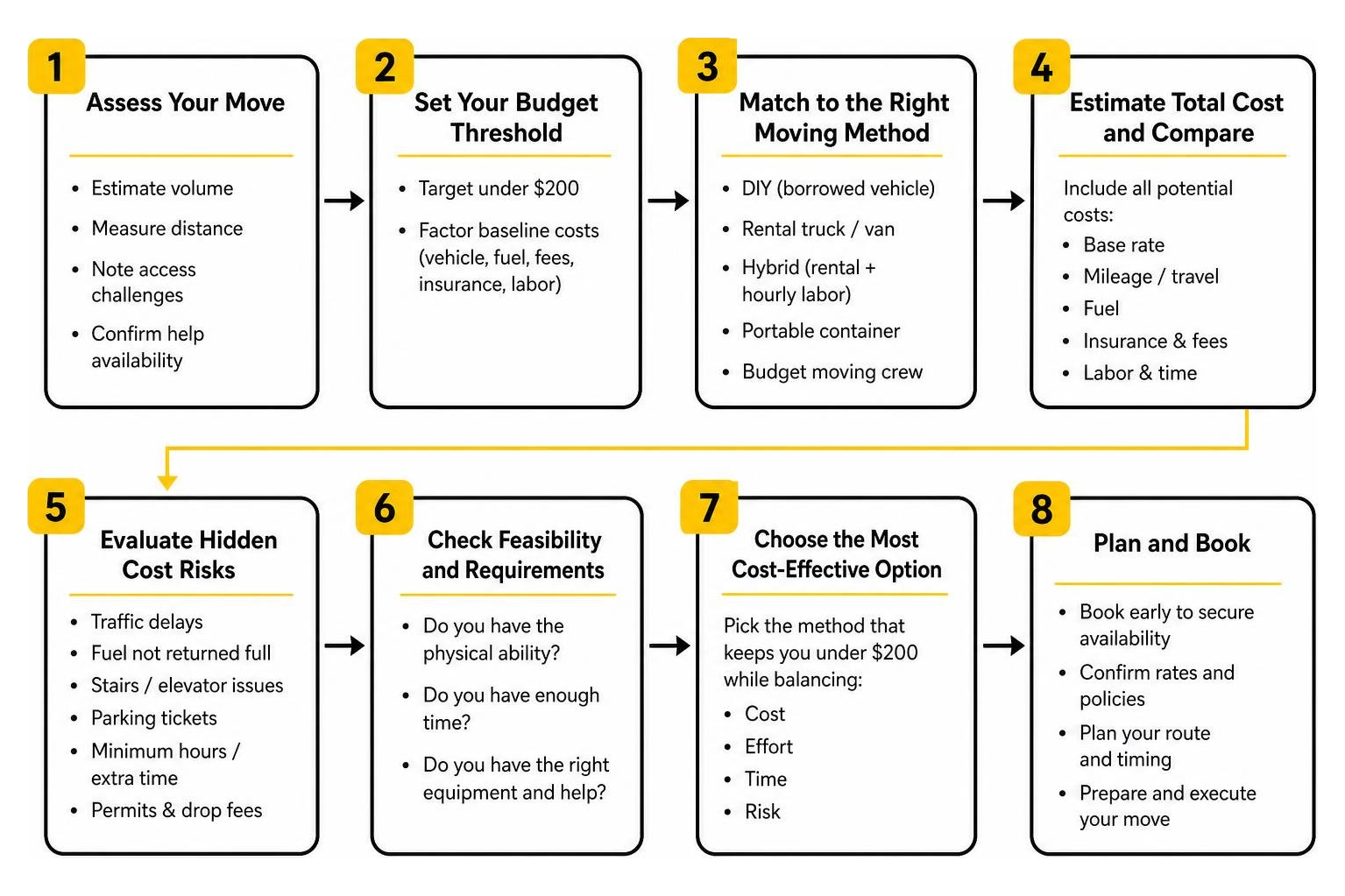
When people ask whether moving under the $200 threshold is possible in August 2026, the answer comes down to volume, distance, and your willingness to handle physical labor. If you are relocating an entire three-bedroom house or executing a cross-country move, $200 will not even cover your fuel and toll costs. However, for micro-moves, dorm relocations, or single-item pickups, a sub-$200 budget is entirely attainable.
A successful sub-$200 relocation generally falls into one of three categories:
- The Cargo Van Micro-Move: Renting a small cargo van or pickup truck for a local run across town. The base rental might run $19.95 to $29.95 per day, but you must also account for per-mile charges (typically $0.69 to $1.29 per mile), mandatory collision damage waivers, fuel replenishment, and environmental fees. If your total round trip is under 25 miles and you supply your own labor, the final cost frequently lands between $75 and $150.
- The Single-Item or Craigslist Pickup: When you only need to transport a couch, a heavy dining table, or a washer-dryer set across the neighborhood, renting basic equipment or paying a driver-only rate can keep you comfortably under your limit. Industry rates for driver-only services or simple pickup-and-van labor often start around $60 to $65 per hour.
- Targeted Hourly Labor: If you already have access to a borrowed pickup truck or your own trailer, hiring a dedicated pair of hands for a quick, one-hour loading job can sneak under the $200 barrier—provided the company offers flexible billing without aggressive mandatory minimums.
Where budget relocations fail is when unexpected logistical friction enters the equation. If you rent a truck for four hours but get stuck in traffic, fail to return the fuel tank to full, or find yourself carrying boxes down three flights of stairs because an elevator was out of order, that initial $150 budget can quickly snowball past $300. Realistic budgeting means planning for baseline operational costs rather than assuming perfect conditions.
Top 5 Cheap Moving Solutions Compared: From DIY to Hourly Labor
Selecting the right strategy requires balancing financial expense against personal physical effort, time commitment, and damage risk. To help identify the best strategy for your situation, we have compared the five most common budget moving methods based on average market pricing and logistical requirements.
| Moving Method | Typical Cost Range | Physical Effort | Best Suited For | Key Hidden Cost Risks |
|---|---|---|---|---|
| Pure DIY (Borrowed Vehicle) | $30 – $80 | Very High | College dorms, single-room micro-moves, studio apartments | Food/drinks for friends, vehicle wear, dropped/damaged items |
| DIY Rental Truck / Van | $80 – $250 | High | 1-to-2 bedroom local apartment relocations | Mileage rates, mandatory insurance, fuel refills, parking tickets |
| Hybrid (Truck Rental + Hourly Labor) | $180 – $450 | Moderate | 2-to-3 bedroom homes, bulky furniture loading | Travel time fees, minimum hour policies, stair surcharges |
| Portable Moving Container | $400 – $1,200 | Moderate | Flexible transition timelines, intermediate home staging | Delivery/drop-off drop fees, street permit charges, monthly container rent |
| Budget Professional Moving Crew | $420 – $1,250+ | Low | Complete apartment or multi-room home moves | Long-carry fees, flight charges, packaging tape/wrap markups |
Hourly Labor and Hybrid Cheap Moving Solutions
The hybrid method is one of the most cost-effective strategies in modern relocation. Instead of hiring a full-service moving team to handle every aspect from packing to transit, you rent your own vehicle or container and contract professional labor strictly for the heavy lifting.
Professional labor-only moving help typically scales based on crew size. For instance, basic industry labor rates often run around:
- Driver only (operating your vehicle): ~$60/hr
- Pickup/Van plus 1 mover: ~$65/hr
- Small truck plus 2 movers: ~$115/hr
- Large truck plus 3 movers: ~$155/hr
Most moving companies enforce a standard two-hour minimum plus travel time, charging overtime rates if a job exceeds eight hours. However, at Handle With Care Moving & Delivery, we eliminate arbitrary minimums by offering transparent 15-minute-increment billing. This ensures you only pay for the precise time our crew spends handling your belongings.
If you are planning an interstate relocation, pairing self-managed logistics with regional specialists makes long-distance transitions far more manageable. If your route involves the Midwest, our team offers dedicated long distance movers in Ann Arbor: cross-country relocation made easy to streamline multi-state transport without unexpected brokerage markups.
DIY Truck Rentals and Borrowed Vehicles
Renting a moving truck from a commercial fleet appears inexpensive on roadside billboards, but the final invoice depends heavily on local driving conditions. While a $19.95 flat rate catches the eye, real-world expenses include:
- Mileage Fees: Ranging between $0.69 and $1.29 per mile, a 40-mile round trip adds roughly $30 to $50 to your bill.
- Fuel Costs: Commercial box trucks average a mere 8 to 12 miles per gallon. Returning a rental truck with less fuel than when you received it triggers steep refueling penalties (frequently $7 to $10 per gallon).
- Equipment Rentals: Renting hand trucks, utility dollies, and furniture pads can add another $20 to $40 to your invoice. While some independent services charge upwards of $25 for a basic package consisting of a hand truck and half a dozen blankets, our crews provide complimentary pad wrapping and shrink wrap to keep furniture safe without padding your bill.
Moving Containers and Flexible Storage Options
If you face a gap between your move-out and move-in dates, portable storage containers offer a predictable flat-rate alternative to commercial truck rentals. Instead of rushing through a 24-hour truck return window, containers give you days to load at your own pace.
For extended transitions or phased renovations, combining modular transport with dedicated storage units safeguards your goods in climate-controlled environments until your new residence is ready for delivery.
What Factors Impact the True Cost of a Budget Move?

A moving estimate is only as reliable as the logistical details provided before moving day. Unforeseen access challenges at either the pickup or delivery address can cause budget-friendly quotes to rise unexpectedly.
- Walk-Up Flights and Narrow Stairwells: Navigating multiple flights of stairs adds substantial time and physical strain. Standard industry data shows that moving a studio apartment locally costs between $420 and $800, while a two-bedroom apartment typically ranges from $1,050 to $1,950. When movers must climb three or four flights of stairs in a historic walk-up or brownstone, companies often assess flight charges or see hourly labor totals climb due to slower turnaround times.
- Long-Carry Distances: If bike lanes, fire hydrants, or restricted loading zones force a moving truck to park 100+ feet away from your building entrance, movers must physically haul every item across that distance. This “long-carry” requirement directly inflates labor hours.
- Elevator Reservations and Certificates of Insurance (COIs): Many condominium and high-rise properties mandate strict freight elevator reservation windows (such as a 2-hour window on weekday mornings) and require a Certificate of Insurance from the mover naming building management as an additional insured. If an unvetted mover cannot produce an active COI, building security may deny property access entirely.
- Specialty Heavy Items: Transporting residential safes, commercial equipment, or large upright pianos demands specialized rigging. Relocating a heavy safe (which can weigh up to 1,200 lbs) requires dedicated hydraulic lifts, heavy-duty stair climbers, and reinforced dollies. Attempting to move such items using basic budget labor risks property damage and serious personal injury.
How to Vet Budget Movers and Avoid Low-Ball Scams
When searching for economical moving options, the greatest financial danger is falling victim to rogue operators who hook customers with low-ball telephone estimates, load personal belongings onto a truck, and then hold the shipment hostage until exorbitant “unforeseen” fees are paid in cash.
To protect yourself, avoid relying on verbal agreements over the phone. Request a formal binding or “not-to-exceed” written estimate that details all inclusions, labor allocations, and service expectations. When reviewing quotes, secure a fast and transparent free quote from an established carrier to benchmark fair local labor rates.
Every legitimate mover operating across state lines must maintain active registration with the Federal Motor Carrier Safety Administration (FMCSA) and hold an active USDOT number. For local intrastate moves, carriers must be registered with their respective state Department of Transportation or state commerce commission. You can independently confirm safety records, fleet size, and insurance status through the FMCSA SAFER database.
Understanding coverage limits is equally essential before moving day. Federal regulations require interstate carriers to provide basic Released Value Protection at no additional charge, which compensates lost or damaged items at a default rate of $0.60 per pound per item. For a comprehensive overview of how basic released valuation differs from full-value replacement protection, consult our guide on understanding liability and claim policies.
How to Spot Hidden Fees in Cheap Moving Solutions
Low-cost moves turn expensive when hidden line items surface on final invoices. To avoid billing surprises, carefully inspect your estimate for these standard surcharge mechanisms:
- Travel Time Charges: Reputable companies charge a clear portal-to-portal fee or standard round-trip travel time. Beware of operations that bill excessive travel hours from remote dispatch facilities.
- Fuel and Toll Surcharges: Fluctuating fuel rates lead some companies to add flat percentage surcharges (often 5% to 15%) on top of their labor quote.
- Materials Markups: Certain budget movers charge premium retail prices for rolls of stretch wrap, tape, and mattress covers used during transit. Clarify what materials are included before signing.
- Seasonal Price Increases: Relocation demand rises dramatically between May and September. Industry data confirms that peak summer moves routinely cost 15% to 25% more than identical moves scheduled during the late fall or winter months.
For a detailed review of standard service inclusions and trade terms, visit our library of moving information.
Key Questions to Ask Before Signing an Estimate
Before confirming a reservation, ask these vetting questions to ensure billing transparency:
- How are labor hours calculated and billed after reaching minimum requirements? Look for companies billing in fair 15-minute intervals rather than rounding up to full billable hours.
- Are furniture pads, dollies, and shrink wrap included in the base rate, or billed per unit used?
- What is your policy and fee structure for schedule changes or unexpected cancellations? While some budget firms charge strict $100 cancellation fees for adjustments inside four days, reputable carriers offer flexible terms.
- Do you require a substantial upfront cash deposit? Legitimate carriers rarely ask for large upfront cash deposits before arriving at the job site.
Reviewing practical planning strategies, such as our checklist of 10 great moving tips to make your move efficient and easy, helps ensure every phase of your move remains structured from day one.
Pro Strategies to Drastically Lower Moving Costs

Minimizing total relocation expenses requires reducing the total volume, weight, and billable handling time of your shipment. By handling non-essential prep work independently, you protect your budget without compromising safety.
1. Declutter Systematically Before Sourcing Quotes
Moving companies calculate pricing based on shipment volume (cubic feet), total weight, or total crew hours. Hauling damaged furniture, outdated electronics, or unused garments directly increases your labor bill. Host a garage sale, donate unwanted goods to regional charities, or recycle worn items room by room. Reducing your inventory by 25% can translate into hundreds of dollars in direct moving savings.
2. Master the Art of Self-Packing
Hiring professional packing teams provides convenience, but packing standard household items yourself offers the largest single cost reduction on a budget move. To package fragile items securely without overspending on retail boxes:
- Source clean, recycled cardboard boxes from grocery stores, bookstores, or local community exchange groups.
- Use household linens, towels, and blankets to cushion kitchen dishware rather than purchasing reams of packing paper.
- Follow foundational packing principles outlined in our packing 101 primer to prevent box crushing and balance heavy loads properly.
If you are pressed for time, opt for a hybrid packing approach. You handle books, clothes, and non-breakable household goods, while hiring professionals solely for fragile china, glass tabletops, or valuable art. Explore our breakdown on movers who pack for you: everything you need to know to compare full-pack vs. partial-pack costs, or purchase commercial-grade materials directly through our packing services materials catalog. If you prefer professional hands for delicate items, discover options through our local packing services near me to make moving completely stress-free.
3. Move During Off-Peak Windows
Timing plays a direct role in moving pricing. Peak moving season runs from May through September, when lease rollovers and school calendars drive demand to annual highs. Moving rates during off-peak months (October through April) are consistently lower. Within any given month, scheduling your move between the 5th and the 24th—and opting for a Tuesday or Wednesday instead of a weekend—delivers lower baseline rates and expanded crew availability.
4. Leverage Group and Demographic Discounts
Always ask prospective movers about demographic discounts before finalizing an agreement. Many reputable moving companies offer 5% to 10% discounts for military personnel, first responders, healthcare workers, seniors, and college students. Combining these savings with off-peak booking windows can lower your final bill significantly.
Frequently Asked Questions About Budget Relocation
What is the cheapest day and time of month to move?
The most affordable time to move is mid-week (Tuesday or Wednesday) during the middle of the month (between the 5th and the 24th), outside of peak summer season. The highest rates occur on weekends and during the first and last days of the month, when lease rollovers create peak moving demand. Booking during the winter months (October through April) can save you 15% to 25% compared to peak summer pricing.
What standard services are included in a budget moving package?
A standard budget moving package generally includes the moving truck, a trained professional crew (typically 2 to 3 movers), standard equipment (dollies, moving straps), basic furniture disassembly and reassembly, and fundamental Released Value Protection ($0.60 per pound per item). Some budget movers charge extra for consumables like tape, shrink wrap, and moving blankets, so confirm that protective materials are included before booking.
How can I verify if a cheap mover is licensed and insured?
You can verify an interstate mover by searching their USDOT or MC number on the official FMCSA SAFER system (safety.fmcsa.dot.gov) to review their operating authority, safety record, and insurance filings. For local, intrastate moves within Michigan or other individual states, verify credentials through your state Department of Transportation or regional regulatory licensing bureau. Always request an up-to-date Certificate of Insurance showing active commercial general liability and cargo coverage.
Conclusion
Finding cheap moving solutions does not require taking chances on unvetted movers or risking personal injury with unmanageable DIY labor. By decluttering your home, sourcing economical packing supplies, scheduling your move during off-peak windows, and contracting labor only for heavy lifting, you can execute an organized relocation that stays well within your target budget.
At Handle With Care Moving & Delivery, we believe moving should be straightforward, careful, and affordable. With transparent 15-minute-increment billing, complimentary protective shrink wrap and pads, no rigid labor hour minimums, and discounts for students, seniors, and veterans, our Ann Arbor team delivers dependable service without unexpected billing surprises. Get in touch with our team today to schedule your move with confidence.