
How to Find Affordable Furniture Moving Help in 5 Steps
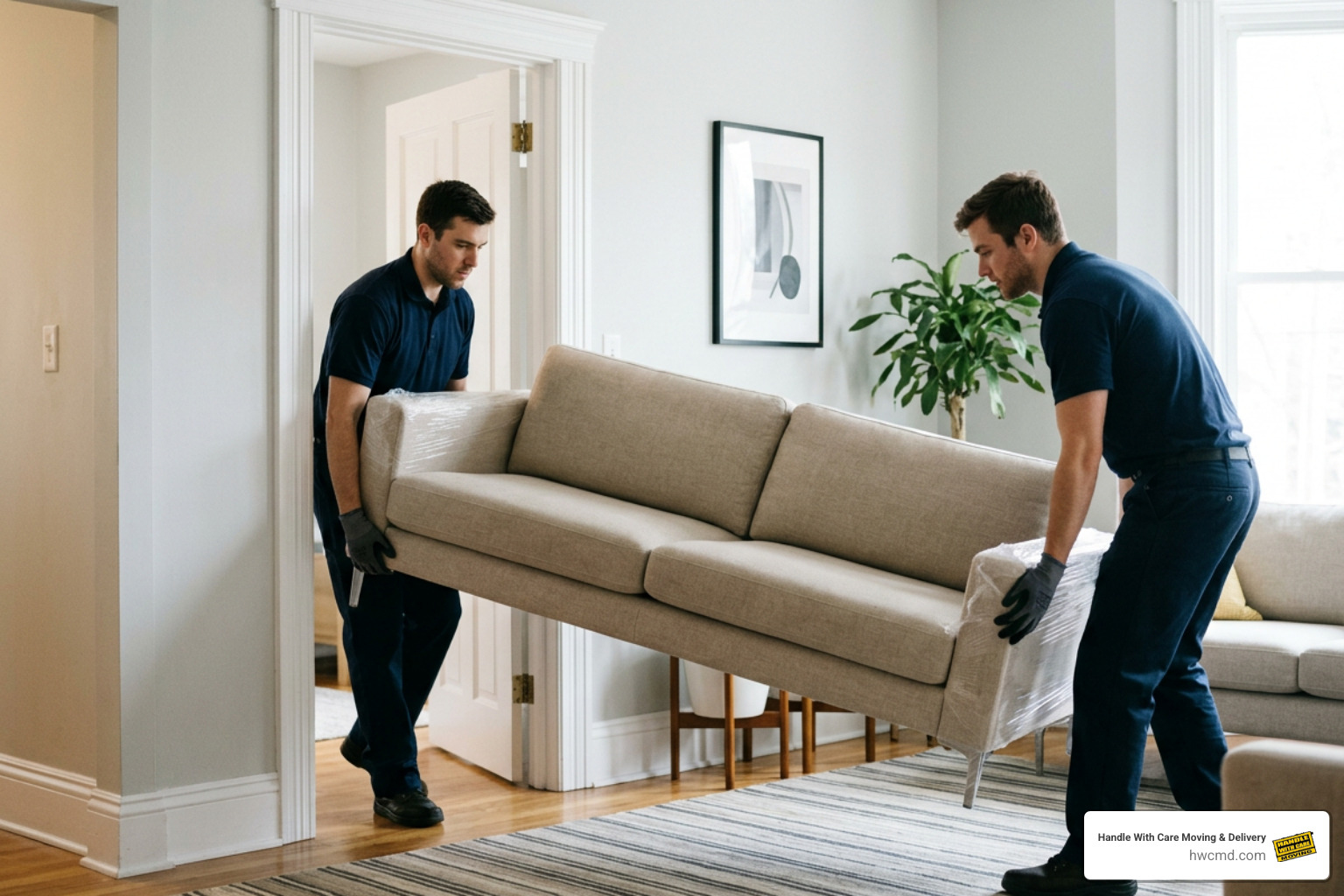
How to Find Affordable Furniture Moving Help Without the Hassle
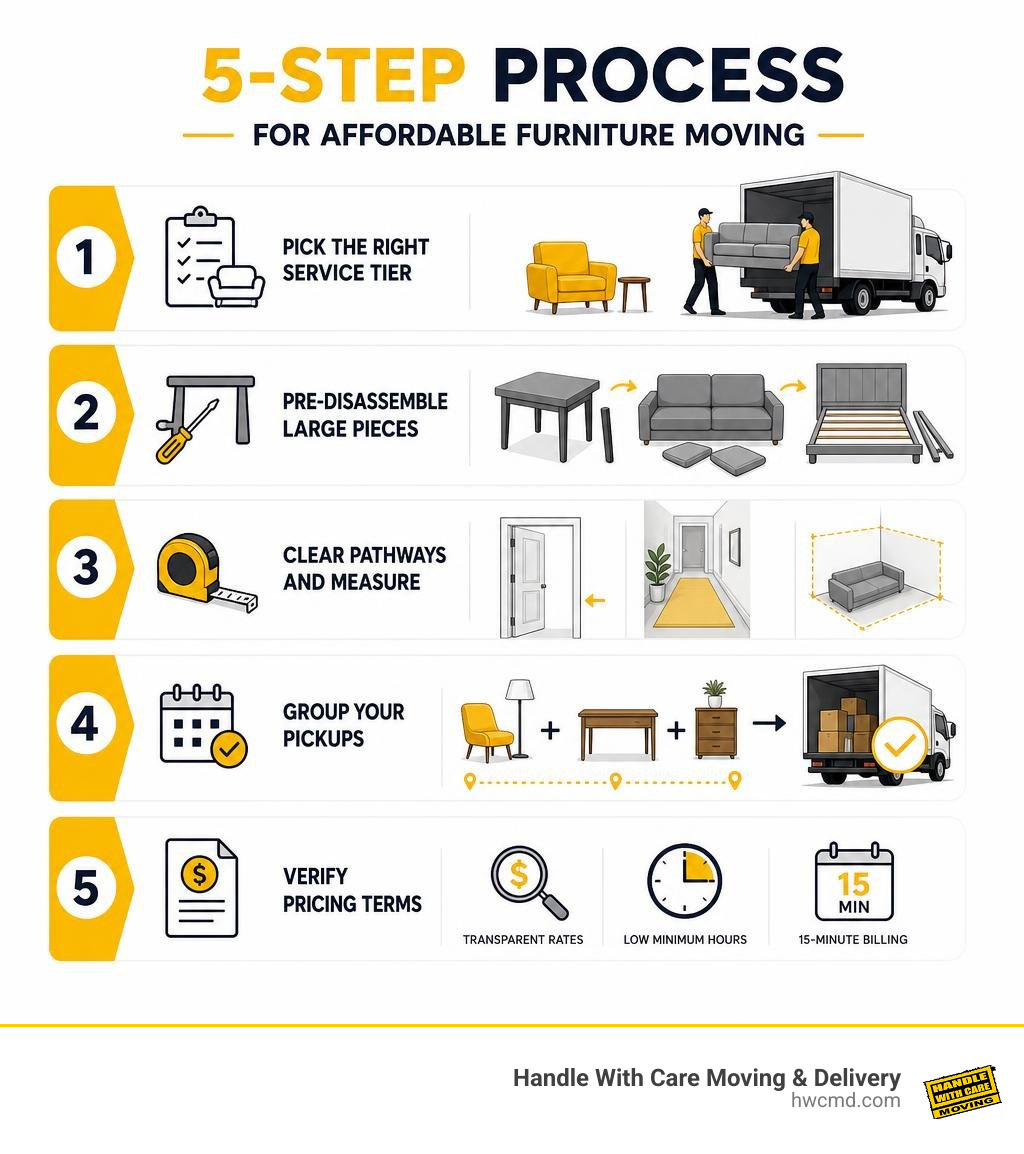
Finding reliable, budget-friendly furniture moving help comes down to eliminating unnecessary labor time and choosing the right service tier. Here is the direct 5-step playbook to keep costs low:
- Pick the right service tier: Book a furniture-only or small-load crew rather than paying for a full-day household move.
- Pre-disassemble large pieces: Take off table legs, remove couch cushions, and disassemble bed frames yourself to save billable minutes.
- Clear pathways and measure: Remove door hinge pins and measure tight corners ahead of time so the crew moves quickly without delays.
- Group your pickups: Combine retail pickups or online marketplace purchases into a single, organized route on off-peak weekdays.
- Verify pricing terms: Choose movers who offer transparent rates, low minimum hours, and billing in 15-minute increments.
Most people think hiring professional help requires paying for an entire 4-person crew with steep hourly minimums. In reality, targeted small-load moves let you pay strictly for the heavy lifting you actually need.
I’m Anthony Denha, President of Handle With Care Moving & Delivery, where I have spent years leading crews and refining practical strategies for safe, cost-effective furniture moving. Let’s explore the step-by-step process to get your heavy items safely into your new space without overspending.
Step 1: Assess Your Inventory and Choose the Right Service Tier
The first move toward lowering your relocation expenses starts with an honest room-by-room inventory audit. When people schedule moving services, they often overbuy or underbuy the labor they need. Moving an entire house involves boxes, fragile packing, wardrobe cartons, and heavy staging, but moving a single sofa or bedroom set requires a much leaner approach.
A full 2-bedroom home typically holds 60 to 80 boxes worth of personal items and furniture. Self-packing an inventory of that size takes most households 3 to 5 full days, whereas discovering how full service packers can save your sanity during a move shows that an experienced two-person crew can pack that exact volume in a single day.
If you are only transporting specific pieces, you do not need an extensive packing package. Exploring whether can you move for under 200 a practical guide to cheap moving solutions is realistic reveals that targeted, furniture-only appointments and single-item deliveries keep costs strictly aligned with the time spent on the road and at your door.
| Service Tier | Best Suited For | What Is Included | Typical Billing Model |
|---|---|---|---|
| Furniture-Only / Micro-Move | 1 to 5 large pieces (couches, dressers, tables) | Loading, pad wrapping, transit, unloading, room placement | Hourly rates, low or no minimums, 15-minute increments |
| White-Glove Delivery | High-end retail purchases, delicate antiques | In-room delivery, unpacking, complex assembly, packaging debris removal | Flat rate or hourly plus specialized assembly fees |
| Full-Service Moving | Entire home or apartment relocations | Packing supplies, full-home boxing, disassembly, transport, reassembly | Standard hourly crew rates (often starting around $175/hr for a 2-person crew and truck) |
Understanding the distinction between these service levels prevents you from booking a full-service moving package when all you need is a reliable two-mover team to transport a heavy credenza across town.
Evaluating DIY vs Professional Furniture Moving Help
Tackling heavy items on your own with a rented truck seems cheaper on paper, but hidden expenses and injury risks add up quickly. A DIY move requires renting a truck, paying for mileage and fuel, buying packaging materials, and finding friends who will not cancel at the last minute.
Packing materials alone can be a surprising expense:
- Studio Apartment: $150 to $250
- 2-Bedroom Home: $250 to $400
- 4-Bedroom Home: $600 to $900
Reviewing 10 great moving tips to make your move efficient and easy highlights that professional crews bring commercial equipment, high-tensile ratchet straps, and specialized knowledge that keep your walls, doorframes, and spinal discs safe. If your move involves spiral staircases, steep outdoor steps, or solid hardwood dressers weighing over 250 pounds, hiring trained help with no minimum labor hours is significantly safer and more economical than an emergency room visit or repairing gouged drywall.
Step 2: Prepare and Disassemble Bulky Pieces to Lower Labor Time
Professional movers work against the clock, which means every task you complete before they arrive directly lowers your final bill. Disassembling modular furniture, bed frames, and dining tables is one of the easiest ways to streamline labor time.
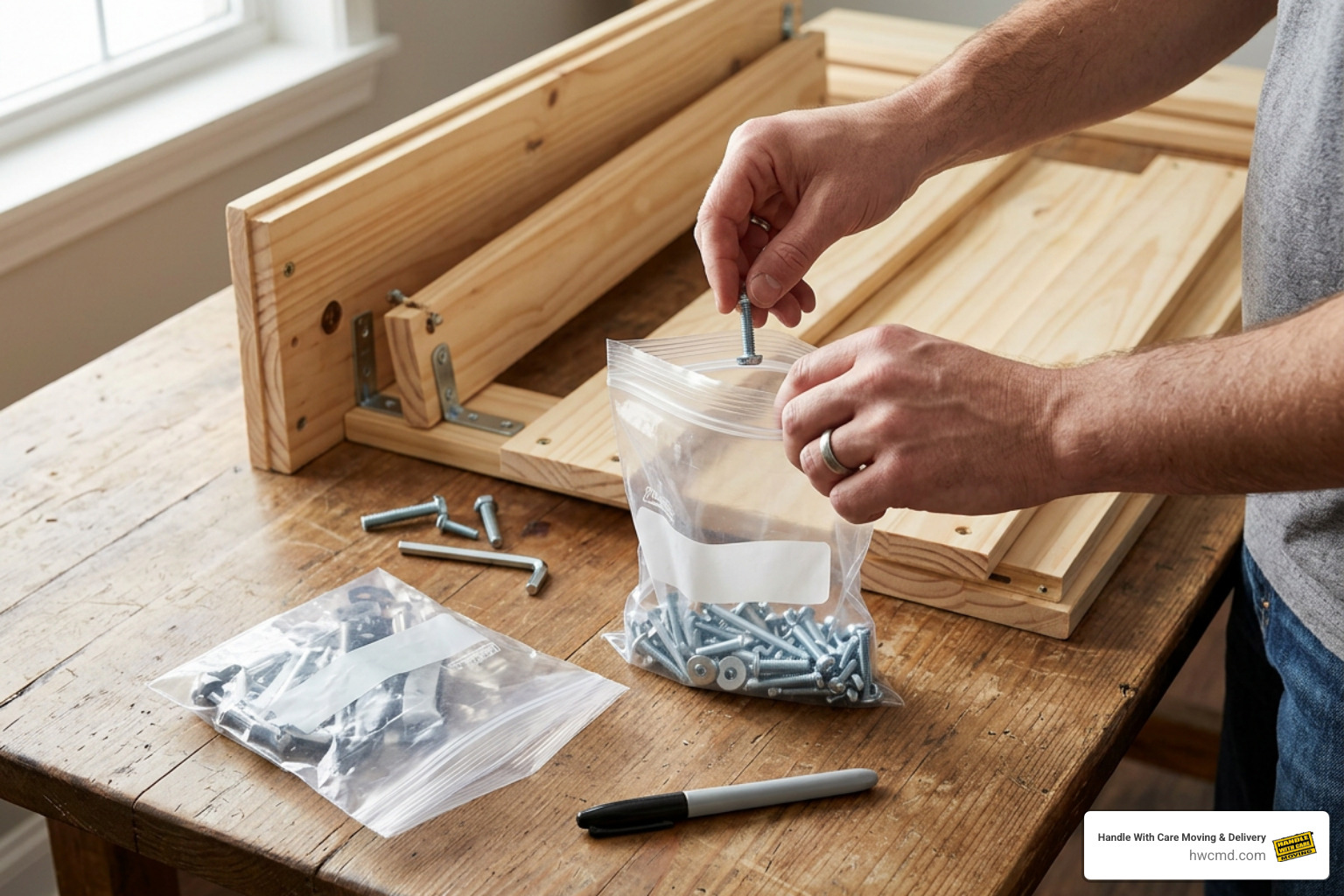
When taking furniture apart, systematic organization is essential:
- Take Reference Photos: Snap clear pictures of structural joints, wire runs (for power recliners), and bracket alignments before turning a single screw.
- Bag the Hardware: Place all bolts, washers, nuts, and dowels into clear zip-top plastic bags. Label each bag with a permanent marker (e.g., “Master Bed Frame – Footboard”).
- Secure the Hardware to the Item: Tape the hardware bag securely to the underside or hidden inner frame of the matching piece using blue painter’s tape to avoid adhesive residue.
- Remove Detachable Shelves and Drawers: Pull glass shelves and heavy wooden inserts out of hutches and dressers. Carrying an empty dresser frame prevents joint strain and reduces unit weight by up to 40%.
When stocking up on supplies, you can master your move with the best amazon packaging materials available today to secure quality bubble protection, zip-lock bags, and heavy-duty tape at reasonable prices.
Disassembly Techniques for Couches, Beds, and Recliners
Certain large pieces require specific teardown techniques to avoid damaging structural locking mechanisms:
- Sectional Sofas: Most modular sectionals connect via bottom-mounted fork-and-pin brackets or sliding alligator clips. Lift the female side straight up vertically to disengage the sections. Always remove screw-in wooden or metal feet; keeping legs attached is the number one cause of snapped frames and torn door jambs during tight maneuvers.
- Bed Frames & Platform Bases: Unscrew headboards from the metal perimeter frame. For platform beds with wooden slats, unroll or unscrew the slats, bundle them together with stretch film, and label the center support beam.
- Recliners: Most modern recliners feature a removable backrest. Reach into the lower back seam between the seat back and bottom base to locate the metal locking levers on either side of the bracket tracks. Lift the small lever tabs with a flathead screwdriver or your fingers, then pull the entire backrest straight up and off the base tracks.
- Tight Stairwell Box Springs: If a queen or king box spring cannot clear a low-ceiling stairwell turn, an old mover trade hack involves carefully slicing the underside dust cover, cutting through the outer wooden perimeter frame on either side of the center crosspiece, folding the box spring gently like an open book to navigate the corner, and securing it at the destination with 1×2 wood bracing screws.
Step 3: Protect Items and Clear Entryways to Prevent Costly Damage
Damaged walls, scuffed floors, and chipped furniture corners turn a budget move into an expensive repair project. Taking twenty minutes to prep your home’s entry points and wrap sensitive finishes ensures the transit path is clear and fast.

To maximize doorway clearance:
- Pop Door Hinge Pins: Tap out hinge pins with a hammer and a nail to remove interior doors completely. This instantly adds 1.5 to 2 inches of clearance.
- Remove Door Stop Moldings: If a large refrigerator or solid wood armoire is within a fraction of an inch of fitting, gently prying off the thin wooden door stop molding from the jamb provides up to an extra 3/4-inch of critical pass-through space.
- Measure the Entire Route: Measure the narrowest hallway widths, stairwell overhangs, and exterior gates against the height, width, and diagonal depth of your largest items.
For comprehensive packing workflows, check out our baseline guide on packing 101 to protect glass tabletops and fragile decor before moving day.
Safe Handling Tools for Heavy Furniture Moving
Professional moving crews utilize mechanical advantages rather than raw physical strength. Having the right tools on hand makes moving massive objects smooth and controlled.
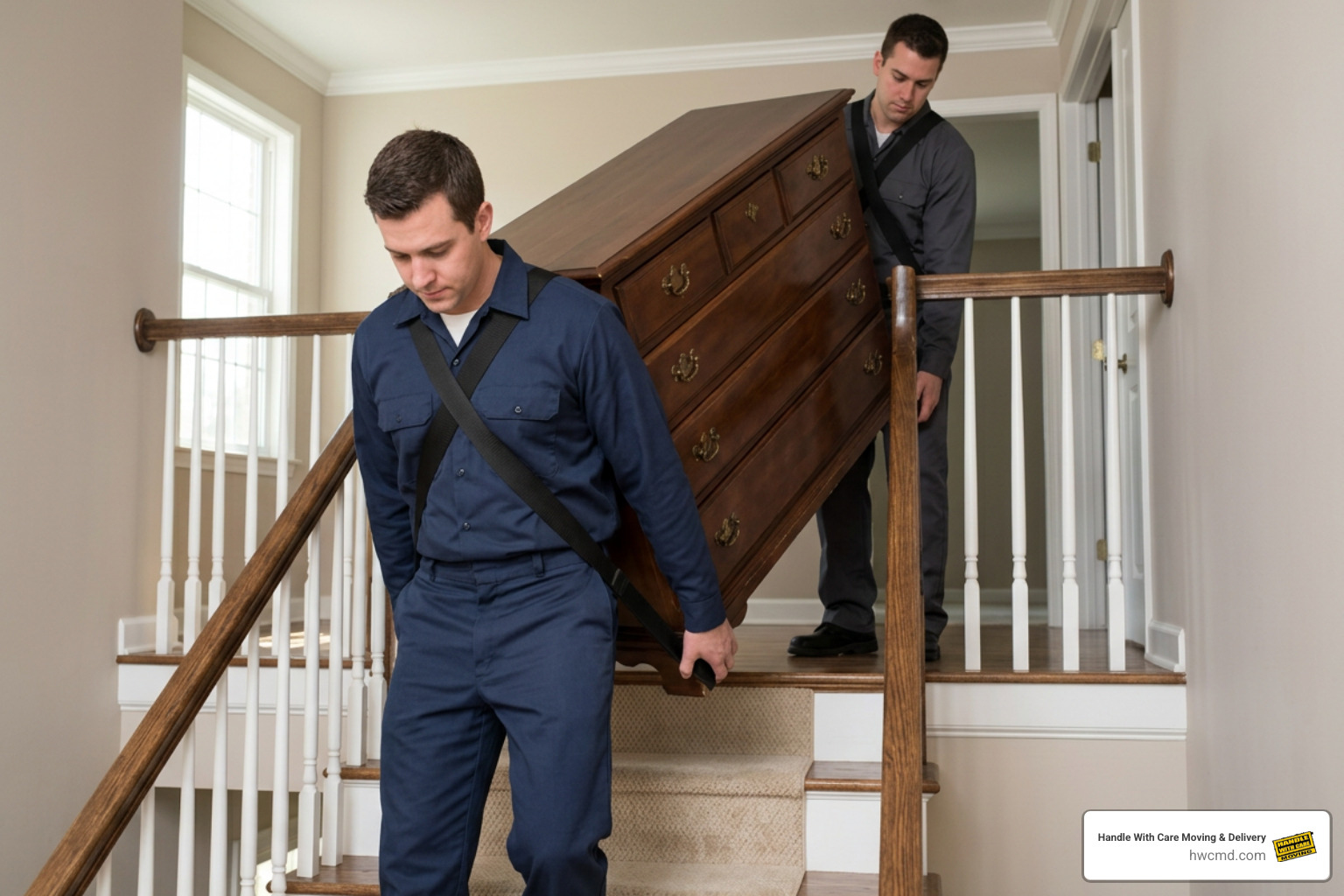
- Furniture Sliders: Use hard, smooth plastic sliders underneath furniture legs on carpeted floors, and thick felt-padded sliders on hardwood, tile, or vinyl plank. Sliders allow a single person to push a 300-pound oak desk across a room without scratching the finish.
- Shoulder Dollies & Lifting Straps: Webbing harnesses leverage leg strength and balance the load between two movers, keeping hands free to stabilize the top of tall bookcases and armoires. Note: When walking down stairs, the lower mover carries significantly more load weight, so always coordinate steps verbally.
- Hydraulic Furniture Lifters: A mini pry-lever jack lets you elevate the corner of a heavy cabinet just high enough to slip a 4-wheel dolly or slider underneath without straining your lower back.
- Heavy-Duty Suction Cups: Dual-pad glass suction lifters provide secure handles when carrying polished glass tabletops, marble slabs, or large vanity mirrors that are difficult to grip from the bottom edge.
Step 4: Streamline Pickup Logistics, Retail Stops, and Scheduling
If you are buying furniture secondhand or picking up new pieces from big-box retailers, route organization directly impacts the total time billed.
When coordinating retail pickups or multiple online marketplace stops, understanding how to pick the best furniture delivery app for your next move alongside how local ann arbor delivery services keep the city moving will help you schedule multi-stop routes effectively.
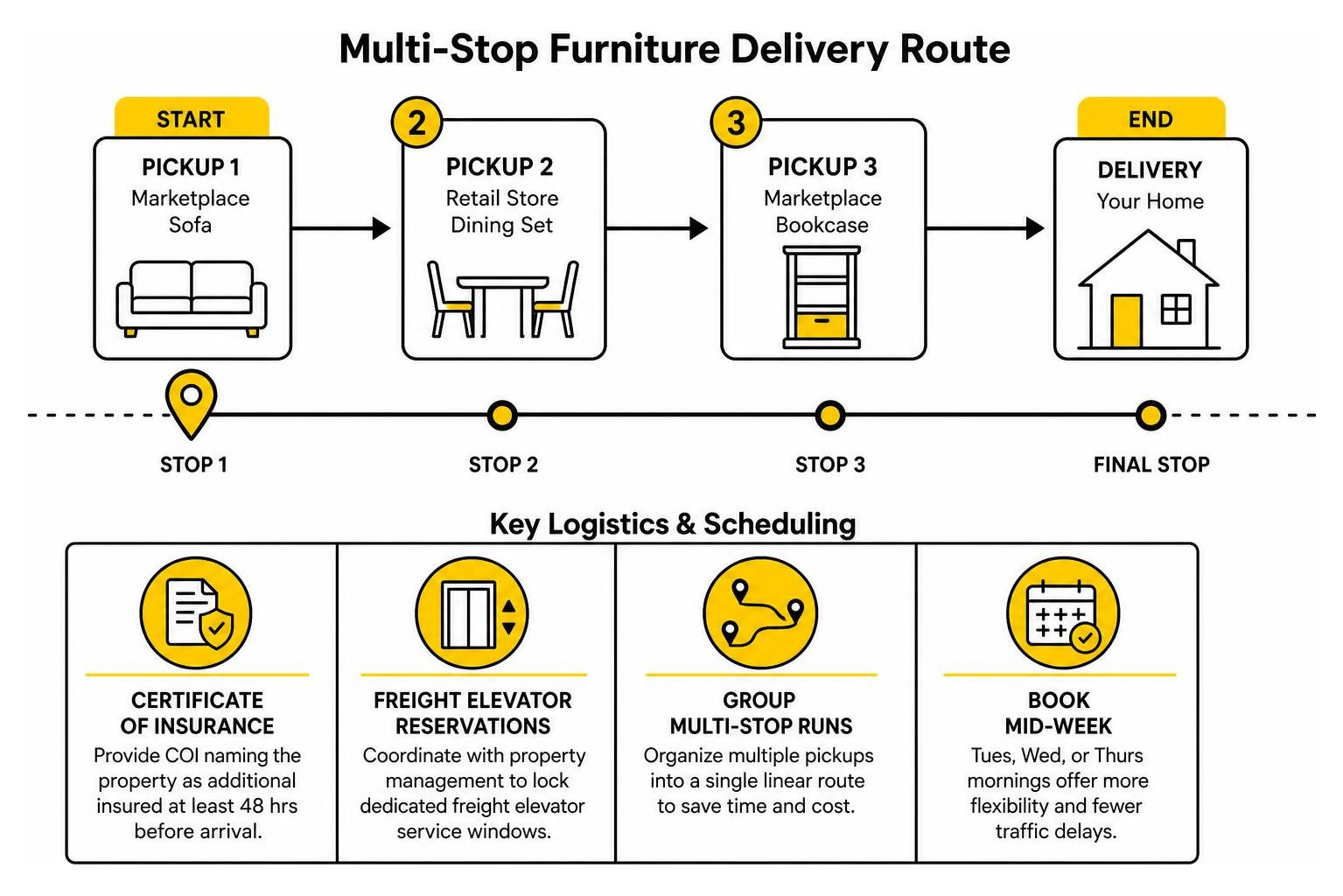
Keep these logistical steps in mind:
- Certificate of Insurance (COI): Many commercial loading docks and high-rise condominiums require a Certificate of Insurance from your delivery service naming the property as an additional insured at least 48 hours prior to the truck arriving.
- Freight Elevator Reservations: Never assume an elevator is available. Coordinate with property management to lock off dedicated freight elevator service windows so your moving crew is not waiting in the lobby between loads.
- Group Multi-Stop Runs: Instead of booking three separate transport runs for a Craigslist sofa, a marketplace dining set, and a store pickup, organize them into a single linear route on the same morning.
- Book Mid-Week: Demand spikes on weekends and the first/last days of the month. Scheduling your furniture move on a Tuesday, Wednesday, or Thursday morning often provides the greatest scheduling flexibility and lowest potential traffic delays.
Step 5: Understand Pricing Models, Liability Coverage, and Quotes for Furniture Moving
Transparent pricing separates professional moving services from unpredictable operations. When comparing quotes, always look closely at how the company bills time and what materials are included.
Key pricing components to verify:
- Billing Increments: Standard full-service movers often impose rigid 3-hour or 4-hour minimums. For single-piece pickups or short apartment transitions, look for movers who bill in precise 15-minute increments after a low baseline initial hour.
- Complimentary Materials: Packing materials can drive up the final invoice. Look for providers that include protective moving blankets, mattress covers, and stretch wrap at no additional cost. A single 20-inch x 1,500-foot roll of commercial stretch film costs about $20 at retail centers, and professional wrapping should always be part of the service standard.
- Liability & Valuation Coverage: By federal and state standards, base carrier liability default coverage is set at **$0.60 per pound per article**. If an antique lamp weighing 10 pounds is damaged, standard valuation covers $6.00. For high-value heirlooms, ask about Full Value Protection options before transport begins.
Review our dedicated moving information hub to evaluate quote structures, binding estimates, and liability documentation thoroughly.
Frequently Asked Questions About Moving Large Items
What is the most cost-effective way to move single furniture pieces?
The most affordable way to move single pieces—like a couch, refrigerator, or sectional—is to book a dedicated small-load moving service that offers 15-minute increment billing. You can significantly reduce the billable time by pre-wrapping the piece, taking off legs, clearing hallway obstacles, and staging the item near the entryway or garage for curbside pickup. To get an accurate idea of pricing for your specific items, request a free quote online with exact dimensions and access details.
How do you maneuver an oversized sofa or box spring through tight spaces?
To fit an oversized sofa through a narrow entryway, stand the sofa vertically on its end with the seat facing forward. Slide it toward the door jamb, then rotate or “hook” the back of the sofa through the doorway first. Once the back clears the opening, pivot the seating section through in an L-shaped motion. If vertical clearance is tight, tilting the top of the sofa slightly backward will help you navigate standard 80-inch door frames.
What liability coverage applies if furniture is damaged in transit?
Under standard moving industry regulations, movers provide basic Released Value Protection at no extra charge, which reimburses damage at a rate of $0.60 per pound per item. For high-value designer pieces or family heirlooms, you can declare a higher valuation and purchase Full Value Protection, which requires the carrier to repair the item, replace it with a similar piece, or pay the full replacement cash value. Any transit damage should be clearly noted on the bill of lading upon delivery with photographic evidence submitted within standard claim filing windows (typically 7 to 14 days).
Conclusion
Finding affordable, stress-free help for large household items comes down to smart prep work, clear logistics, and selecting a team with flexible, transparent pricing. By disassembling bulky frames, measuring your exit doorways, and choosing a mover that bills in 15-minute increments without hidden material fees, you can complete your relocation safely within budget.
At Handle With Care Moving & Delivery, we treat every couch, heirloom dresser, and bedroom set with the highest standard of care. We provide complimentary pad wrapping, shrink wrap, and specialized handling across Ann Arbor, Michigan, alongside dedicated discounts for students, seniors, and veterans.
Whether you need a single piece transported across the city or a complete apartment transition, explore our full range of moving solutions today to schedule your move with transparent rates and expert care.