
The Best Specialty Crating and Packaging Options Near You

Finding the Best Crating Services Near Me: What to Look For
Evaluating crating providers requires looking past simple cardboard box assembly. When shipping valuable, delicate, or unusually shaped cargo, standard parcel carriers and generic moving boxes rarely cut it. Finding reliable crating options requires identifying specialists who understand dynamic physics, wood engineering, and interior cushioning mechanics.
A professional crating team should offer a robust consultation process. They must assess item weight, fragility points, center of gravity, surface vulnerabilities, and transit duration. Whether you require specialty packing and delivery services for delicate heirlooms or industrial manufacturing components, your provider should possess a diverse portfolio of successful shipments, transparent pricing models, and specialized tooling.
Key evaluation criteria include:
- Material Engineering: Use of high-grade lumber, specialty plywood, precision fasteners, and closed-cell cushioning.
- Tailored Internal Support: Expertise in custom blocking, bracing, contour-cut foam, and floating bases.
- Handling Transparency: Clear estimates without hidden storage, access, or fuel surcharges.
- Comprehensive Equipment: Availability of rigging gear, heavy-duty pallet jacks, lift-gate vehicles, and on-site building tools.
Key Certifications and ISPM 15 Compliance
For shipments crossing international borders, choosing a certified provider is non-negotiable. Wooden packaging materials made from raw wood can harbor invasive pests. To protect global forest ecosystems, the International Plant Protection Convention (IPPC) enforces the International Standards for Phytosanitary Measures No. 15, commonly known as ISPM 15.
Under ISPM 15 rules, all solid wood packaging exceeding 6mm in thickness must be debarked and heat-treated until its core temperature reaches at least 56°C (133°F) for a minimum of 30 continuous minutes. Once treated, the lumber is stamped with an internationally recognized IPPC mark indicating:
- The country code (e.g., US)
- The unique facility registration number
- The treatment method (HT for Heat Treated)
Shipping overseas without an authentic ISPM 15 stamp can result in customs holds, expensive fumigation fines, immediate return of the cargo at your expense, or complete shipment destruction. Reputable builders also construct crates to rigid military specifications (Mil-Spec) when requested, ensuring the container withstands severe drops, vibration frequencies, and extreme moisture.
On-Site vs. Facility-Based Crating Capabilities
Crating providers generally offer two operational formats: on-site crating and facility-based construction. Determining which service fits your scenario depends primarily on your item’s mobility and logistical constraints.
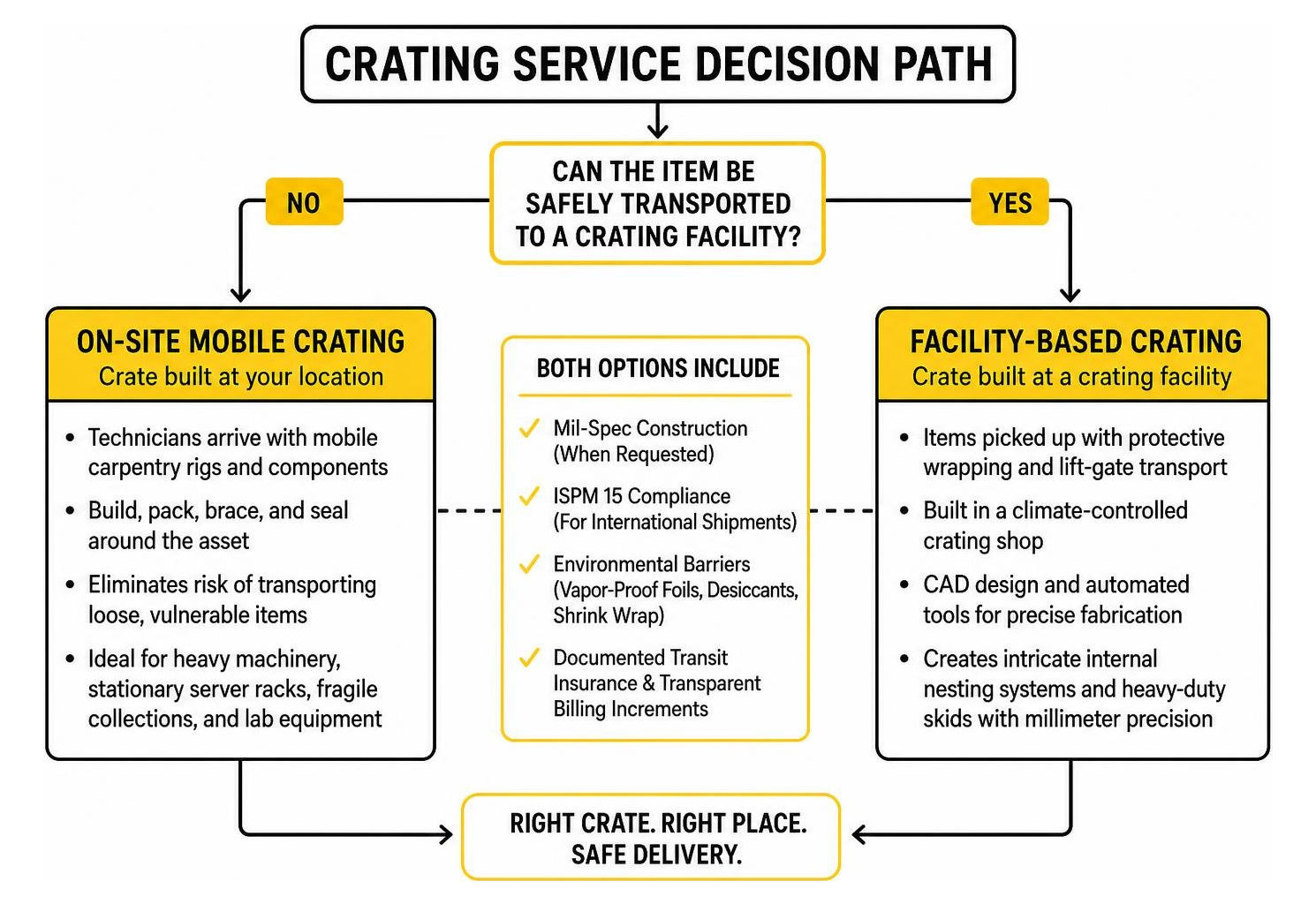
- On-Site Mobile Crating: Technicians arrive at your residence, warehouse, or laboratory with mobile carpentry rigs and pre-dimensioned components. They build, pack, brace, and seal the crate directly around the asset. This approach eliminates the risk of transporting loose, vulnerable items across town to a warehouse. It is ideal for heavy industrial machinery, stationary server racks, fragile museum collections, and cleanroom laboratory equipment.
- Facility-Based Fabrication: Your items are picked up using protective blanket wrapping, lift gates, and dedicated transport, then brought to a climate-controlled crating shop. Highly specialized computer-aided design (CAD) software and automated panel saws can fabricate intricate internal nesting systems and heavy-duty skids with millimeter precision.
Custom Crating vs. Shrink Wrapping and Standard Packaging
Choosing the right packing method requires balancing fragility, total value, transit distance, and cost efficiency. While corrugated cardboard boxes and stretch film are moving day staples, they offer limited defense against heavy structural impacts, cargo shifting, and severe weather changes. Industry standards, such as those documented in the Packaging and labeling guidelines, reinforce the importance of matching packaging strength to transit risk.
Understanding how custom crating services protect your most valuable items enables you to select the appropriate protective tier for every asset.
| Packaging Type | Structural Rigidity | Puncture Resistance | Moisture & Vapor Protection | Reusability | Ideal Applications |
|---|---|---|---|---|---|
| Custom Wooden Crates | Maximum | Extreme | High to Maximum (with foil barrier) | High (with hinges/hasps) | High-value art, antiques, lab devices, heavy equipment |
| Engineered Wooden Skids | High (Base Only) | Moderate | Moderate (with heavy wrap) | Moderate | Heavy engines, industrial machines, production line gear |
| Heavy-Duty Shrink Wrap | Minimal | Low to Moderate | High (against rain/dust) | None (Single Use) | Weatherproofing large equipment, bundling palletized boxes |
| Standard Corrugated Boxes | Low to Moderate | Low | Poor | Low | Common household items, clothing, lightweight non-fragiles |
Comparing Custom Crating Services Near Me to Standard Packing
Cardboard containers rely on fluted paper layers to absorb minor scuffs and impacts. However, standard corrugated boxes compress under vertical stacking loads, buckle under side impacts, and disintegrate when exposed to ambient moisture or standing water inside shipping containers. The broader field of packaging engineering outlines how material rigidity and environmental resistance drive container performance.
Custom wooden crates provide a rigid, puncture-proof external shell. They absorb heavy transit vibrations and isolate delicate items from external shocks. While standard cardboard has its place for books and everyday goods, high-value, fragile, or heavy items demand the load-bearing strength of wood framing and heavy-duty plywood skin.
Advanced Transit Protection: Moisture Barriers, Bracing, and Shock Absorption
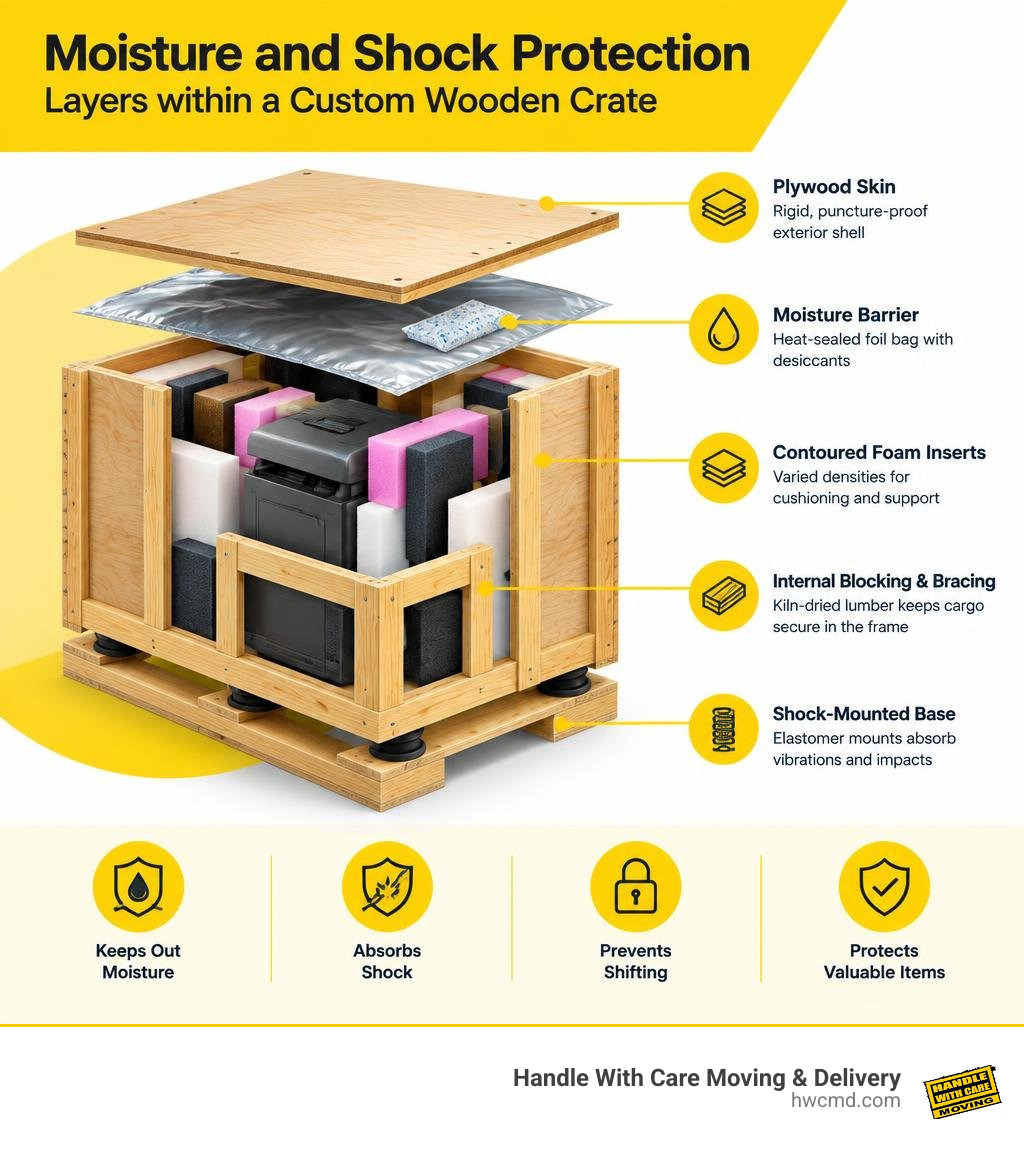
Building a secure wooden shell is only half the battle. What goes inside the crate determines whether your items survive real-world transit conditions. Professional crating integrates multiple internal protection systems:
- Contoured Foam Inserts: Utilizing varied densities of polyethylene (rigid support), polyurethane (soft cushioning), and anti-static pink foams to isolate delicate electronic circuits and painted surfaces.
- Internal Blocking and Bracing: Kiln-dried dimensional lumber fastened to the crate’s internal skeleton locks the cargo’s structural frame in place, preventing shifting during sudden braking or rough ocean transit.
- Moisture and Vapor Barriers: Long-haul ocean voyages and cross-country transits expose freight to humidity, salt air, and temperature swings. Applying heat-sealed vapor barrier foil bags with activated desiccants (silica gel or clay) extracts ambient moisture and creates an airtight, corrosion-proof microclimate.
- Shock-Mounted Bases and Pallet Dampers: Fragile calibration gear, medical scanners, and sensitive electronics benefit from elastomer shock mounts installed directly between the wooden skid and the crate floor to absorb drops and continuous road vibrations.
Proper selection of these materials is essential, as detailed in our guide on suitable packing materials.
Specialized Applications for Custom Crates and Skids
Different high-value assets present unique packaging challenges. Professional crating technicians design around specific structural vulnerabilities, weight distribution, and finish requirements.
Fine Art, Antiques, and High-Value Collectibles
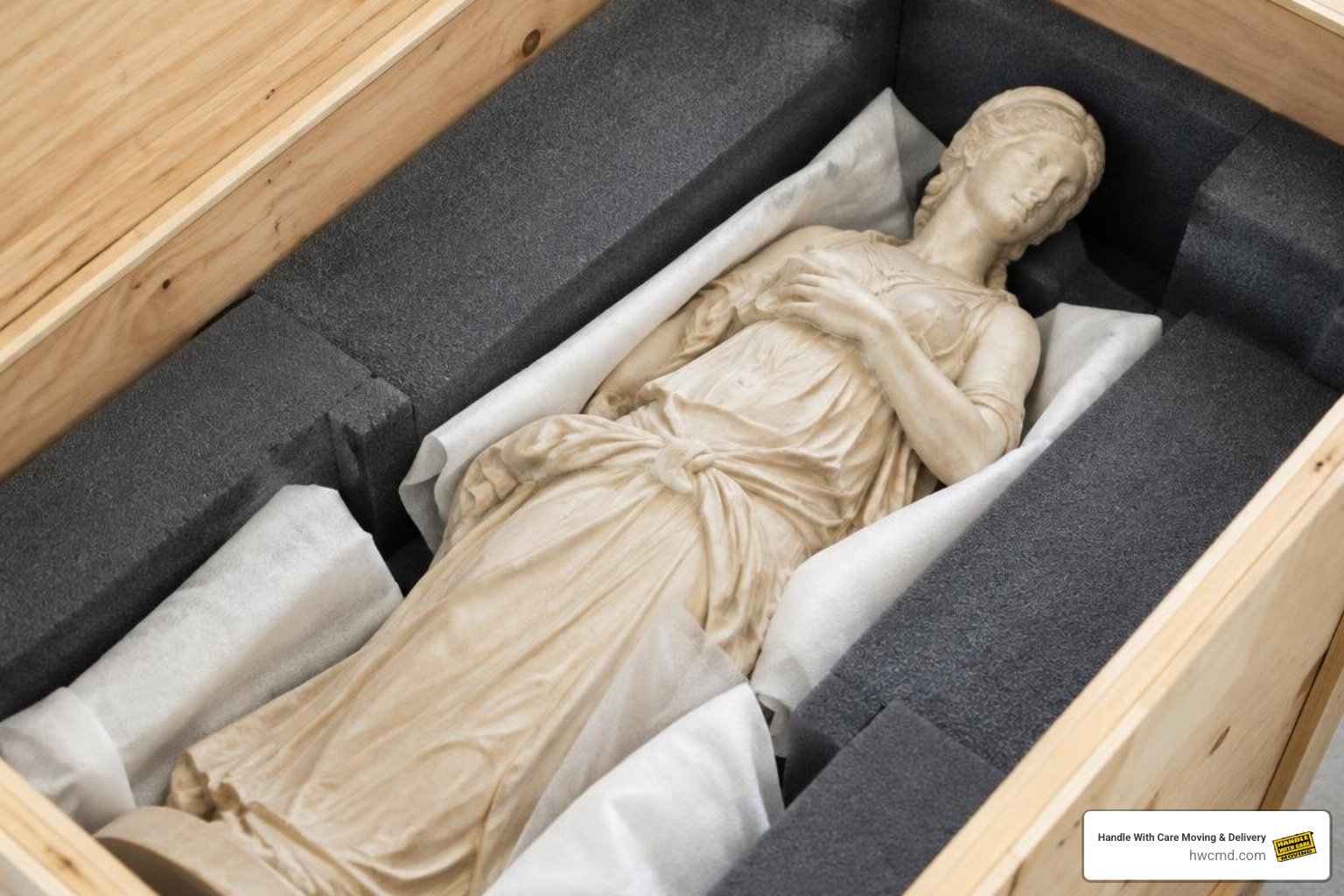
Fine art and delicate antiques require non-invasive, archival-grade packing. Direct contact with acidic papers, low-grade plastic wraps, or abrasive foams can permanently degrade historic varnishes, oil pigments, and antique patinas.
Specialist art packaging involves:
- Archival Wrapping: Wrapping surfaces in acid-free glassine paper, Tyvek, or non-abrasive soft foam.
- Gasketed Art Crates: Building sealed wooden crates lined with closed-cell thermal insulation to prevent rapid interior temperature fluctuations.
- Cavity and Shadowbox Nesting: Sculptures and multidimensional artifacts are secured inside precision foam cavities that support internal armatures without putting pressure on delicate decorative elements.
For artists, curators, and collectors, following dedicated packaging and crating materials for artists prevents irreversible damage during gallery transport and museum loans.
Heavy Industrial Machinery, Electronics, and Medical Equipment
Industrial mechanisms, electrical enclosures, and sensitive medical imaging equipment (like MRI subcomponents, centrifuge machines, and surgical lasers) carry extreme weights paired with delicate calibration tolerances.
Crating these assets requires:
- Engineered Skids and Heavy-Duty Bases: Heavy 4×4 or 6×6 timber skids machined with integrated 4-way forklift entry pockets and beveled skid runners.
- Precision Load Bolting: Securing equipment to the wooden skid through threaded tie-downs and heavy-duty steel lag bolts.
- Anti-Static Enclosures: Sensitive server racks and laboratory analyzers require anti-static (ESD) wrapping to eliminate electrostatic charge accumulation.
Logistics, Shipping Modes, and Transit Insurance
Once an item is crated, selecting the correct transit mode balances delivery speed against dynamic physical stresses:
- Dedicated Ground Freight (Full Truckload / LTL): Less-Than-Truckload (LTL) shipping exposes crates to multiple forklift transfers and hub reloads. High-value cargo benefits from dedicated truckload service or direct-route logistics to minimize handling touchpoints and reduce damage risk.
- Air Freight: Air transport requires lightweight yet strong crating designs to withstand cargo bay pressure changes while keeping dimensional weight costs low.
- Ocean Freight: International maritime shipping demands ISPM 15 certified timbers, vapor-barrier bagging, and heavy-duty container blocking to endure weeks of rolling seas narratives and high humidity. For background on how global shipping containers standardized these processes, see the history of containerization.
Before dispatching any shipment, review carrier coverage options. Standard freight carrier contracts often limit liability to pennies per pound. For irreplaceable assets, high-value antiques, or commercial equipment, arrange comprehensive transit insurance. Understanding transport liability and claims ensures you hold the proper coverage documentation, condition reports, and pre-transit photographs before the shipment leaves your facility.
Frequently Asked Questions About Specialty Crating
How to Request a Fast Quote for Crating Services Near Me
To secure a prompt, accurate quote, gather the following details before reaching out to crating specialists:
- Exact Dimensions: Measure maximum length, width, and height (including all knobs, handles, caster wheels, or protrusions) to the nearest inch or centimeter.
- Accurate Weight: Provide exact or closely estimated weight to calculate skid requirements and lumber thickness.
- Value and Fragility Points: Highlight glass elements, delicate finishes, calibration sensors, or structural balance concerns.
- Site Access Logistics: Note whether pickup and delivery locations feature loading docks, stairs, tight residential doorways, gravel pathways, or require lift-gate trucks.
- Final Destination Details: State whether the delivery is local, cross-country, or international (requiring ISPM 15 compliance).
What Is the Typical Turnaround Time for Custom Crating?
Standard custom crate design and fabrication typically takes 2 to 4 business days from initial measurement to completed assembly. Production timelines follow the same planning principles found in broader packaging and labeling operations, where design, material preparation, and assembly are carefully sequenced. For urgent industrial breakdowns, estate settlements, or tight gallery schedules, many mobile crating companies offer expedited, next-day, or same-day emergency on-site fabrication.
How Do I Know If My Item Requires a Custom Skid or Crate?
Your item likely requires custom crating or a engineered skid if it is unusually heavy, unevenly balanced, highly sensitive to moisture or vibration, or carries high monetary or sentimental value. Formal frameworks from the International Plant Protection Convention (IPPC) also influence crate construction requirements for cross-border shipments, particularly when solid wood materials are used.
Conclusion
Securing your most valuable, fragile, or oversized assets during transit begins with selecting the proper crating and packing method. From solid ISPM 15 certified lumber and custom-engineered skids to advanced shock mounting and internal moisture barriers, high-grade specialty packaging protects your investments across every leg of their journey.
At Handle With Care Moving & Delivery, we bring expert, careful handling to residential and commercial clients across Ann Arbor, Michigan. We make your relocation simple and transparent with our signature 15-minute billing increments, zero minimum labor hours, and complimentary protective pad and shrink wrap on every project. Whether you need on-site protective packing, fine art handling, or reliable local transport, our team is equipped to safeguard your belongings.
Ensure your items receive the highest level of care. Explore our comprehensive packing and crating services today to request your customized estimate!