
Pro Moving Hacks: Best Furniture Moving Tips for Any Home

Furniture Moving Tips That Make the Job Safer
Empty and measure each piece before you lift it. Clear the route, remove parts that come off, and pad the furniture and nearby walls. Use sliders on floors, a strapped dolly for heavy pieces, and a helper for awkward lifts. If the route includes stairs or you cannot control the weight, stop and get moving help.
The best furniture moving tips start with preparation, not strength. I’m Anthony Denha, President of Handle With Care Moving & Delivery, where I oversee how our team plans routes, protects furniture, and handles each move. Here are the steps I use to make a move safer and easier to manage.
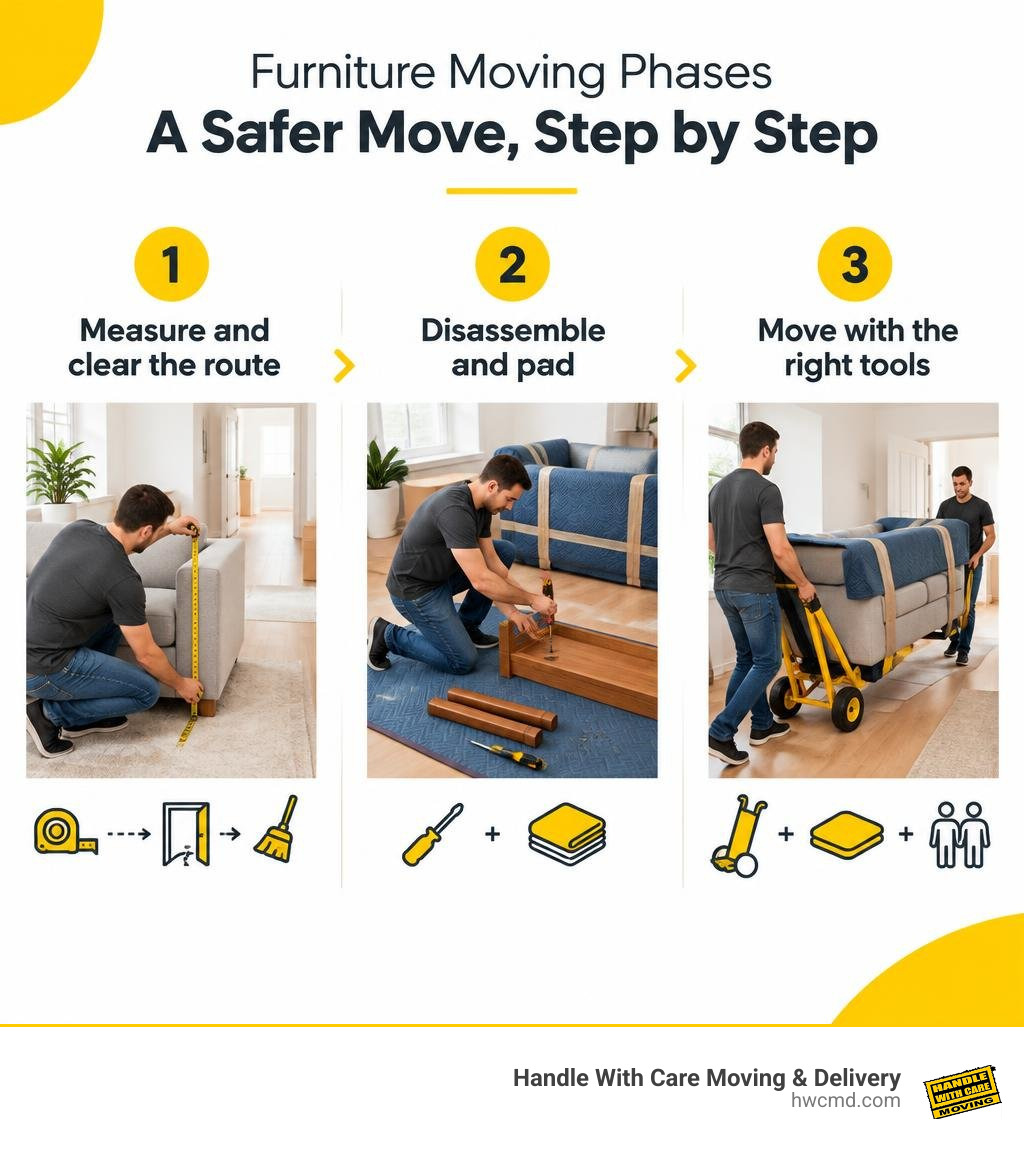
Furniture moving tips terminology:
Essential Preparation and Furniture Moving Tips
When people prepare for a move, they often imagine hours of grueling physical exertion. In reality, nearly half of a successful relocation involves prep work that requires lifting zero weight. When you execute the preparation phase correctly, the dangerous under-load portion represents less than a fifth of your moving day.
Before lifting an armoire, sofa, or desk, you need to eliminate dead weight and confirm your transit path. A loaded solid-wood dresser can weigh double its empty figure once you factor in clothing, books, and drawer hardware. Removing drawers entirely turns an unmanageable 175-pound monolithic block into a lightweight, structural frame that one or two people can easily maneuver.
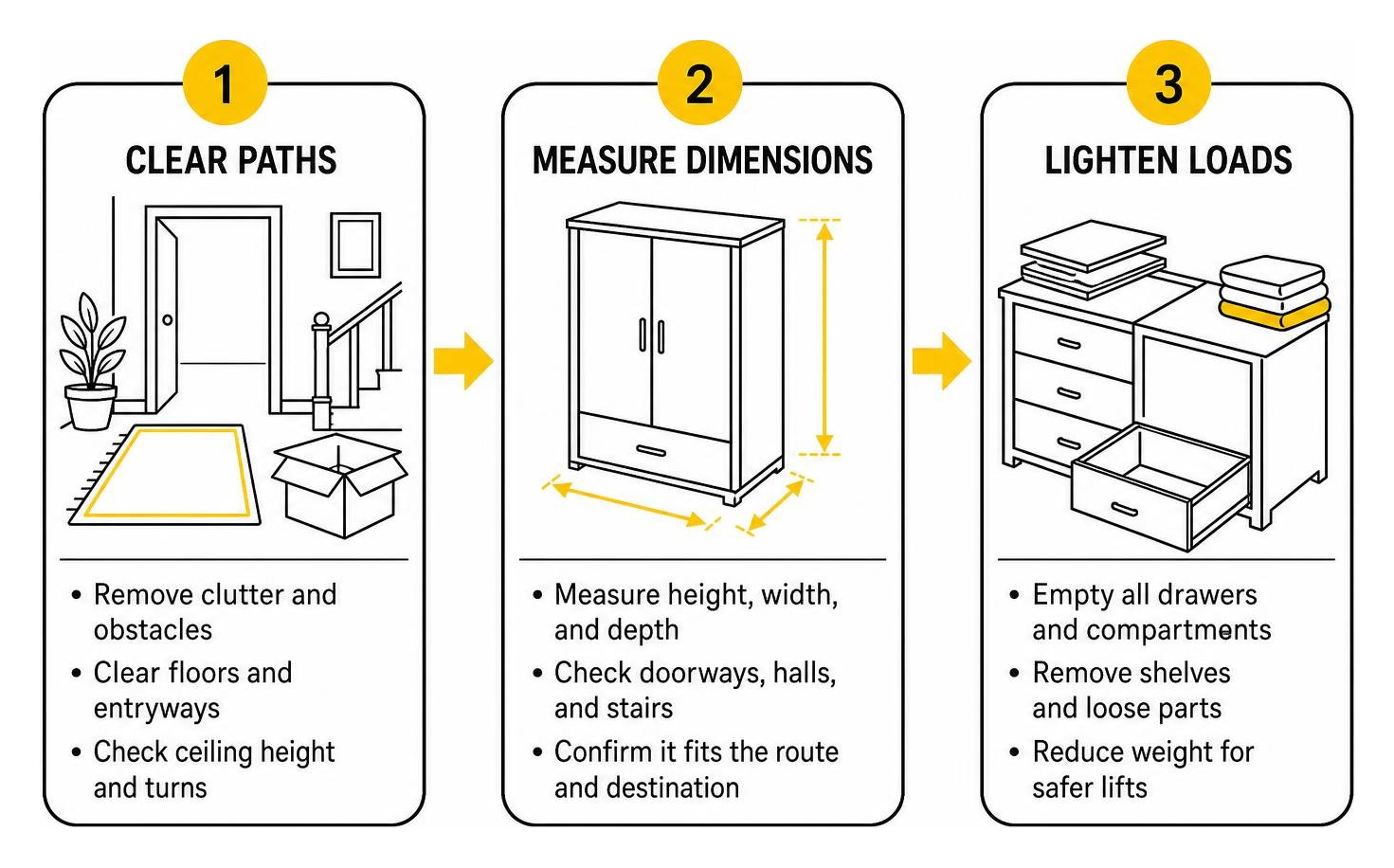
Follow these fundamental preparation rules before shifting any large item:
- Empty every compartment: Take out shelves, drawers, clothing, and loose organizers.
- Inspect the travel path: Walk the exact route from the room to the exit, removing throw rugs, low-hanging light fixtures, and entryway clutter.
- Account for landing zones: Know precisely where the piece will land in the truck or the destination room so you do not carry weight while deciding placement.
- Check the clearance: Verify ceiling heights in stairwells and turn radiuses in tight hallways.
Strategic Disassembly and Measurement Hacks
Never wrestle with a bulky item through a doorway when simple tools can make it two to three inches smaller. Taking a few minutes to take apart furniture saves hours of frustration and prevents costly structural damage.
Start by collecting basic tools: a cordless drill, a hex-key set, and plenty of resealable plastic bags. Whenever you remove a fastener, bracket, or drawer pull, seal it in a labeled baggie and tape it directly to the underside of the piece or keep it in a dedicated hardware container.
- Table Legs: Remove bolted table legs so flat surfaces can travel vertically on their edges.
- Reclining Chairs: Locate the locking levers on the back of most recliners (hidden beneath the fabric flap on the back frame) and slide the backrest straight up and off the base.
- Bed Frames: Break headboards, footboards, and side rails down into individual pieces.
- Interior Doors: Removing an interior door from its hinges takes five minutes with a screwdriver and a hammer, instantly buying roughly two inches of clearance through narrow entryways. If you still need an extra half-inch, pry off the doorstop molding along the inner jamb.
Integrating these steps with efficient household moving ideas keeps your relocation organized while preventing chipped trim and bruised knuckles.
Essential Gear and Protective Supplies
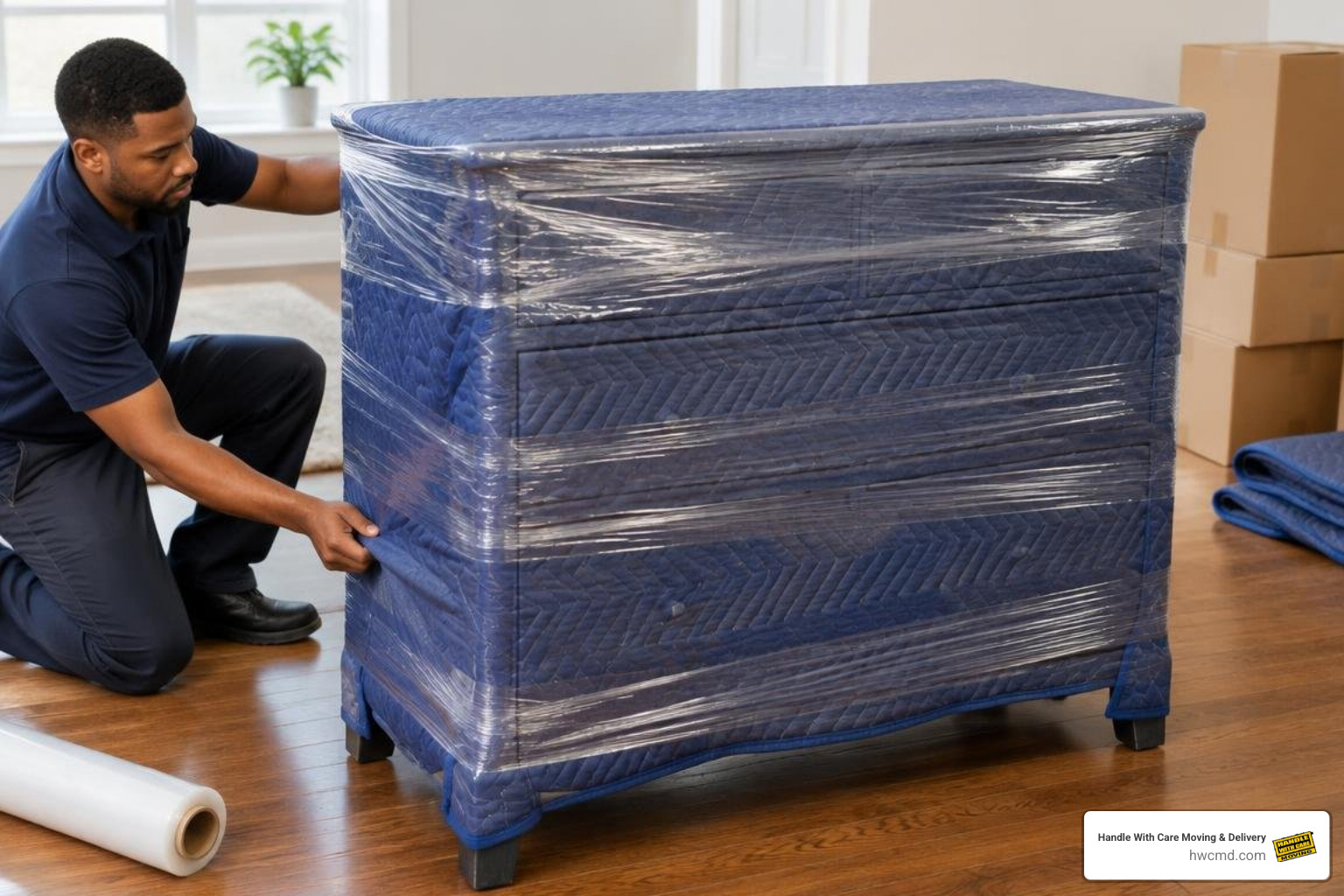
Attempting to transport finished hardwoods or delicate upholstery without protective supplies is a huge gamble. A dozen rented moving blankets and a single roll of heavy-duty stretch wrap cost a fraction of what a carpenter charges to refinish a gouged oak door casing.
When padding furniture, place clean moving blankets over exposed surfaces and secure them snugly using commercial stretch wrap. Keep the plastic wrap directly on the blankets—never apply adhesive packing tape directly to finished wood or genuine leather, as tape adhesives can peel away lacquers and leave permanent residues. For high-end tables, snap rigid cardboard or plastic corner guards onto the edges before wrapping.
Investing in high-grade furniture pads ensures your investment remains scratch-free during transit. If your items are destined for a garage or a transitional facility, read up on protecting items for storage and transport to protect upholstery from moisture, dust, and temperature shifts.
Safe Lifting and Maneuvering Techniques for Heavy Pieces
Lifting heavy furniture safely is a matter of physics and leverage rather than brute strength. Knowing your physical limits protects you from severe back and joint injuries. As a baseline rule of thumb, an illustrative 50 pounds per carrier is comfortable, while 75 pounds represents the caution line. Anything over 300 pounds—or moderately heavy pieces facing a full staircase—belongs firmly in experienced crew territory.
| Equipment Type | Best Use Cases | Weight Capacity | Ideal Flooring / Surface |
|---|---|---|---|
| Furniture Sliders | Dressers, desks, heavy tables | Up to 1,000 lbs (distributed) | Hardwood (felt) / Carpet (smooth plastic) |
| 4-Wheel Flat Dolly | Large credenzas, book cases, sofas | 600 – 1,000 lbs | Flat interior floors, loading ramps |
| 2-Wheel Hand Truck | Tall appliances, stacked crates | 600 – 800 lbs | Exterior sidewalks, single threshold steps |
| Shoulder Dolly Straps | Mattresses, smooth sideboards | Up to 800 lbs (combined) | Flat hallways, gentle inclines |
Ergonomic Furniture Moving Tips for Two-Person Lifts
When two people lift a tall or long item, they must work as a synchronized unit. The standard method for this is the high-low carry. One carrier grips the top end of the piece (such as a tall dresser tilted on its side or an upright shelving unit) while the other grips the bottom end from the opposite side.
This technique centers the object’s center of gravity between both carriers, prevents the piece from tipping out of their hands, and allows the top carrier to see over the load.
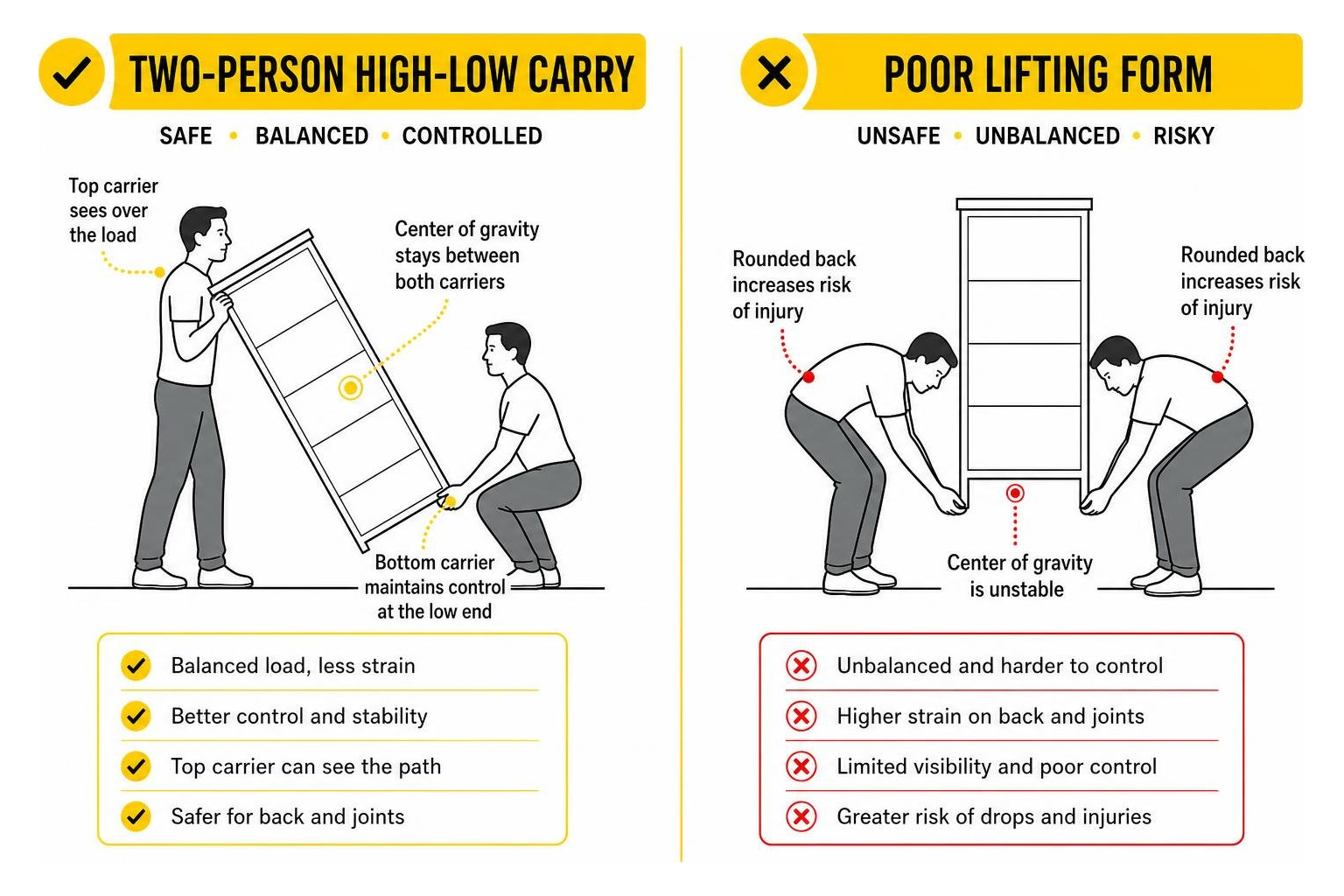
- Drive through the legs: Squat at your hips and knees, keep your spine neutral, and push straight up through your heels. Never bend at the waist to hoist dead weight.
- Keep the load close: Hold the item as close to your core as possible to minimize spinal torque.
- Avoid twisting: Pivot with your feet rather than twisting your torso while under load.
- Incorporate forearm or shoulder straps: Harnesses like shoulder dollies rely on leg and shoulder power, freeing your hands to balance and guide the load through corners.
Reviewing techniques on mastering large furniture lifts helps maintain safety when handling bulky sectionals and solid-wood tables.
Solo Furniture Moving Tips and Sliding Strategies
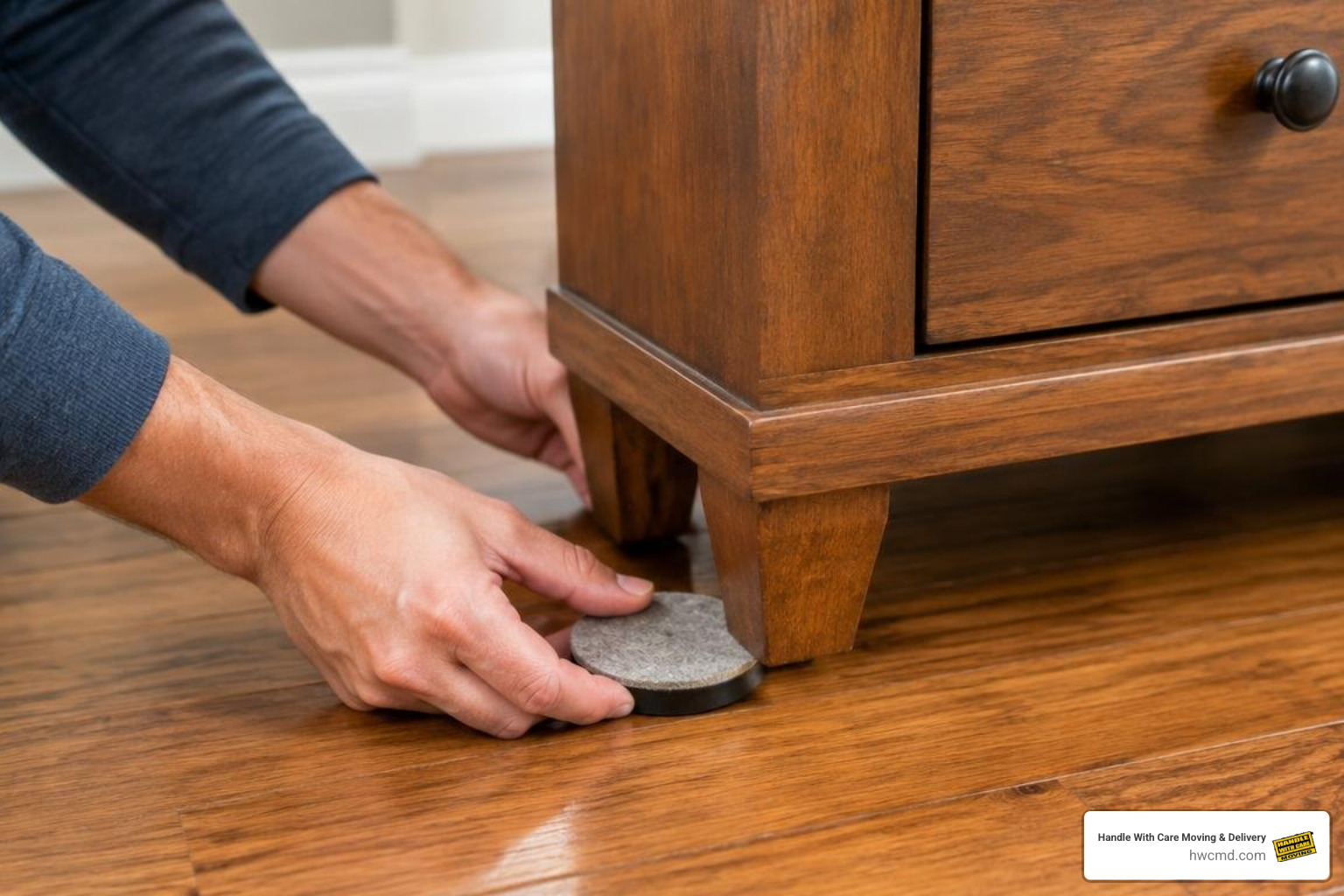
If you are rearranging or relocating items on your own, eliminate carrying entirely by sliding your furniture. An illustrative 175-pound dresser that two people would struggle to carry across a bedroom becomes an easy one-person push once you slip furniture sliders underneath its feet.
Sliders feature a slick, rigid plastic base for carpeted floors and a soft, padded felt base for hardwood, vinyl, and tile. To install them solo, use a simple lever tool (a specialized furniture lifter pry-bar) to raise one corner an inch off the floor, slip the slider underneath with the protective foam facing up, and set the foot down. Repeat for all four corners.
Always push the furniture low from its structural base rather than high near the top to prevent tipping. For additional DIY leverage ideas, check out these smart furniture handling hacks to make shifting heavy home items even easier.
Navigating Stairs and Difficult Thresholds
Stairs represent the most hazardous part of any move. The combination of elevation changes, gravity, and confined clearance leaves no room for improvisation.
Before moving an item onto a flight of stairs, cover the banisters and railings with moving pads, secure loose runners, and assign a dedicated spotter. The spotter does not bear weight; their sole job is to guide the carriers, announce step counts, and watch for blind obstacles.
Moving Heavy Furniture Upstairs vs. Downstairs
The mechanics of carrying heavy items shift dramatically between going upstairs and heading downstairs:
- Downhill Carrier Rule: The stronger of the two carriers must always take the downhill position. On stairs, the downhill carrier supports significantly more of the piece’s total weight due to gravity and angle shifts.
- Tread-by-Tread Movement: Never rush down or up a flight. Treat an illustrative 175-pound dresser on a 13-tread flight as 13 small, controlled moves. Move one step, pause to regain balance, and confirm the next step with your spotter. The entire flight takes roughly two minutes of methodical, safe effort.
- Appliance Hand Trucks: For heavy appliances like a 250-pound refrigerator, strap the unit securely to an appliance dolly equipped with stair-climbing treads. Rolling the weight step-by-step asks each person for only a fraction of what a bare carry requires.
Our guide on navigating staircases safely without back strain covers deeper leverage tricks and safety precautions for multi-story moves.
Fitting Oversized Pieces Through Tight Doorways
When a large couch or armchair seems wider than the entry frame, brute force will only damage your drywall. Instead, rely on geometric maneuvers to work around the frame:
- The ‘L’ Method for Chairs: Turn large armchairs onto their side so the back and seat form an ‘L’ shape. Hook the back of the chair through the doorway first, then rotate the seat cushion through the opening around the door jamb.
- Standing Sofas on End: If a hallway is too narrow for a horizontal couch, stand the sofa completely vertical on one of its padded arms. You can then pivot and ‘swivel’ the piece through tight entryways and around acute hallway corners.
- Measuring the Diagonal: Before attempting a lift, measure the piece’s diagonal depth (from the top-back corner to the bottom-front edge) and compare it against the doorway’s diagonal clear opening. A tilted piece will often clear an opening that looks too narrow straight-on.
When to DIY vs. Calling Professional Movers
Knowing when to step back and call a professional crew is the best way to prevent injuries, damaged property, and broken heirlooms. DIY moving is great for standard boxes and manageable furniture, but certain weight classes and architectural obstacles require professional gear and training.
Use these benchmarks to decide whether to hire pros:
- The 300-Pound Rule: Upright pianos, slate pool tables, massive gun safes, and sleeper sofas exceed normal DIY lifting limits.
- Complex Staircases: Winding spiral stairs, multi-landing switchbacks, or narrow heritage-home stairwells turn heavy items into severe pinch hazards.
- Health and Safety: If you lack at least two physically capable adults, do not risk permanent spinal injury.
Hiring professional help does not have to break your budget. An illustrative two-mover, two-hour labor-only booking commonly costs a small fraction of a full-service move and takes care of your heaviest items in minutes. Learn more about locating affordable moving help and hiring budget-friendly furniture movers to find local loading assistance.
Frequently Asked Questions About Moving Heavy Furniture
What is the safest way to lift heavy furniture by yourself?
The safest way to move heavy furniture alone is to use tools that keep the piece on the ground. Use a furniture lifter lever to place smooth plastic or felt sliders under all contact points, allowing you to push the piece across the room. For loading thresholds, roll the item on a four-wheel flat dolly or an appliance hand truck equipped with ratcheting safety straps.
How do you measure a doorway to ensure furniture fits?
Measure the narrowest interior dimension of the door frame (from the inner doorstop to the opposite jamb) and the vertical height from floor to top frame. Next, measure your furniture’s depth, width, and diagonal plane (from the top-back corner to the bottom-front corner). If the piece’s depth or diagonal measurement is smaller than the door frame’s clear width, you can maneuver it through by tilting or rotating it.
When should you avoid moving a heavy piece on your own?
Avoid moving any piece solo if it exceeds 75 pounds, features smooth surfaces without handholds, or needs to travel up or down a staircase. You should also step aside for specialty items like acoustic pianos, commercial gym equipment, or large marble-topped vanities that require multi-carrier harnesses and stair-climbing equipment.
Conclusion
A successful move is built on careful preparation, mechanical leverage, and clear communication. By taking time to empty drawers, measure your doorways, wrap sensitive surfaces in thick blankets, and utilize sliders and dollies, you turn what feels like an exhausting chore into a smooth, manageable process. Never risk your health or damage your home by forcing an impossible lift.
If you are planning an upcoming transition and want trusted, hands-on support, explore our expert residential moving services at Handle With Care Moving & Delivery. Our team is always ready to take the heavy lifting off your shoulders.
— Anthony Denha, President of Handle With Care Moving & Delivery