
Never Crush a Delivery Again with Superior Carton Boxes for Packing

Why a Corrugated Carton Box Prevents Moving-Day Damage
A corrugated carton box is a shipping or moving box made with flat paper liners around a wavy inner layer called a flute. That structure adds stiffness, cushioning, and crush resistance. For a local move, choose the box by what is inside, not just by its size:
- Use single-wall boxes for lighter, non-fragile household items.
- Use double-wall, higher-ECT boxes for dense or fragile items, such as books, small appliances, and dishes.
- Leave room for padding, fill empty spaces, and keep the heaviest items in smaller cartons.
- Measure boxes by their inside Length x Width x Depth, so your belongings and cushioning materials actually fit.
A box can look fine when it is packed, then fail when stacked in a truck or exposed to a sharp corner. Corrugated board helps prevent that damage because its fluted center absorbs some impact and supports weight from above. The right wall construction, flute type, and strength rating can make a meaningful difference between a box that holds its shape and one that buckles mid-move.
I’m Anthony Denha, President of Handle With Care Moving & Delivery. Through hands-on work planning and managing residential and office moves, I have seen how choosing the right corrugated carton box, packing it with care, and avoiding overloading protects belongings from pickup through delivery.
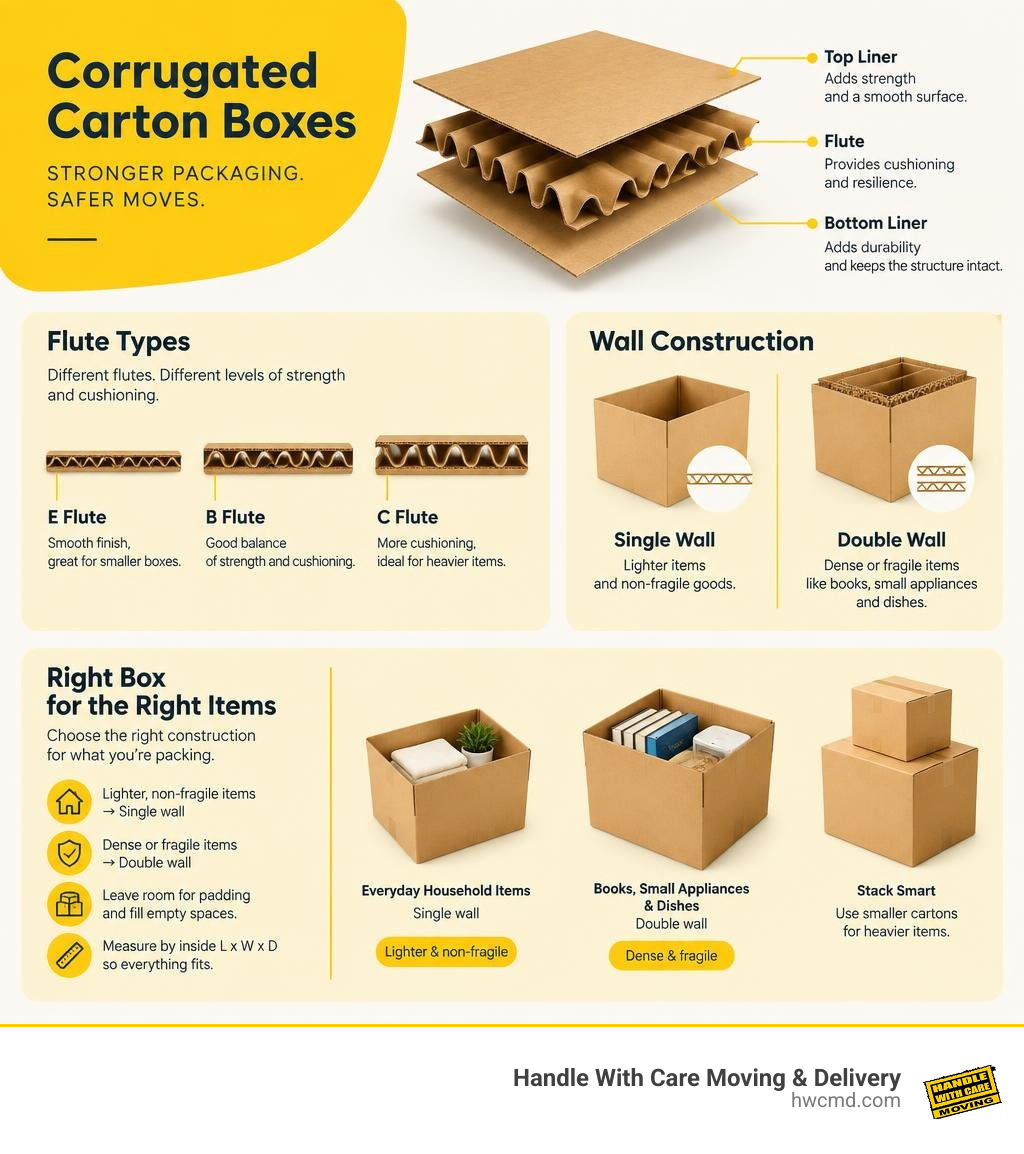
Basic corrugated carton box vocab:
Anatomy and Construction of a Corrugated Carton Box
To choose the right packaging for your items, you must first understand what gives corrugated fiberboard its remarkable strength. Unlike ordinary paperboard—the thin, single-layer material used for cereal boxes—corrugated board is an engineered composite structure. It combines multiple paper layers through an adhesive bonding process to deliver rigidity, shock absorption, and compression resistance.
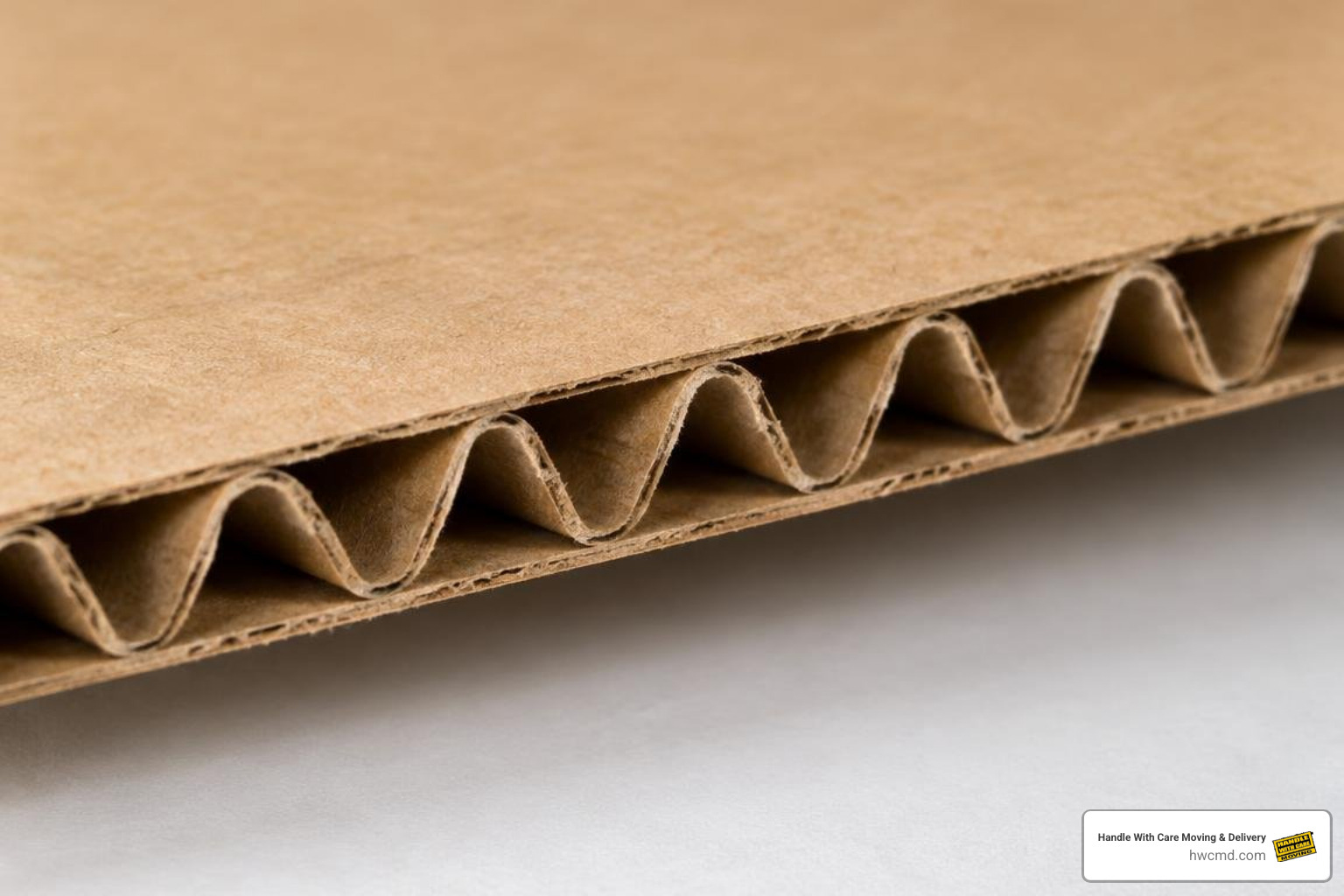
At its core, a corrugated board consists of two essential elements:
- Linerboard: Flat paper sheets that form the exterior and interior faces of the board. Outside liners are typically made of high-strength kraft paper (virgin wood pulp) for puncture resistance and water repellency, while inside liners often incorporate testliner (recycled fiber).
- Fluting Medium: The wave-like, arched paper layer sandwiched securely between the linerboards. The flutes act as continuous structural columns that resist vertical top-to-bottom compression while providing an air cushion that dampens mechanical shocks and vibrations during transit.
When you select suitable packing materials, matching the right liner quality with the appropriate flute size ensures your goods remain intact from departure to destination.
Flute Profiles and Wall Architecture
Flutes are categorized by standardized letter designations that indicate their thickness and the number of wave arches per linear foot. Each profile delivers a unique balance of stacking strength, cushioning capability, and surface printability:
- A-Flute (~4.8 mm thickness): The original corrugated flute profile. Featuring roughly 33 flutes per linear foot, it offers superior cushioning and energy absorption along with high vertical compression strength, making it ideal for fragile, heavier items.
- B-Flute (~3.0 mm thickness): Engineered with approximately 47 flutes per linear foot. While thinner than A-flute, B-flute provides outstanding crush resistance and a flatter surface for clean printing. It is widely used for mailers, canned goods, and counter displays. For instance, compact containers like a 250 x 110 x 63 mm quick-closing mailer often utilize 3 mm B-flute cardboard weighing just 0.077 kg to deliver strong edge protection without excess bulk.
- C-Flute (~3.8 mm thickness): The versatile workhorse of the shipping industry, packing roughly 39 flutes per linear foot. It strikes an optimal middle ground between the stacking strength of A-flute and the crush resistance of B-flute. Most standard moving cartons and parcel shipping boxes utilize C-flute board.
- E-Flute (~1.5 mm thickness): An ultra-thin profile with roughly 90 flutes per linear foot. It offers exceptional crush resistance and a smooth face for high-definition retail graphics and small consumer product cartons.
Single-Wall vs. Multi-Wall Packaging
Board performance is further scaled by layering liners and mediums into multi-wall configurations:
- Single-Face Board: One liner glued to one corrugated medium. Highly flexible, it is used primarily as protective wrapping around furniture or glassware rather than as a standalone carton.
- Single-Wall (Double-Face) Board: One fluted medium glued between two flat liners. This represents over 80% of all cartons produced worldwide. It accommodates most general household goods, apparel, and lightweight kitchenware.
- Double-Wall Board: Two fluted mediums glued between three liners (often combining B-flute and C-flute into a robust BC-flute structure). Double-wall cartons provide superior rigidity, resist severe handling impacts, and are necessary when stacking dense goods inside moving trucks or ocean containers.
- Triple-Wall Board: Three fluted mediums bonded with four liners. Triple-wall containers deliver compressive strength comparable to wooden crating and are deployed for heavy machinery, automotive components, and chemical drums.
Measuring Box Strength: ECT vs. Mullen Burst Test
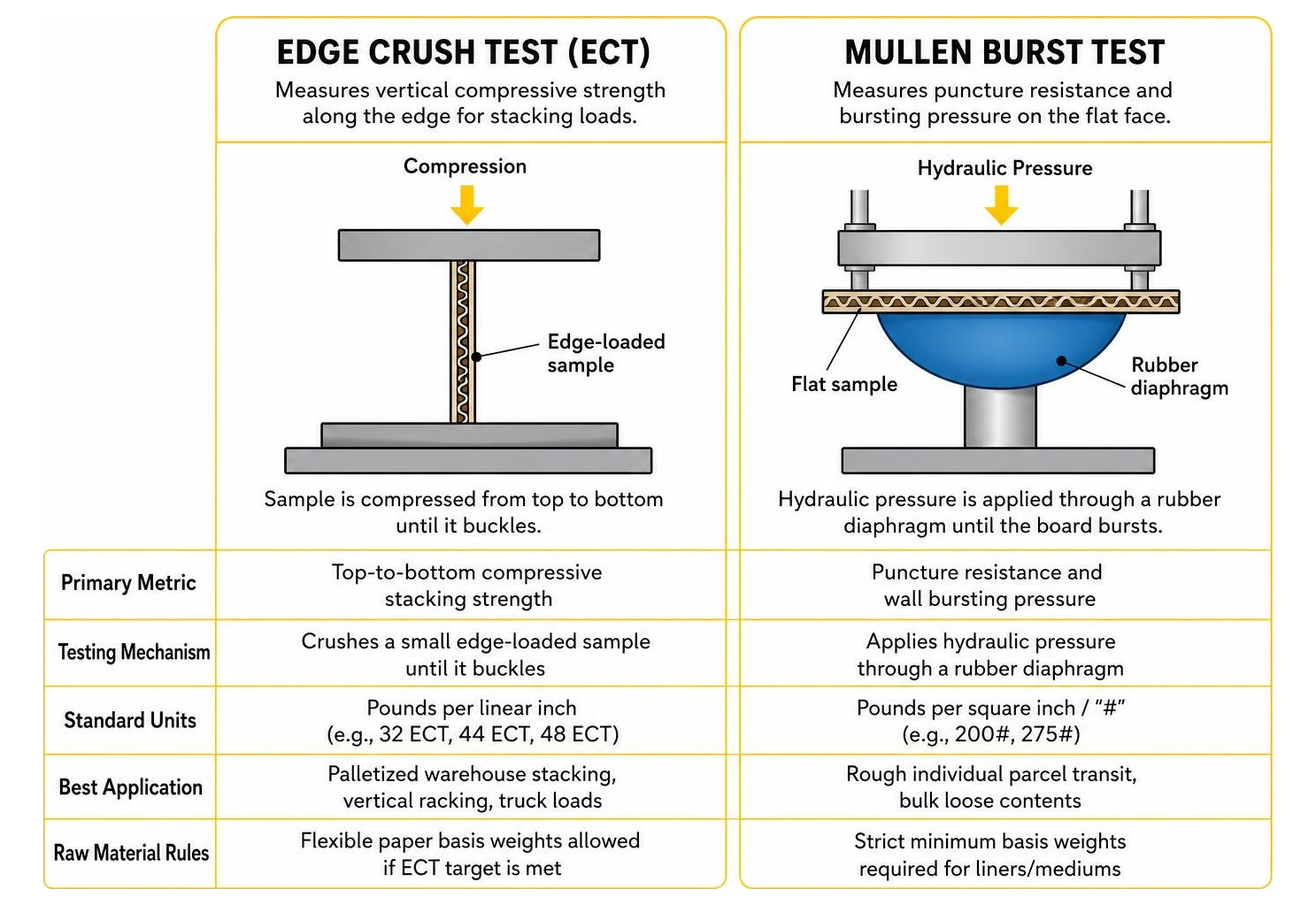
Understanding strength metrics helps you avoid structural blowouts and crushed corners. Packaging engineers assess carton integrity using two distinct testing protocols: the Edge Crush Test (ECT) and the Mullen Burst Test.
Consulting our practical guide to packing services materials options can help clarify which rating best fits your cargo profile.
| Parameter | Edge Crush Test (ECT) | Mullen Bursting Test |
|---|---|---|
| Primary Metric | Top-to-bottom compressive stacking strength | Puncture resistance and wall bursting pressure |
| Testing Mechanism | Crushes a small edge-loaded sample until it buckles | Applies hydraulic pressure through a rubber diaphragm |
| Standard Units | Pounds per linear inch (e.g., 32 ECT, 44 ECT, 48 ECT) | Pounds per square inch / “#” (e.g., 200#, 275#) |
| Best Application | Palletized warehouse stacking, vertical racking, truck loads | Rough individual parcel transit, bulk loose contents |
| Raw Material Rules | Flexible paper basis weights allowed if ECT target is met | Strict minimum basis weights required for liners/mediums |
Edge Crush Test (ECT) for Stacking Load
The Edge Crush Test measures the compressive force a carton wall can withstand along its vertical edge before buckling. Because modern logistics relies heavily on vertical pallet stacking, ECT has become the primary benchmark for transport packaging.
- 32 ECT (Single-Wall): The standard baseline for consumer shipping. Designed to hold up to 35–40 lbs of evenly distributed weight under light stacking conditions.
- 44 ECT (Single-Wall): A heavy-duty single-wall grade capable of holding gross contents up to 65 lbs (such as a 24″ x 24″ x 12″ heavy-duty carton). It delivers roughly 40% more stacking strength than baseline 32 ECT boxes.
- 48 ECT (Double-Wall): Built for severe stacking environments and dense loads up to 80 lbs, such as large appliances and dense mechanical parts. A heavy-duty 24″ x 20″ x 12″ double-walled RSC with a 48 ECT rating will maintain its square structural profile under tall pallet loads without corner roll.
Mullen Bursting Strength for Puncture Resistance
The Mullen Burst Test measures the force required to burst through the flat face of a corrugated board using hydraulic pressure. Unlike ECT, Mullen ratings mandate strict raw-material minimums. For example, a 200# Mullen board must utilize linerboards with a minimum combined basis weight of 84 lbs per 1,000 square feet (42# per liner) and a 23# medium.
When your boxes face internal shifting from sharp, irregularly shaped objects or loose cargo in long-distance transit, a 275# Mullen-rated box provides dense fiber walls that resist lateral punctures far better than lightweight ECT-optimized alternatives.
Common Styles and Manufacturing Standards
Beyond raw material strength, the mechanical cut and fold architecture dictates how a carton performs under stress.
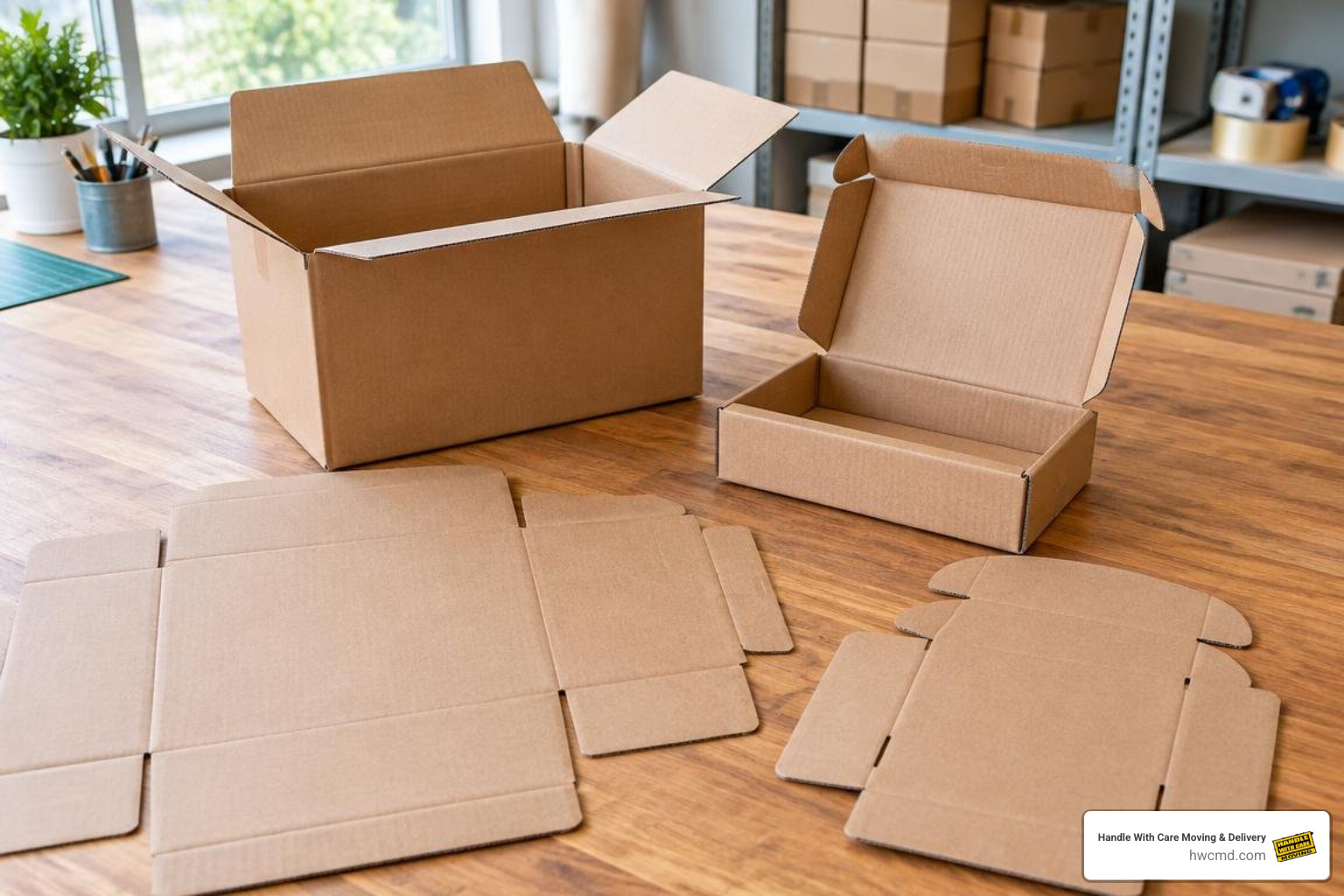
RSC and Die-Cut Packaging Styles
Corrugated containers are manufactured in standard styles identified by international FEFCO (European Federation of Corrugated Board Manufacturers) codes:
- Regular Slotted Container (RSC / FEFCO 0201): The most widely used box style. All flaps have equal lengths, and the two outer lengthwise flaps meet in the exact center when folded. It minimizes paper waste during die-cutting and provides excellent stacking strength when properly taped.
- Full Overlap Container (FOL / FEFCO 0203): Flaps extend fully across the width of the box, overlapping one another entirely. This creates double the board thickness on the top and bottom faces, offering extra protection against bottom blowouts when handling heavy, flat items.
- FEFCO 0427 Roll-End Tuck-Top Mailer: A precision die-cut folder with roll-over side walls and a hinged lid that locks cleanly into front slots without requiring adhesive tape. The Superbox elongated format demonstrates how this structure offers high presentation value alongside rigid corner protection.
- Self-Locking & Auto-Bottom Containers: Feature pre-glued bottom flaps that snap into place instantly upon opening. Pair these with integrated self-sealing adhesive strips and tear tapes for rapid, tape-free assembly and hassle-free returns.
International Standards and Dimensional Tolerances
In commercial logistics, cartons must comply with rigorous manufacturing standards, such as the comprehensive GB/T 6543-2025 standard for single- and double-corrugated transport packages.
GB/T 6543-2025 | Single and double (English PDF) specifies that transport containers designed under its scope have a maximum content mass limit not exceeding 55 kg. The standard establishes strict quality criteria that every packaging engineer and freight handler should recognize:
- Dimensional Tolerances: Internal dimensions must hold within ±3 mm for single-wall boxes and ±5 mm for double-wall boxes.
- Squareness & Skewing: The difference between the top and bottom diagonal measurements across folded boxes must remain ≤5 mm for boxes with an inside dimension up to 1,000 mm, and ≤8 mm for larger containers.
- Corner Holes & Joint Flaps: Gaps at formed corner joints must not exceed 5 mm to prevent dust ingress and preserve edge strength. Overlap tongue widths must be at least 20 mm for single-wall and 30 mm for double-wall constructions.
- Fastening & Bonding: Joint nail spacing must remain ≤80 mm for single-wall and ≤110 mm for double-wall boxes. For glued joints, a peel test must confirm that at least 70% of the bonded surface fibers remain intact upon separation.
How to Choose and Pack for Maximum Protection
Proper box selection prevents transit failures. Understanding basic packing 101 techniques protects your belongings before our crew loads them onto the truck.
Sizing Rules for Any Corrugated Carton Box
Box dimensions are universally communicated using internal measurements listed in strict order: Length (L) x Width (W) x Depth (D).
- Length: The larger dimension of the open carton top.
- Width: The smaller dimension of the open carton top.
- Depth (Height): The vertical dimension measured perpendicular to the opening.
Always calculate dimensions based on your item’s footprint plus a minimum 2-inch clearance on all six sides for protective cushioning. If your item measures 10″ x 8″ x 6″, choose an interior box dimension of at least 14″ x 12″ x 10″ to accommodate cushioning wrap without forcing the outer walls to bulge.
Selecting a Heavy-Duty Corrugated Carton Box for Fragile Goods
Fragile, high-density household items require targeted box selection:
- Glassware & China: Use specialized cell-partition dish packs built from heavy-duty double-wall board rated at 48 ECT. When preparing delicate place settings, review the best way to pack dishes for shipping safely and master the best way to pack dishes for storage without damage so fragile plates stand vertically on edge rather than flat.
- Books & Records: Keep dense items in smaller cartons (1.5 cu. ft. single-wall or double-wall) rated for up to 65 lbs. Large boxes packed with heavy books become dangerous to lift and can burst at the bottom seam.
- Artwork & Electronics: Use telescoping picture boxes or mirror cartons lined with bubble cushioning. Professional setups often benefit from review of the professional artists guide to packaging and crating materials.
- Seasonal & Long-Term Storage: If your goods are heading into long-term storage, humidity will gradually soften wood fibers. Choose double-wall corrugated packaging rated at 44 ECT or 48 ECT to preserve vertical stacking strength across seasonal temperature swings.
When preparing for a comprehensive home move, our guides on smart home shifting packing ideas from frequent movers and 10 great moving tips to make your move efficient and easy show how to streamline preparation. You can also learn how to declutter before moving without losing your mind to avoid packing items you no longer need, or see our advice on how dont crack under pressure how to pack dishes for a move keeps fine china completely secure.
Sustainability and Customization Options
Corrugated packaging remains one of the most environmentally sustainable logistics options available today.
Recyclability and Eco-Friendly Materials
Corrugated fiberboard provides an ideal circular packaging model. Most shipping cartons are manufactured with 70% to 100% recycled post-consumer content and carry standard recycling identification codes (such as PAP 20 for corrugated board).
Standard shipping solutions—like the Dinkhauser CP 098.03 corrugated cardboard mailbox—achieve certified 100% recyclability (A-Rating according to MC501:207 / EN 13430) with water-soluble adhesives and Forest Stewardship Council (FSC) certified kraft fibers. Re-pulping corrugated containers consumes up to 75% less energy than creating virgin board, making corrugated boxes a practical choice for eco-conscious households and sustainable supply chains.
Custom Inserts and Protective Printing
Modern corrugated cartons can be configured to protect high-value cargo while showcasing custom branding:
- Custom Die-Cut Inserts: Utilizing a tailored Corrugated Box with Insert prevents interior shifting by securing delicate products in pre-cut corrugated nests, eliminating the need for single-use plastic foam peanuts.
- Flexographic & Digital Printing: Flexography allows rapid printing of handling instructions, compliance barcodes, and logos using non-toxic water-based or soy inks. High-speed digital printing enables photorealistic graphics without costly tooling plates.
- Protective Coatings: Water-based varnishes, starch-based barrier coatings, and UV finishes provide moisture resistance and anti-scuff protection without interfering with standard cardboard recycling streams.
Frequently Asked Questions About Corrugated Packaging
What is the maximum weight capacity of a standard shipping carton?
A standard 32 ECT single-wall carton safely holds up to 35–40 lbs of evenly distributed weight. Heavy-duty 44 ECT single-wall boxes (such as a 24″ x 24″ x 12″ carton) carry up to 65 lbs, while heavy-duty double-wall 48 ECT cartons support gross loads up to 80 lbs. For international transport packages conforming to GB/T 6543-2025, the total content mass limit is capped at 55 kg (121 lbs).
How do inside and outside box dimensions differ?
Inside dimensions define the usable packing volume (Length x Width x Depth) and determine whether your belongings and protective padding will fit. Outside dimensions include the thickness of the corrugated walls (an additional 1/8″ to 1/2″ depending on flute architecture) and dictate pallet spacing, truck freight space, and courier dimensional-weight billing calculations.
What makes corrugated cartons more sustainable than plastic crates?
Corrugated cartons are 100% biodegradable, manufactured largely from recycled paper pulp, and supported by a well-established municipal recycling infrastructure (PAP 20). Unlike rigid plastic crates that consume petrochemicals and take centuries to decompose in landfills, corrugated board breaks down naturally and can be re-pulped into new packaging materials multiple times.
Conclusion
Choosing the right carton design, flute profile, and strength rating protects your belongings throughout transit. Matching your cargo to the appropriate ECT or Mullen rating prevents box buckling, crushed corners, and broken items during residential moves and commercial freight shipments alike.
When you want an efficient relocation backed by dependable handling and high-grade materials, Handle With Care Moving & Delivery is ready to assist. We provide complete moving solutions across Ann Arbor, Michigan, featuring complimentary pad-wrapping, shrink wrap, and specialized packing services materials to keep every carton secure from departure to arrival. If you are comparing box options for your next project, explore our guide to master your move with the best Amazon packaging materials available today or contact our team for helpful packing support.