
Move Furniture Up Stairs Safely and Save Your Spine

Choose the Right Dolly and Protect Your Back
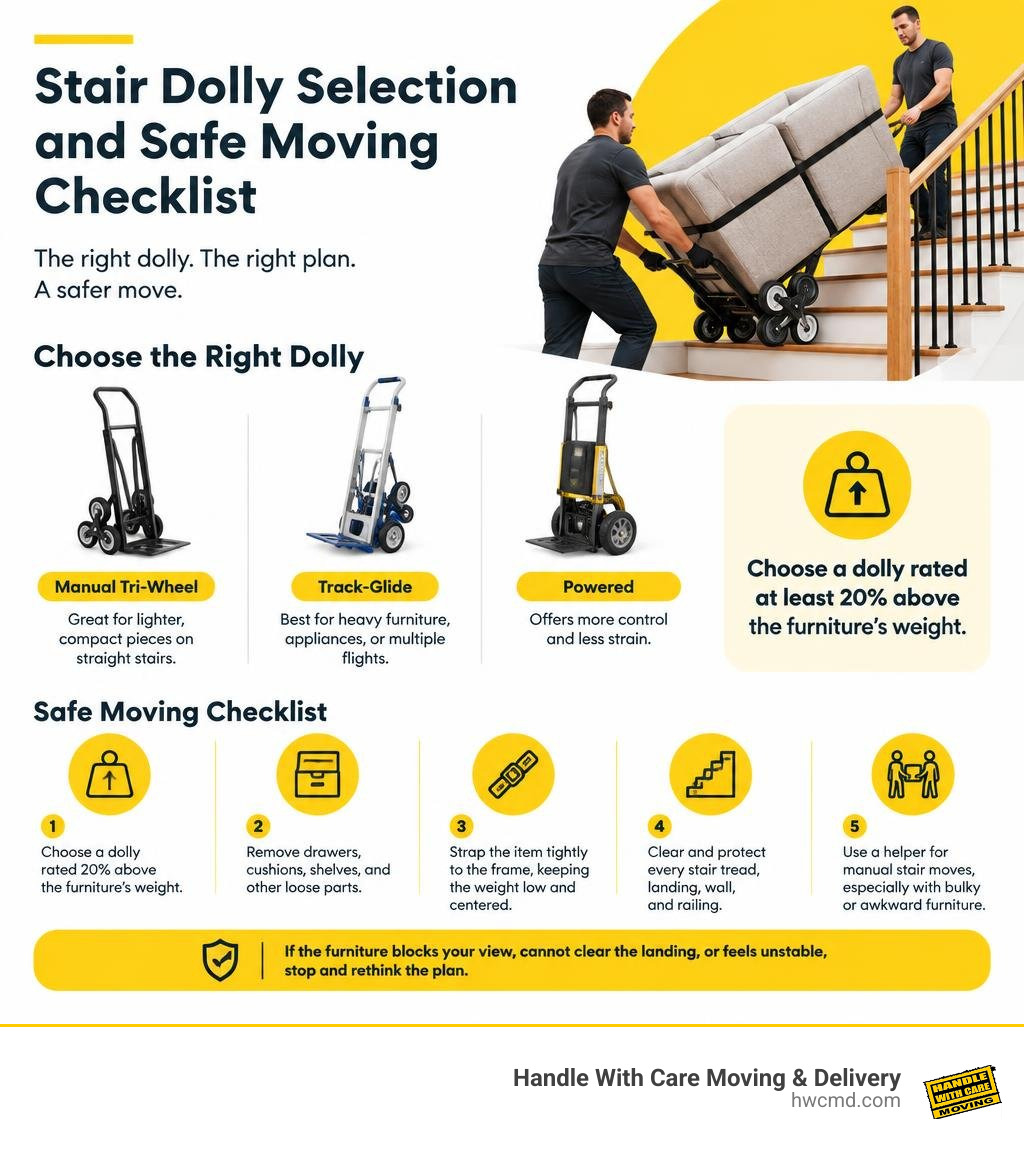
For a dolly for moving furniture up stairs, choose equipment made for steps, not a flat furniture cart. A manual tri-wheel hand truck can work for lighter, compact pieces on straight stairs. For heavy dressers, appliances, or multiple flights, a track-glide or powered stair-climbing dolly offers more control and less strain.
Before you move:
- Choose a dolly rated at least 20% above the furniture’s weight.
- Remove drawers, cushions, shelves, and other loose parts to reduce weight.
- Strap the item tightly to the frame, keeping its weight low and centered.
- Clear and protect every stair tread, landing, wall, and railing.
- Use a helper for manual stair moves, especially with bulky or awkward furniture.
The right tool does not make stairs risk-free. It simply lets you move one step at a time instead of trying to carry the full load. If the furniture blocks your view, cannot clear the landing, or feels unstable during a test on the first step, stop and rethink the plan.
I am Anthony Denha, President of Handle With Care Moving & Delivery, and I have helped lead teams that plan routes, wrap furniture, and use a dolly for moving furniture up stairs without treating safety as an afterthought. Here is how to select the right equipment and use it with control.
Quick dolly for moving furniture up stairs definitions:
Choosing the Best Dolly for Moving Furniture Up Stairs
Staircases turn routine lifting into an awkward balancing act. When moving heavy items upward, traditional flat four-wheel dollies become liabilities rather than helpers. Selecting equipment engineered specifically for stair navigation protects both your physical health and your property.
To choose the best unit, evaluate weight capacity, toe plate depth, center-of-gravity management, and frame maneuverability. A quality hand truck keeps cargo centered directly over the axle or track assembly, reducing the pulling force required on each incline. If your load overhangs the nose plate or shifts balance past your center point, the risk of tipping increases dramatically.
| Dolly Type | Weight Capacity Range | Best Use Case | Maneuverability | Physical Effort Level |
|---|---|---|---|---|
| Manual Tri-Wheel (6–10 Wheels) | 220 lbs – 660 lbs | Straight residential stairs, boxes, light dressers | High on stairs, moderate on tight landings | Moderate to High (requires manual pulling) |
| Track-Glide Hand Truck | 500 lbs – 800 lbs | Heavy appliances, solid wood furniture, multi-flight stairs | Moderate (needs clearance on landing) | Moderate (smooth descent/ascent on stair edges) |
| Motorized / Electric Crawler Dolly | 440 lbs – 1,000 lbs | Safes, large sectionals, commercial equipment, multi-story moves | High (power assist, zero-radius track turning) | Low (motor bears cargo weight) |
Types of Stair-Climbing Equipment
Stair-climbing dollies generally fall into three design categories:
- Tri-Star Rotating Wheel Dollies: These feature a triangular cluster of three wheels on each side. As you pull the cart up a riser, the bottom wheel catches the tread while the upper wheel rotates over the edge of the stair step. This rotational mechanism eliminates hard impacts against the stair nose, spreading the weight across multiple contact points. For general household goods, a heavy-duty 3-in-1 convertible cart offers versatile transport options for flat ground and multi-step transitions.
- Track-Glide Hand Trucks: Outfitted with continuous rubberized stair climbers or skid bars behind the main wheels, these units slide over stair nosings rather than bumping over them. They provide high lateral stability on straight staircases and prevent gouging on finished wood treads.
- Continuous Rubber Crawler Track Systems: Found primarily on powered units, these reinforced rubber tracks grip the lip of two to three stair treads simultaneously, creating a stable, slip-resistant foundation during movement.
Manual vs. Electric Dolly for Moving Furniture Up Stairs
When planning a move, deciding between manual and electric equipment depends on the frequency of use, piece dimensions, and available muscle power.
Manual hand trucks are cost-effective, lightweight, and easy to transport in the trunk of a passenger vehicle. For straightforward moves involving one flight of stairs and lighter items, utilizing manual gear alongside affordable DIY moving solutions provides a reliable approach.
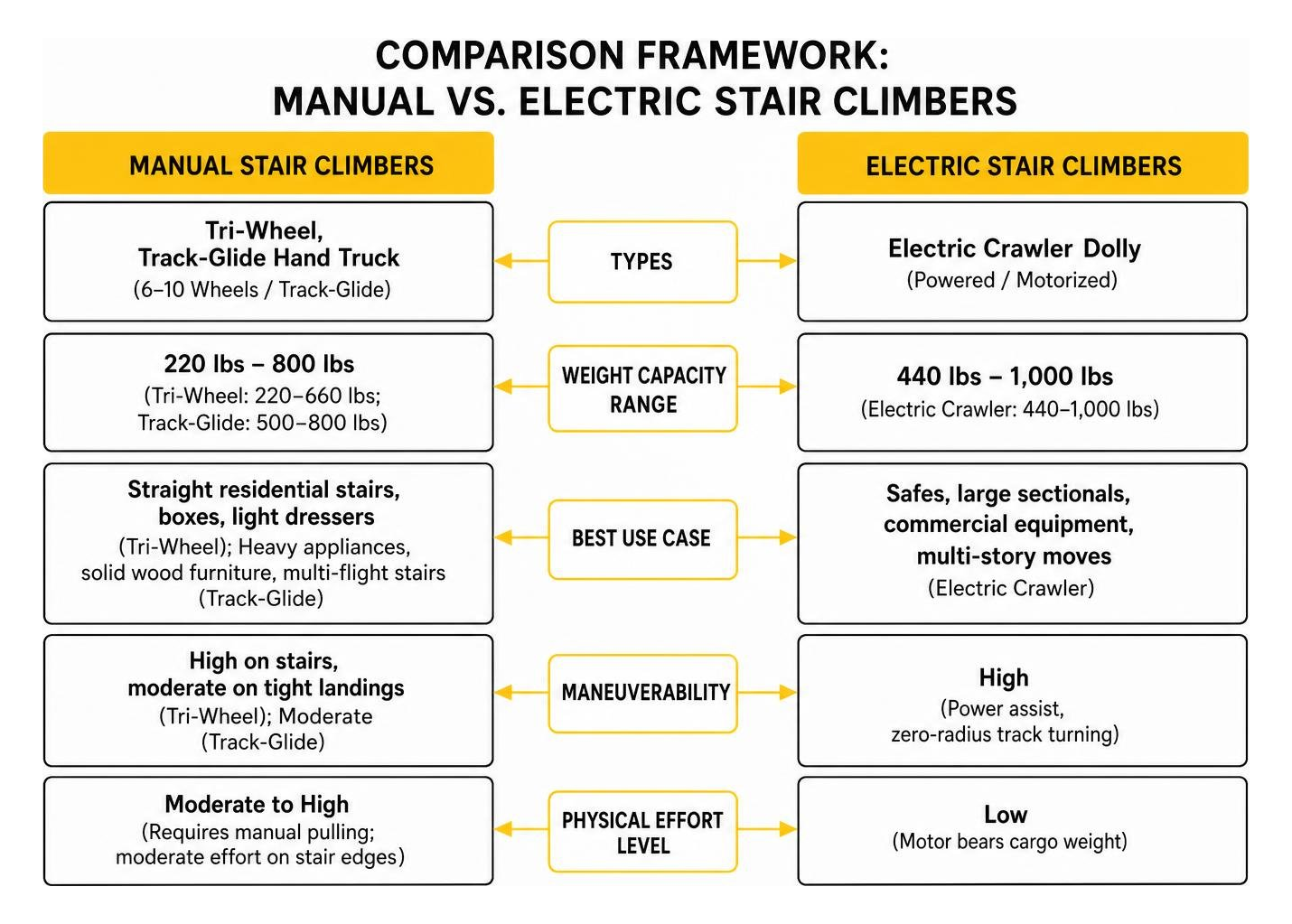
Conversely, electric stair climbers utilize a dedicated 120W to 1200W motor paired with a rechargeable lithium-ion battery system. Reviewing powered stair-climbing hand truck specifications shows how these units can bear upward of 440 to 500 lbs up continuous steps on a single charge. Powered systems eliminate the need to physically drag heavy loads up risers. High-end commercial electric crawlers even feature automatic load leveling and dual-motor 360-degree rotation, enabling single operators to navigate tight landings without physical strain.
Essential Safety Gear and Preparation Before You Move
Moving heavy items up stairs without adequate prep work is a common cause of home damage and back strains. Proper preparation ensures that furniture fits cleanly through narrow passageways without damaging architectural trim.
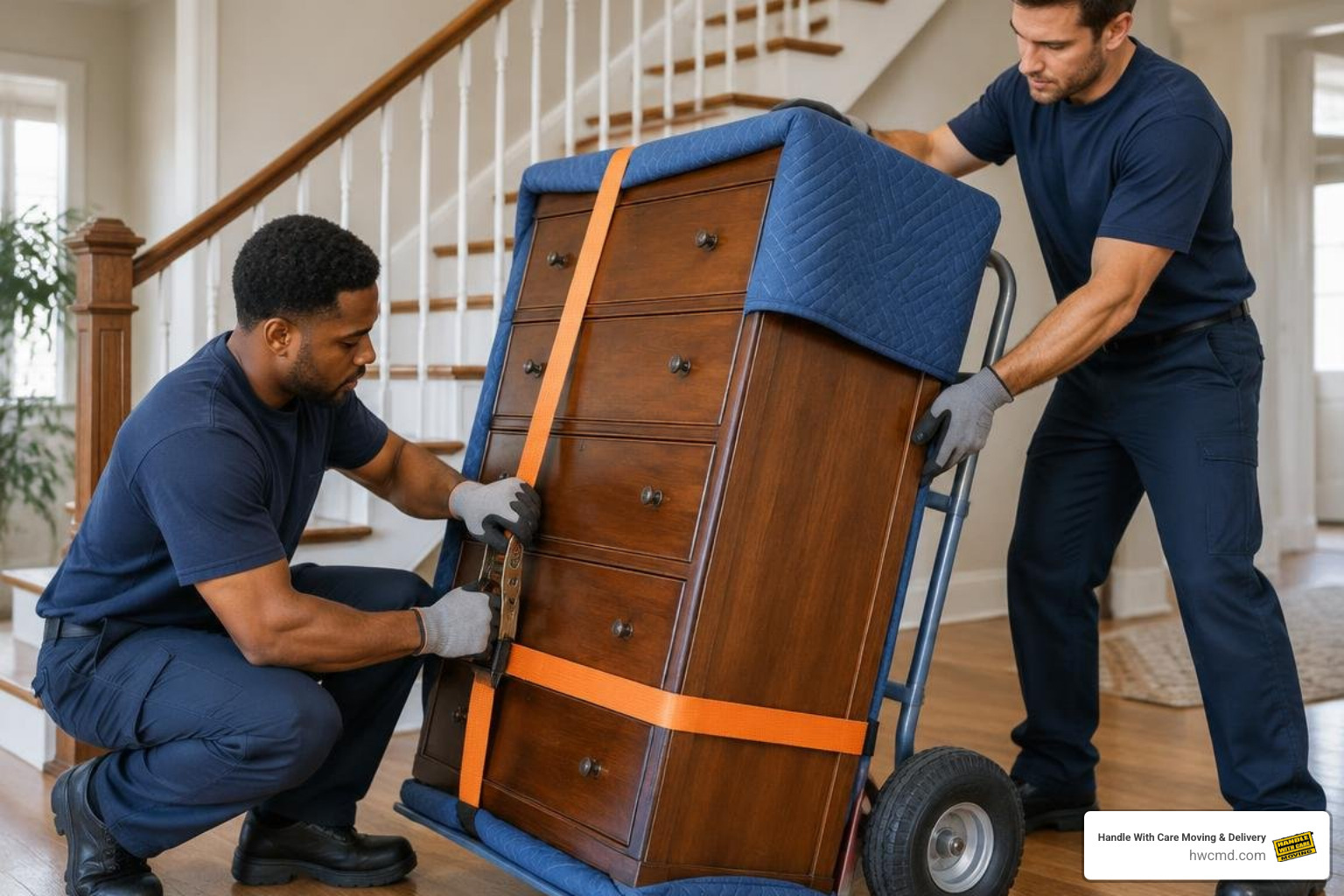
Before lifting anything, assemble the following moving gear:
- High-Grip Work Gloves: Padded palms protect your skin and improve traction on smooth metal dolly frames.
- Heavy-Duty Ratchet Straps: Never rely on light elastic bungees to secure 300-pound dressers; use 1.5-inch to 2-inch commercial ratchet straps.
- Moving Blankets and Stretch Wrap: Thick quilted pads prevent direct impact between furniture edges and stair railings. For more organizational strategies, review these 10 practical moving tips to increase efficiency.
- Closed-Toe Steel-Toe Footwear: Solid shoes provide foot protection and strong arch support while walking backward up inclines.
Staircase Inspection and Surface Protection
Every staircase has structural quirks. Take time to inspect and measure the dimensions before moving day:
- Measure the Tread and Rise: Verify stair depth and height. Risers greater than 7 inches create steeper angles that demand slower, more controlled dolly tilts.
- Protect Hardwood and Carpet: Install heavy-duty neoprene floor runners or non-slip drop cloths along the stair treads. Secure the runner at the top landing to prevent it from slipping beneath the dolly wheels.
- Shield Railings and Trim: Wrap stair banisters, newel posts, and tight corner drywall with moving pads secured by stretch wrap. Temporary corner edge guards prevent deep gouges if a wide load drifts during a pivot.
Furniture Disassembly and Weight Distribution
Never haul fully assembled, heavy furniture upstairs if components can be removed safely.
- Remove Detachable Parts: Strip out all drawers, interior shelves, modular legs, glass inserts, and sofa cushions. Removing drawers from a solid oak dresser can reduce total weight by up to 30% while preventing contents from sliding around.
- Secure Doors and Moving Elements: Lock cabinet doors with stretch film to prevent them from swinging open midway up a flight.
- Center the Weight: Place the heaviest, flattest side of the furniture against the upright rails of the hand truck. Keep the center of gravity low toward the toe plate so the piece does not feel top-heavy when tilted back. For complex furnishings, refer to professional packing guidance to wrap and prep delicate components properly.
Step-by-Step Moving Technique for Staircases
Ascending stairs with a loaded hand truck requires controlled, rhythmic movement rather than speed. Rushing leads to lost footing, damaged steps, and physical injuries.
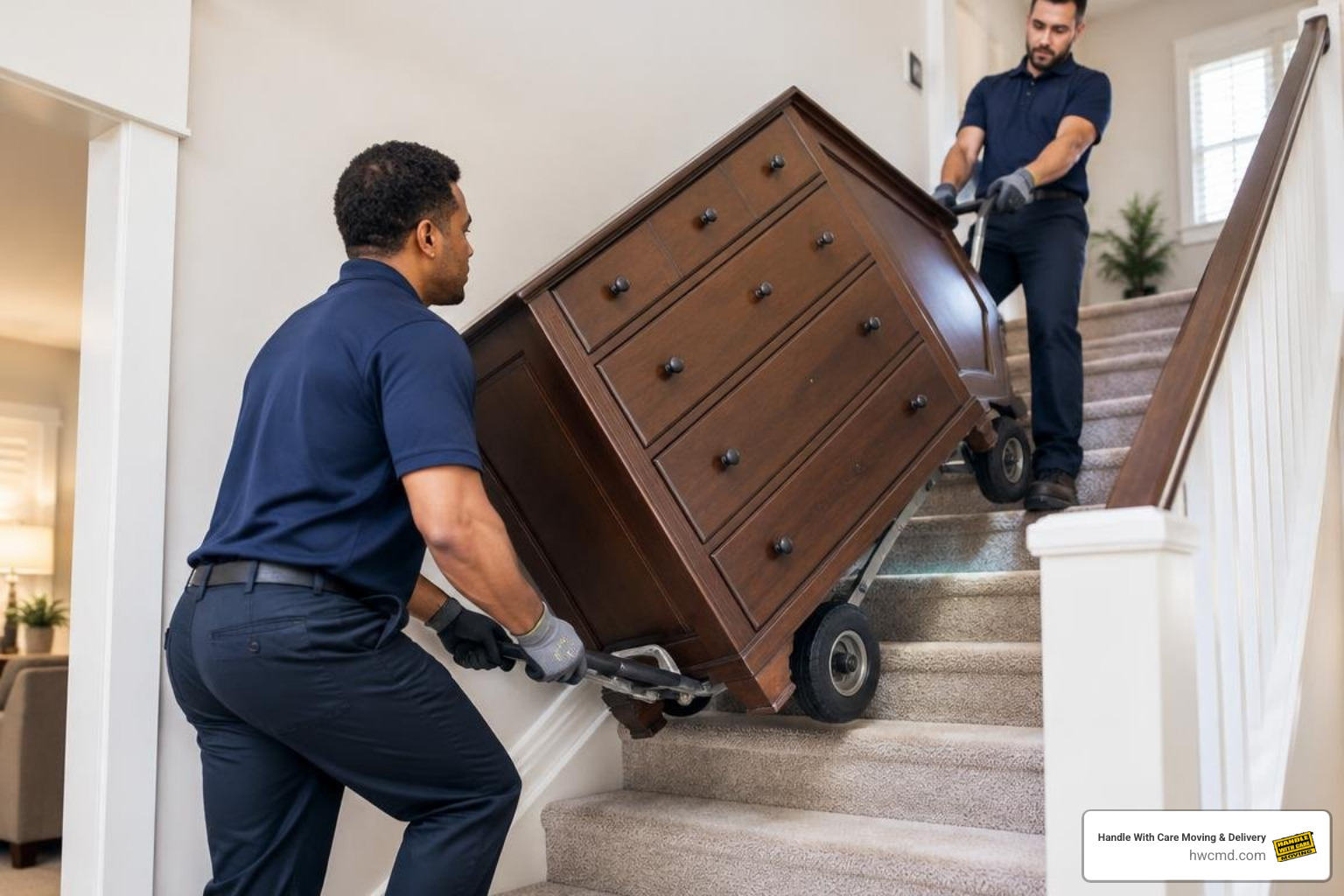
How to Safely Operate a Dolly for Moving Furniture Up Stairs
Follow these sequential operating steps when navigating steps:
- Center and Strap: Position the base plate fully beneath the item. Wrap your ratchet strap horizontally around both the cargo and the vertical spine of the dolly, cinching it down firmly.
- Tilt to Balance: Place one foot firmly on the axle bar and gently pull the upper handles toward your chest until the load finds its natural balance point on the rear wheels.
- Approach Backwards: Back up to the first stair step, aligning the dolly wheels square with the stair tread.
- Step, Pull, and Pause: Step up onto the first tread with both feet. Bend your knees, keep your spine straight, and pull the hand truck upward using your leg power until the wheels roll smoothly over the stair edge. For foundational safety practices, consult our essential moving information archive.
- Establish Controlled Rhythm: Pause on each step to steady the load before taking the next upward step. Never attempt to roll through multiple steps in a single continuous pull.

Spotter Roles and Two-Person Coordination
Unless you are operating a self-climbing motorized crawler track unit, stair moves require two individuals: a lead puller at the top and a spotter at the bottom.
- The Lead Operator (Top): Controls balance, direction, and upward leverage. This person sets the pace and initiates each step pull.
- The Spotter (Bottom): Positions themselves two steps below the load, placing both hands on the lower frame or sturdy non-cosmetic areas of the cargo. The spotter provides steady upward lifting pressure to assist the puller and acts as an immediate safety brake if the dolly starts to roll back.
- Clear Communication: Establish simple verbal commands (“Ready, Lift, Step, Set”) before starting the ascent. If either person loses their grip or footing, call “Stop” immediately to hold the dolly stable on the current tread.
If an oversized piece proves too cumbersome for your team, consider hiring affordable furniture moving help to prevent personal injury.
Frequently Asked Questions About Moving Furniture on Stairs
Can one person move heavy furniture up stairs with a dolly?
Moving standard bulky furniture upstairs with a manual dolly should not be attempted alone. While lightweight boxes or mini-fridges under 75 lbs can be managed solo on straight steps, heavy items like solid wood dressers or sectionals require a bottom spotter to stabilize the center of gravity and prevent runaway slips.
The only exception is when using an electric stair climber equipped with continuous rubber crawler tracks and automatic braking systems. These motorized dollies hold themselves securely to stair nosings, allowing a single trained operator to guide heavy loads upward via push-button controls.
What weight capacity should a stair dolly have?
Your moving equipment should carry a weight capacity rating at least 20% higher than your heaviest item. For instance, if you are transporting a 400-lb armoire, use a dolly rated for at least 480 to 500 lbs.
Exceeding maximum load limits can warp aluminum axles, buckle toe plates, or strip wheel bearings midway up a flight. For general residential use, hand trucks rated between 600 and 800 lbs offer a reliable safety margin for major household appliances and heavy bedroom sets.
How do you prevent stair damage when moving heavy items?
Stair damage occurs when hard metal components or gritty wheels drag across tread surfaces. To protect steps:
- Ensure dolly tires are made of non-marking rubber or polyurethane, and clean out any embedded grit before entering the home.
- Cover the stair flight with neoprene runners or thick moving blankets taped securely to avoid bunching.
- Never drop the weight onto a step riser; roll the wheels over the nose in a fluid, steady motion.
- If renting or moving into a newly built home, review policies regarding understanding property liability during moves so you know how structural or cosmetic issues are handled.
Conclusion
Navigating stairs with heavy furnishings does not have to result in strained muscles or scratched baseboards. By selecting the right tri-wheel, track-glide, or motorized stair hand truck, securing loads with heavy-duty ratchet tie-downs, and working with a spotter, you can transport bulky items safely to upper floors.
If you are facing an upcoming move in Ann Arbor, Michigan, our team at Handle With Care Moving & Delivery is here to help. We provide expert handling with transparent, 15-minute-increment billing, no minimum labor hours, and complimentary pad and shrink wrap on every move. We also proudly offer discounts for local students, seniors, and veterans. Explore our complete professional moving services to request an estimate and make your next multi-story move smooth and stress-free.