
Mastering the Heavy Lift: The Best Ways to Move Large Furniture Yourself

Easy Ways to Move Heavy Furniture Without Hurting Yourself
The easiest way to move heavy furniture is to reduce its weight, protect the route, and slide or roll it instead of carrying it. Empty drawers, remove detachable legs, measure doorways, and clear the path first. Then use the right tool for the job:
- Use felt sliders on hardwood or tile and hard plastic sliders on carpet.
- Use a four-wheel furniture dolly for long, flat moves.
- Use a lifter and roller set to raise one corner at a time without deadlifting.
- Save stairs, bulky pieces, and items over roughly 300 pounds for a helper or professional movers.
Most damage and injuries happen when people rush, twist while lifting, or try to muscle a piece through a space it will not fit. A few minutes spent measuring, wrapping sharp edges, and using leverage can save your back, walls, and flooring.
I’m Anthony Denha, president of Handle With Care Moving & Delivery. After overseeing careful residential and office moves, I have seen how the right tools, route planning, and simple techniques create safer, easy ways to move heavy furniture – and when a DIY move should stop.
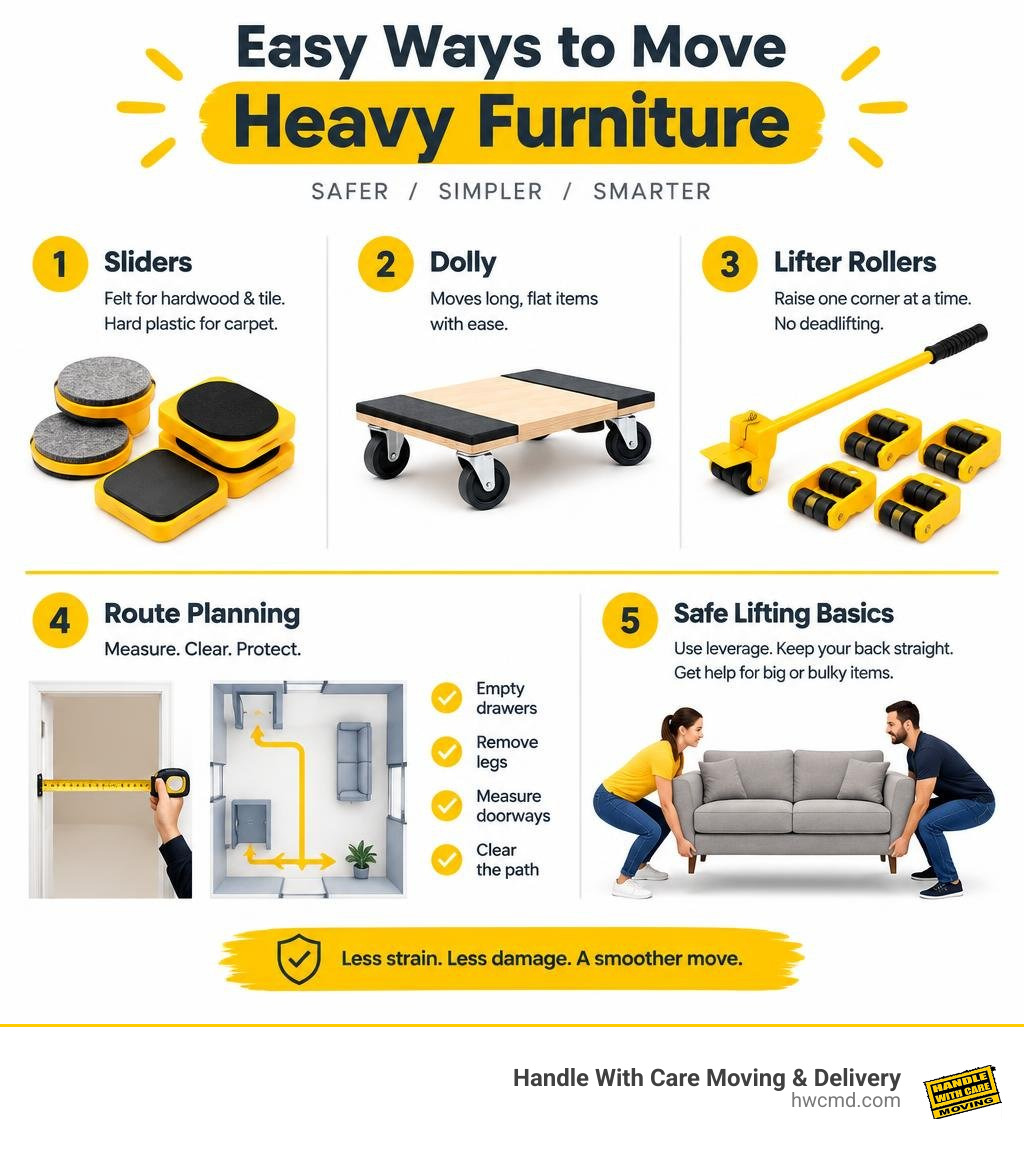
Handy easy ways to move heavy furniture terms:
Pre-Move Preparation: Lighten, Measure, and Protect
Moving bulky household items safely begins long before anything leaves the floor. Brute force rarely solves a relocation challenge; smart planning, geometry, and weight reduction do. Reviewing a few moving tips to make your move efficient ahead of time helps keep the entire process organized and prevents unnecessary property damage.
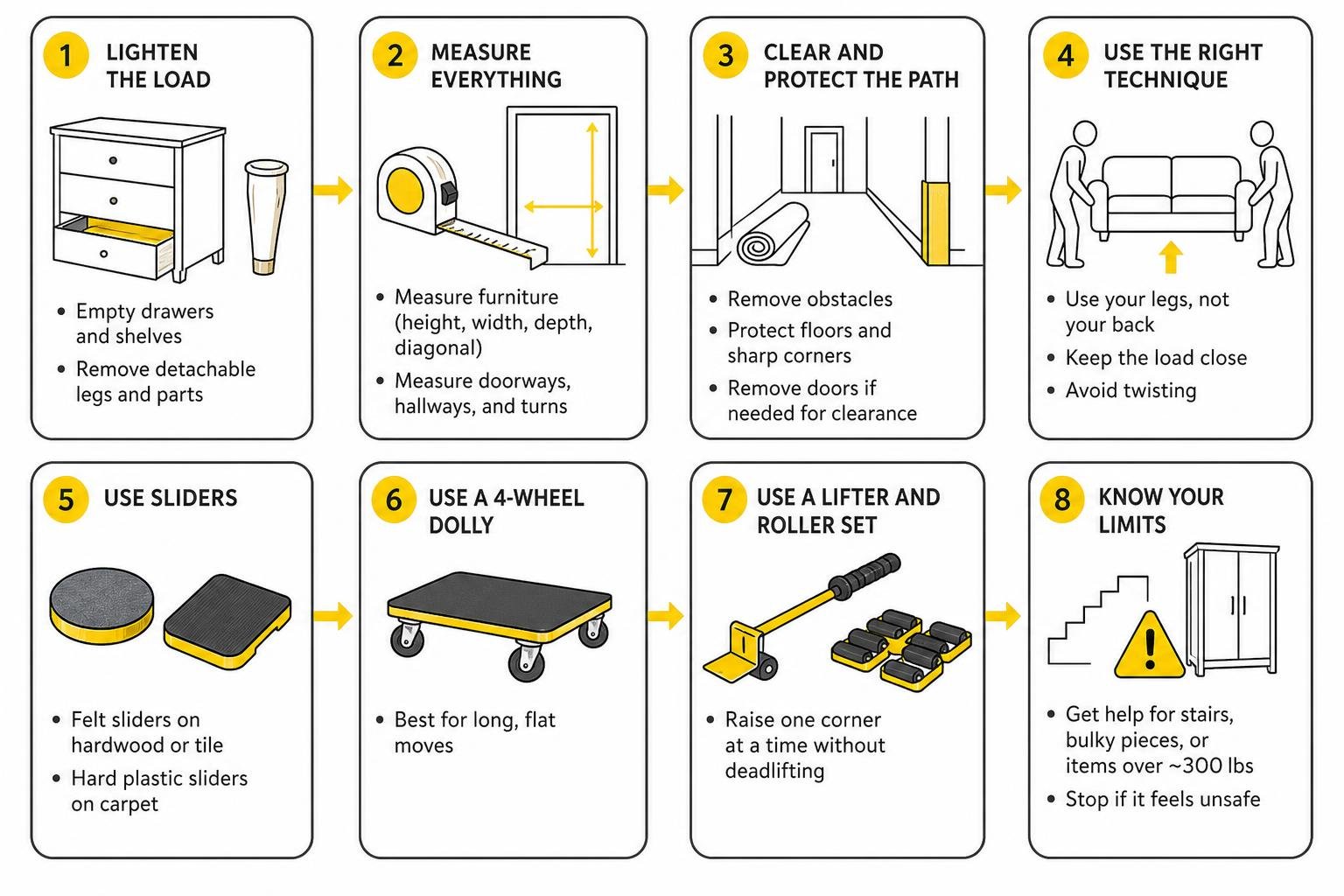
Measure Doorways and Map Clearance Routes
Never guess whether an armoire or sectional sofa will clear a hallway corner. Grab a tape measure and record the height, width, depth, and diagonal dimensions of every large piece. Then measure the narrowest points along your exit route: interior doorframes, stairwell turns, and exterior entryways.
When navigating tight frames, standard interior doors often rob you of 1.5 to 2 inches of clearance. Popping the hinge pins out to temporarily remove a door can make the difference between a clean passage and a gouged jamb. For comprehensive route sizing strategies, explore expert advice on how to move heavy furniture without hiring movers.
Disassemble and Lighten the Load
Solid wood dressers, executive desks, and sleeper sofas carry immense dead weight. Stripping a piece down makes it manageable for one or two people:
- Remove all contents: Empty books, clothing, and loose goods from drawers and cabinets.
- Pull out modular parts: Take out drawers, remove glass shelves, and detach vanity mirrors. Removing drawers alone can reduce a dresser’s total weight by 25% or more.
- Unscrew detachable legs: Low-profile legs frequently snag on carpets and doorframes during turns.
- Secure loose doors: Use stretch wrap rather than sticky packing tape to keep cabinet doors shut without ruining delicate finishes.
When preparing pieces for a truck or long-term unit, taking time to properly protect your furniture in storage keeps wood surfaces pristine and scratch-free. Place all screws, bolts, and mounting brackets into labeled zip-top bags and tape them securely inside an empty drawer cavity.
Essential Gear and Easy Ways to Move Heavy Furniture on Your Own
Having the right mechanical leverage transforms a dreaded heavy-lifting chore into a smooth, low-effort roll. Instead of straining muscles, let physics do the hard work.
Furniture Sliders vs. Dollies vs. Lifter Jacks
Different tools excel under different circumstances. Matching your equipment to the surface and weight class ensures safe handling:
| Equipment | Typical Load Capacity | Average Cost | Best Use Case |
|---|---|---|---|
| Furniture Sliders | 600–1,000 lbs (distributed) | $10 – $20 | Gliding sofas and dressers across flat carpet or hardwood |
| Furniture Lifter Jack | 300–660 lbs | $15 – $30 | Solo lifting of heavy furniture corners to insert pads/rollers |
| 4-Wheel Flat Dolly | 1,000–3,400+ lbs | $25 – $50 | Long horizontal hauls across hallways, garages, and driveways |
| 2-Wheel Hand Truck | 500–800 lbs | $40 – $90 | Tall vertical items, appliances, and stacked boxes |
Lever jacks use mechanical advantage to let a single person raise a 300-pound wardrobe corner with one hand. Once elevated, you can easily slide 360-degree swivel rollers or low-friction pads beneath each leg.
Budget-Friendly Easy Ways to Move Heavy Furniture Under $25
You do not need an industrial budget to handle bulky items safely. Several highly rated consumer options provide great capability under $25:
- Reusable Furniture Sliders: Multi-packs like Super Sliders or Slipstick GorillaSliders cost between $11 and $15 and feature durable bases that glide across carpets without catching.
- Hardwood Felt Gliders: Packs of heavy-duty felt pads (such as X-Protector 8-packs for around $10 to $14) let you shift solid wood tables over oak or maple flooring without scuffing.
- Compact Lever Lifters: Basic metal pry levers paired with four mini caster pads retail for $18 to $24, allowing you to lift and roll end tables, nightstands, and credenzas solo.
Single-Person vs. Two-Person Moving Straps
Moving straps fundamentally alter body mechanics by transferring weight away from your lower back, hands, and forearms directly onto your legs, shoulders, and core.
- Two-Person Harnesses (Shoulder Dolly / Forearm Forklift): Systems like the Shoulder Dolly or Forearm Forklift handle up to 800 pounds. They distribute weight evenly between two lifters, leaving your hands free to steady and balance the load through doorways.
- Solo Lifting Straps: Single-person strap systems loop beneath an item with handles positioned at hip level. While helpful for lifting boxes or small crates off the floor without bending your back, solo straps should never be used on stairs or for top-heavy pieces over 150 pounds due to balance risks.
Step-by-Step Moving Techniques for Every Floor Type
Floor damage is one of the most common—and expensive—consequences of DIY moving. A tiny pebble trapped beneath a dragged couch leg can leave a deep gouge across an entire room.
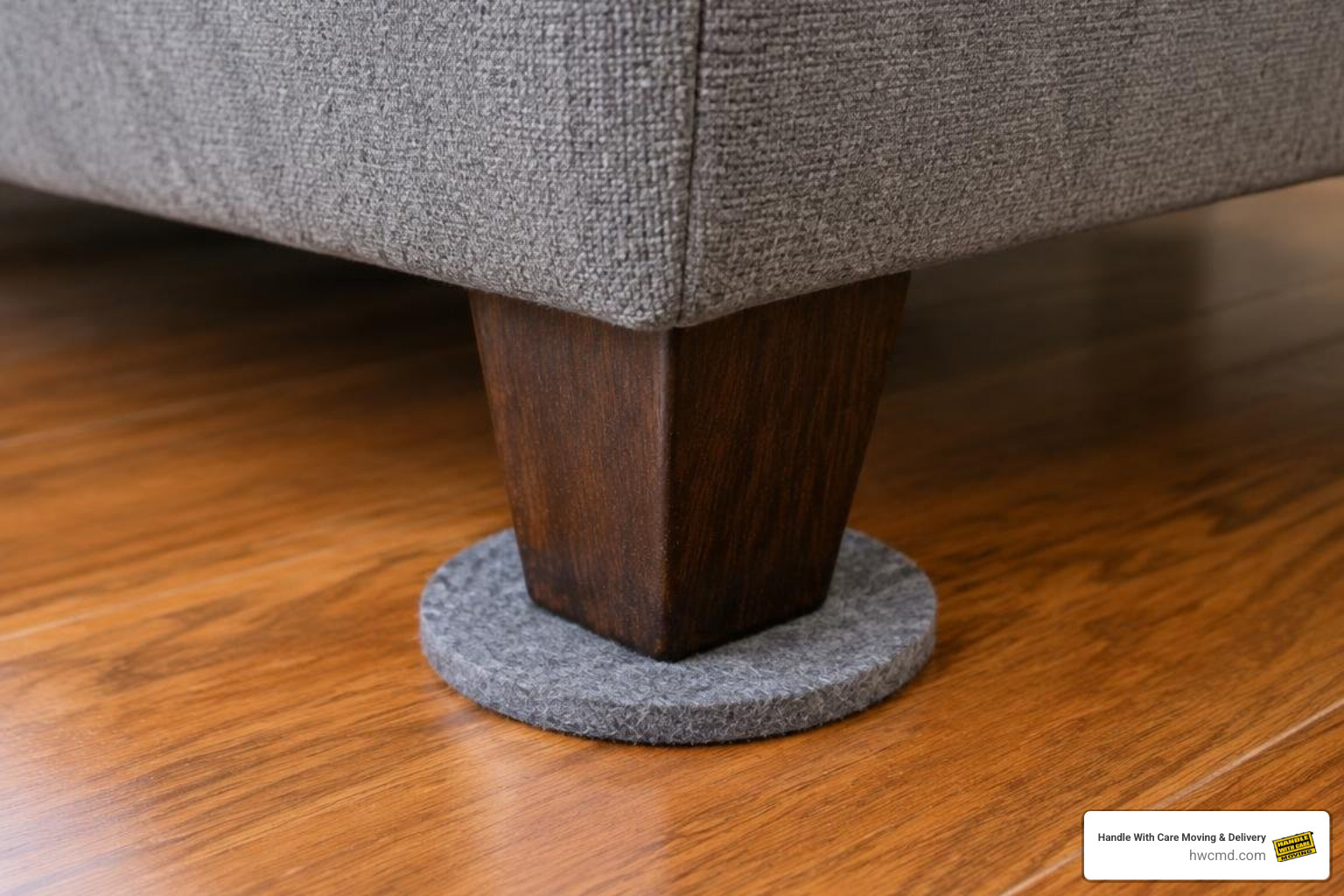
Protecting Hardwood, Tile, and Carpeted Floors
Always inspect and prepare the flooring surface before moving large items:
- Hardwood and Laminate: Always sweep or vacuum the pathway first. Use sliders with a thick, dense felt backing. Never use bare plastic discs on hardwood, as grit can embed in the plastic and scratch polyurethane finishes.
- Carpet and Area Rugs: Smooth, hard plastic discs glide effortlessly across plush fibers. If a heavy dolly’s small wheels sink deep into carpet padding, lay down sheets of 1/4-inch hardboard or smooth plywood runners to create a firm rolling track.
- Tile and Natural Stone: Tile grout lines can catch small dolly wheels. Use wide, soft-rubber caster wheels or large padded felt blankets beneath the piece to absorb vibrations and prevent chipping.
DIY Household Hacks When You Lack Specialty Tools
If you are rearranging a room on short notice and lack commercial moving gear, standard household items can serve as effective temporary substitutes:
- Glossy Magazines and Plastic Lids: Placing heavy, glossy magazines or smooth plastic container lids beneath furniture legs creates a smooth glide over thick carpet.
- Heavy Bath Towels and Moving Blankets: Fold a thick cotton bath towel beneath each side of a dresser on hardwood floors to pull the piece smoothly across the room.
- Cardboard Sheets: Flattened shipping boxes make great sliding pads and surface protectors across tile and laminate walkways.
Navigating Stairs, Doorways, and Awkward Angles
Moving heavy items across flat ground is relatively straightforward, but staircases, tight landings, and narrow doorways require precise technique and clear communication.
Easy Ways to Move Heavy Furniture Across Stairs and Tight Corners
Navigating stairs is a high-control task. Gravity works against you, and weight distributes unevenly on an incline. For a structured breakdown of staircase transit, consult How to Move Heavy Furniture in 8 Steps (Stairs Included).
- The High-Low Technique: When two people carry furniture up or down stairs, the person on the downhill side carries the lower end, while the person uphill carries the upper end. The lower mover absorbs the majority of the weight and sets the pace, while the upper mover stabilizes the angle.
- The “Hook” or L-Shape Maneuver: For large armchairs and loveseats that seem too wide for standard doors, turn the chair on its side so it forms an “L” shape. Hook the backrest through the doorframe first, then rotate the seat cushions through the opening.
- Vertical Corner Pivoting: On narrow staircase landings, stand tall pieces like bookshelves or dressers straight up on end (cushioned on a thick blanket). Slowly pivot the piece around the corner on its base before tilting it back for the next flight.
Safe Lifting Ergonomics and Injury Prevention
Protecting your body requires disciplined lifting mechanics on every lift:
- Bend at the knees and hips: Never bend over at the waist with locked knees. Drop into a deep squat and let your quadriceps and glutes drive the upward lift.
- Keep the weight against your core: Holding a 75-pound weight twelve inches away from your chest places exponential stress on your lumbar spine. Keep items tight against your center of gravity.
- Never twist while under load: If you need to change direction, pivot with your feet rather than twisting your torso.
- Wear high-grip gloves: Rubber-dipped work gloves prevent slippage, protect fingers from pinch points, and improve grip security on smooth, polished furniture.
Frequently Asked Questions About Moving Large Furniture
What is the maximum weight capacity needed for home furniture movers?
For standard residential items, a toolset rated between 600 and 1,000 pounds provides plenty of safety margin. Most three-seat sofas weigh 150 to 250 pounds, solid wood dressers weigh roughly 175 pounds, and heavy appliances run between 200 and 350 pounds. Choosing tools rated well above your furniture’s actual weight prevents caster failure and structural bending during transit.
Can one person safely move a heavy couch or dresser alone?
Yes, provided the move takes place on a single flat level using proper mechanical leverage. By using a lever lifter to position furniture sliders or 360-degree roller pads under each corner, a single person can glide a heavy piece across a room. However, solo movers should never attempt to move items over 100 pounds on stairs or lift top-heavy furniture overhead. If a project exceeds your solo capabilities, learn how to find affordable furniture moving help to get the necessary hands on deck safely.
When should you stop DIY moving and call professional movers?
You should transition from a DIY move to professional movers when:
- An individual item exceeds 300 pounds (e.g., upright pianos, large gun safes, solid marble tables).
- The route involves narrow, spiral, or steep staircases with tight landings.
- The piece is a delicate, irreplaceable antique prone to structural damage if tilted.
- You or your helpers experience physical fatigue, back strain, or lack proper lifting gear.
Conclusion
Successfully moving large furniture comes down to technique, preparation, and using the right mechanical tools rather than relying on raw physical strength. By taking a few extra minutes to measure doorways, disassemble modular parts, and position low-friction sliders or dollies, you can protect both your home and your spine.
When a project involves complex staircases, oversized specialty items, or long hauls, partnering with experienced professionals is the safest choice. At Handle With Care Moving & Delivery, we provide transparent, 15-minute-increment billing, free protective pad and shrink wrap, and specialized discounts for students, seniors, and veterans across Ann Arbor, Michigan. Explore our dependable professional moving services to ensure your large furniture arrives safely at its destination without the physical stress.