
How to Pack Dishes Safely, Even When You Don’t Feel Like It

Essential Supplies and Preparation for Packing Dishes
To pack dishes safely, line a double-wall dish barrel with crumpled unprinted newsprint, wrap each piece individually, load plates vertically on edge rather than flat, and fill every remaining void with paper so nothing shifts. This approach protects fragile kitchenware from the bumps and vibrations of transit. Before you begin wrapping your first plate, review a comprehensive guide to suitable packing materials.
Setting up a dedicated packing station makes the entire process faster and far less stressful. Clear off a large kitchen island or dining table so you have ample room to lay out sheets of paper, assemble cartons, and create organized stacks of wrapped items.
| Packing Supply | Standard Dimensions / Spec | Best Used For |
|---|---|---|
| Dish-Pack Barrel | 18″ x 18″ x 28″ (5.2 cu. ft., double-wall) | Plates, platters, mixing bowls, and heavy dinnerware |
| Unprinted Newsprint | 24″ x 36″ sheets (25 lb. roll) | Primary wrapping, nesting layers, and crumple fill |
| Cell Divider Kit | Configurable inserts for dish barrels | Stemware, fragile tumblers, and specialty drinkware |
| Heavy-Duty Packing Tape | 2-inch wide acrylic or hot-melt tape | Reinforcing box bottoms with standard “H-tape” seams |
| Bubble Cushioning | 12″ wide, small-to-medium bubble | Extra protection for crystal, fine china, and teapot spouts |
Must-Have Materials: Dish Barrels, Paper, and Cell Dividers
Never pack heavy ceramic or porcelain items into standard, single-wall grocery or book cartons. You need heavy-duty dish barrels constructed from double-walled corrugated cardboard. These boxes offer superior crush resistance against heavy stacking inside the moving truck, ensuring you never crush a delivery again with superior carton boxes for packing.
Plain, unprinted newsprint is the gold standard for fragile kitchenware. While it might be tempting to recycle old newspapers, standard print ink easily transfers onto porous porcelain, matte glazes, and fine bone china. Removing those ink stains often requires abrasive scrubbing that can permanently ruin delicate patterns. A standard 25-pound bundle of clean packing paper provides enough material to safely pack several dish-pack boxes.
For delicate glassware, adjustable cardboard partition kits divide the box into isolated chambers. These cell dividers eliminate direct contact between glass items, absorbing shock as the moving truck travels.
Calculating Box Needs and Safe Weight Limits
To avoid mid-packing supply runs, estimate your box requirements based on your cooking and dining habits:
- Minimalist Kitchen (1–2 people): 4 to 6 total boxes (2 dish barrels)
- Average Family Kitchen: 8 to 10 total boxes (3 to 5 dish barrels)
- Well-Stocked Kitchen: 12 to 14 total boxes (5 to 7 dish barrels)
- Avid Cook or Frequent Host: 15 to 18+ total boxes (8+ dish barrels)
Each loaded 5.2-cubic-foot dish barrel should stay within a safe weight threshold of 55 to 65 pounds. Exceeding this limit strains the taped bottom seams, increases the risk of dropped boxes, and places excessive downward pressure on the items inside. For additional guidance on protecting fragile kitchenware, the American Moving & Storage Association offers consumer resources on packing and moving best practices.
Step-by-Step Techniques for Every Fragile Item
Before placing any fragile item into a box, you must construct a shock-absorbing foundation. Begin by sealing the bottom of your double-wall box with an “H” pattern of heavy-duty packing tape across the center seam and side edges. Next, crumple individual sheets of unprinted newsprint into loose balls and build a dense, three-inch foundation across the bottom.
Load items systematically from heaviest to lightest. The bottom layer should hold dense dinner plates and heavy serving platters, the middle tier should house bowls and ceramic mugs, and the top tier should contain delicate glassware.
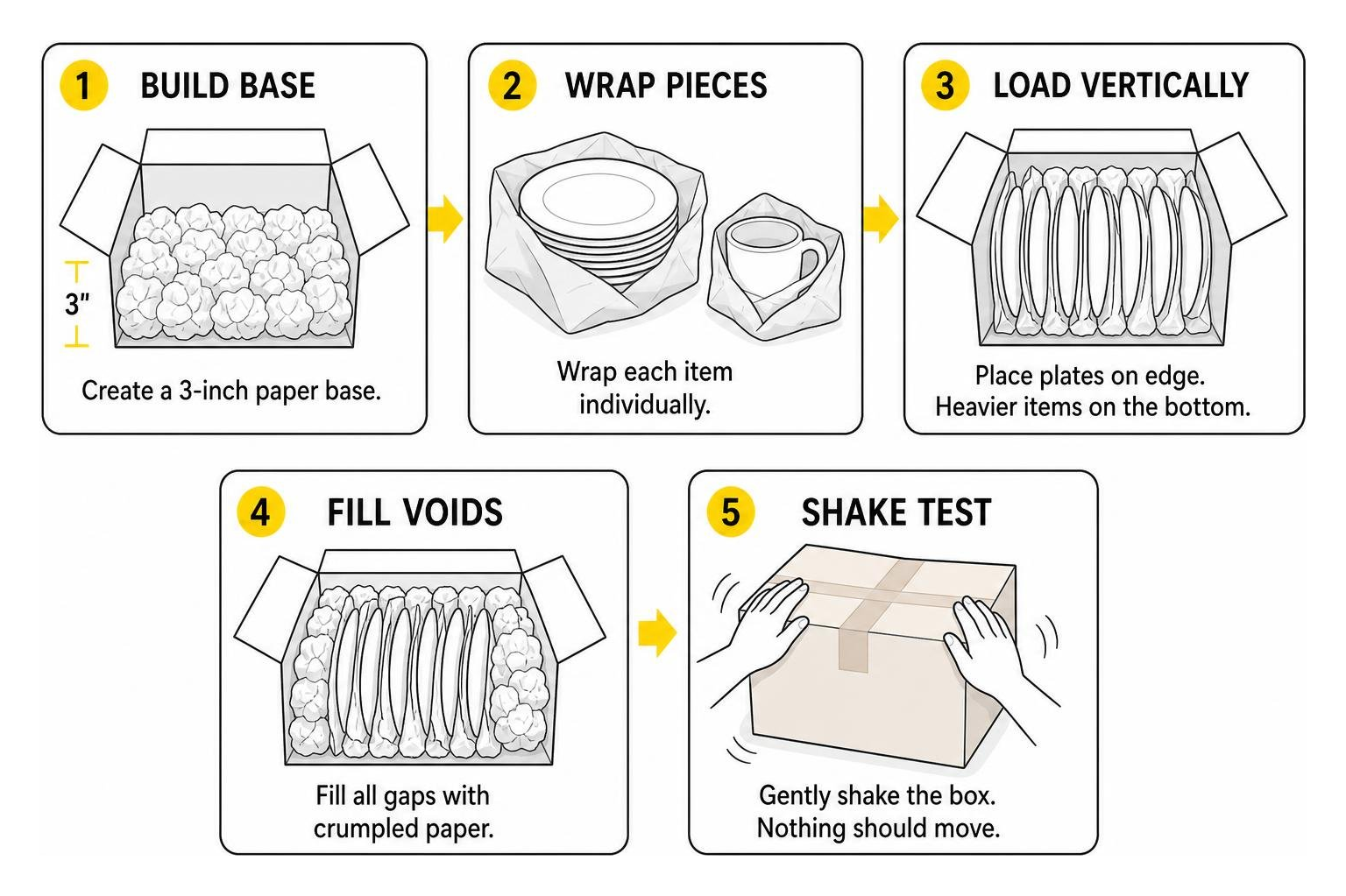
Before closing the box, perform the “shake test”: place your hands on the top layer and gently wiggle the carton. If you feel or hear anything shifting, fill the remaining voids with crumpled paper until everything sits completely immobile.
Step-by-Step Instructions for Packing Dishes and Plates on Edge
The most common DIY packing mistake is stacking dinner plates flat on top of one another. Plates are built to withstand vertical pressure applied directly across their rims, but flat impacts easily snap plate centers. Master the packing paper bundling technique to create sturdy, edge-standing plate rows:
- Center the First Plate: Lay your stack of packing paper flat on your table. Place a large plate in the center of the top sheet.
- Fold and Tuck: Pull one corner of the paper over the plate so it covers the face completely.
- Stack and Bundle: Place a second plate of identical size directly over the first, pull the next corner of paper across it, and repeat until you have a bundle of two to three plates.
- Wrap the Exterior: Gather the remaining paper edges around the bundle, fold them tightly, and secure the edges with a short piece of tape.
- Pack Vertically: Place the bundle into the box vertically on its edge, standing upright like vinyl records in a storage crate.
- Pad the Perimeters: Pack rows snugly against each other and fill all perimeter gaps between the dishes and the box walls with tightly crumpled paper.
Cushioning Bowls, Mugs, and Odd-Shaped Cookware
Bowls, mugs, and specialty cookware require targeted wrapping so delicate handles, rims, and spouts don’t crack under transit pressure, as detailed in our guide on how to pack dishes for a move.
- Cereal and Soup Bowls: Place a sheet of newsprint inside a bowl’s cavity, nest a second bowl inside, and fold the outer sheets around the pair. Pack these nested bundles upright on edge or placed rim-down atop a flat cardboard separator pad.
- Coffee Mugs and Teacups: Stuff crumpled paper into each mug cavity to support the circular structure. Wrap extra paper around the handle to form a thick, protective bumper before rolling the entire mug in a full sheet of newsprint. Place mugs upright on their bases.
- Serving Platters and Mixing Bowls: Wrap large ceramic pieces individually with double layers of packing paper. Heavy stoneware mixing bowls should sit near the bottom tier of the box, cushioned by extra crumpled paper.
- Teapots and Pitchers: Roll a sheet of newsprint into a tight cylinder and wrap it along curved spouts or handles. Wrap the removable lid separately and invert it upside down inside the opening before wrapping the whole piece together.
Securing Delicate Wine Glasses and Stemware
Stemware and thin glassware require dedicated space and gentle handling. Never allow thin crystal glasses to touch one another inside a carton.
- Fill the Hollow: Lightly crumple a half-sheet of newsprint and tuck it inside the bowl of the glass to prevent internal collapse.
- Protect the Stem: Roll a piece of packing paper into a supportive wrap around the thin stem until its thickness matches the base and bowl.
- Roll and Tuck: Place the glass horizontally at the corner of a clean sheet of newsprint. Roll the glass diagonally, tucking the left and right paper ends inward as you roll.
- Insert into Dividers: Place the wrapped glass base-down and upright inside an individual cell pack compartment. For extra peace of mind, add a final layer of bubble wrap over delicate crystal before placing it inside the box.
Modern Containers, DIY Alternatives, and Material Choices
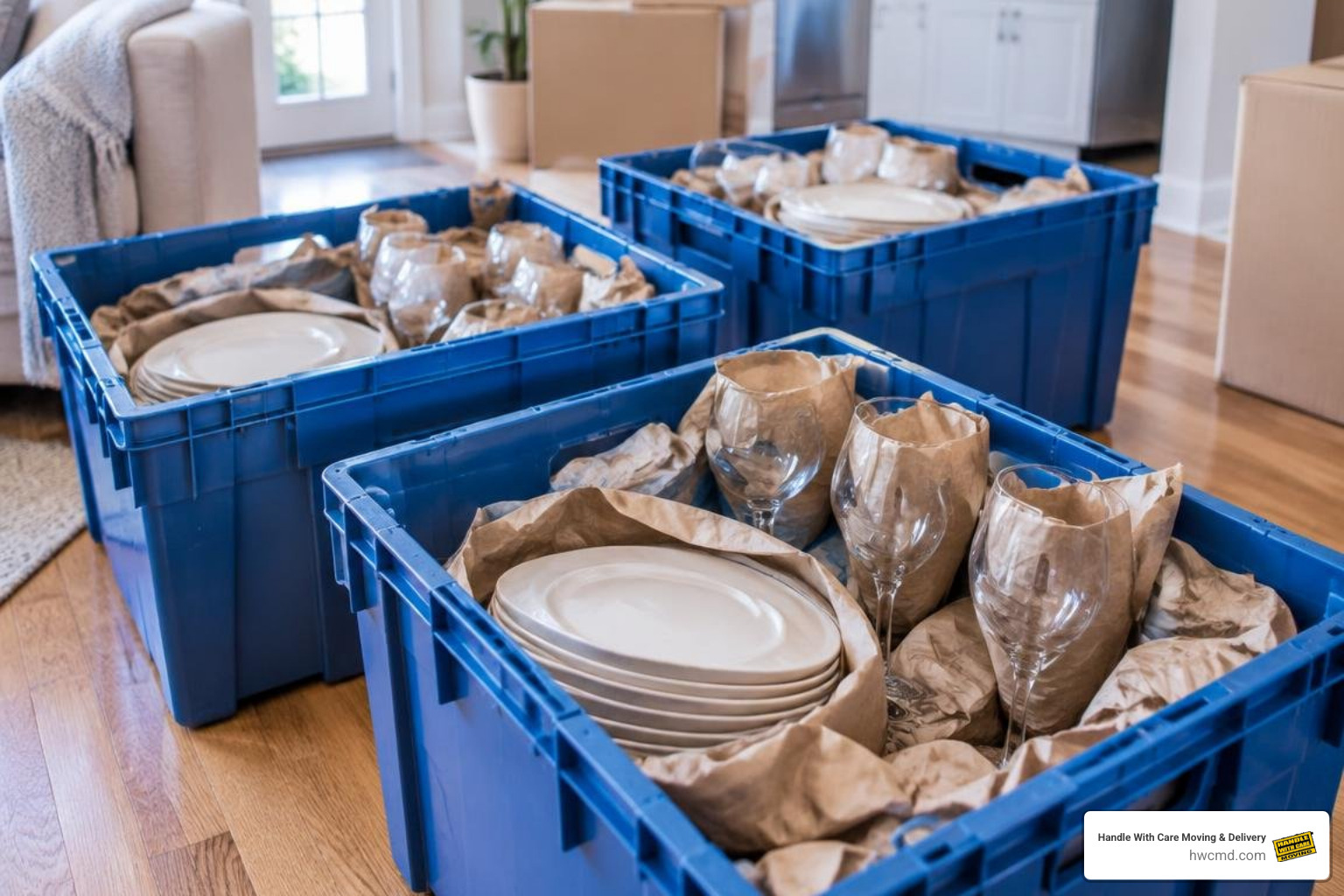
While corrugated dish barrels remain the industry standard, modern moving methods include durable, reusable plastic crates. Understanding how alternative materials compare ensures your breakables remain safe across any relocation format.
Pro Strategies for Packing Dishes in Reusable Bins
Reusable plastic bins offer excellent side-impact protection and eliminate cardboard waste. However, because plastic bins have rigid, non-yielding walls, you must implement specialized packing precautions. For practical container tips, explore the best easy packing ideas to save space and time.
- Maintain a 45-Pound Limit: While a plastic bin can physically hold more weight than cardboard, keep the total weight under 45 pounds so the handles do not buckle and the bin remains safe to carry.
- Check Lid Clearance: Never force a bin lid closed over tall wine glasses or large standing platters. If an item extends above the rim line, move it to a deeper specialty carton.
- Line the Interior: Smooth plastic offers zero impact absorption. Line the bottom and all four interior walls with dense, crumpled packing paper or protective foam liners before loading your vertical plate rows.
Towels, Linens, and Bubble Wrap vs. Unprinted Newsprint
Many homeowners attempt to cut costs by using household linens or bubble wrap instead of professional packing paper. While these materials have their place, they perform differently under pressure:
- Bath Towels and Dish Linens: Excellent for padding the bottom 3 inches of a box or filling empty space at the very top. However, towels should never replace individual paper wrapping. Fabric easily compresses and slips during transport, allowing glazed ceramics to rub together and chip.
- Bubble Cushioning: Great for high-value crystal, delicate porcelain figurines, and fragile teapot spouts. However, using bubble wrap as the primary fill for an entire kitchen is expensive and bulky. Furthermore, trapped air pockets can pop under heavy point loads, leaving open gaps inside the box.
- Unprinted Newsprint: The most reliable, cost-effective choice. It compresses uniformly under weight, absorbs transit vibrations evenly across stacks, and leaves zero surface residue.
Common Mistakes and When to Hire Professional Help
Packing an entire kitchen takes considerable patience and focus. Rushing through the process often leads to common mistakes that result in broken items and costly replacements.
Expensive Packing Errors to Avoid
- Stacking Plates Flat: Stacking dishes flat turns bottom plates into fragile shock absorbers for the entire box. A single bump in the road can snap the whole stack.
- Leaving Empty Air Pockets: Any empty space allows items to shift and collide inside the box. Always fill side voids with crumpled paper until the contents are completely snug.
- Overloading Cartons: Filling standard large boxes with heavy stoneware makes them prone to dropped handles and burst bottom seams.
- Using Low-Grade Tape: Standard masking tape, painter’s tape, and cellophane tape lack the tensile strength to hold packed dish cartons together. Use 2-inch heavy-duty packing tape.
- Inadequate Labeling: Marking only the top of a box leaves movers blind once boxes are stacked. Always label multiple sides clearly.
DIY Kitchen Packing vs. Professional Fragile-Only Services
Kitchen packing is often the most time-consuming part of moving. An experienced professional packer can typically pack a standard kitchen much faster than a homeowner working alone, and they arrive with the right commercial supplies already on hand.
If you have valuable heirlooms, wedding china, or delicate stemware, hiring experts provides peace of mind. Learn how full service packers can save your sanity during a move and explore what to expect when hiring movers who pack everything for you.
| Metric / Feature | DIY Kitchen Packing | Professional Fragile-Only Service |
|---|---|---|
| Time Investment | Varies based on kitchen size and experience | Typically faster with a professional crew |
| Material Sourcing | DIY ordering, pickup, and estimation | Movers bring commercial supplies |
| Packing Technique | Variable; higher risk of improper flat loading | Standardized vertical loading and cell isolation |
| Transit Protection | Basic homeowner insurance coverage | Enhanced carrier liability on packed goods |
| Estimated Labor Cost | Materials only | Transparent hourly rates based on job size |
Frequently Asked Questions
How many dishes fit in a standard dish-pack box?
A standard 5.2-cubic-foot dish barrel typically accommodates:
- 30 to 40 standard ceramic dinner plates (packed vertically in bundled pairs)
- 24 to 32 standard wine glasses or tumblers (using cell partition kits)
- 4 to 6 large nested mixing bowls or specialty serving platters
Always prioritize box weight over internal space. Even if empty volume remains at the top, cap your carton weight at 55 to 65 pounds and fill the remaining space with crumpled paper.
Why should plates never be stacked flat during a move?
Plates have high structural strength around their outer rims but are vulnerable to point-load impact across their flat center surfaces. When stacked flat, the bottom plates carry the full, concentrated weight of the dishes above them. Standing plates upright on edge distributes shocks and road vibrations along their thickest edges, dramatically reducing the risk of cracking.
What is the proper way to label boxes containing fragile dishes?
Label every fragile box on the top and at least two vertical sides using a broad black permanent marker. Include:
- Handling Instructions: Large, clear “FRAGILE — GLASSWARE / DISHES” and “THIS SIDE UP” indicators with directional arrows pointing toward the top lid.
- Destination Room: Clearly mark “KITCHEN” so movers place the box directly in the right staging area.
- Open Priority: Designate an “Open First” kitchen box containing everyday essentials (e.g., 2 mugs, 2 plates, basic utensils, and a coffee pot) for your first night in your new home.
Conclusion
Taking the time to cushion, wrap, and vertically orient your kitchenware ensures your dinner sets arrive at your new table intact. By reinforcing your boxes with heavy-duty tape, packing plates upright on edge, and filling all internal gaps with unprinted paper, you protect your kitchen essentials from unexpected transit bumps.
At Handle With Care Moving & Delivery, we help make every step of your relocation seamless and stress-free. Whether you need an experienced crew to handle delicate china or simply want to review the best way to pack dishes for shipping safely, our team is here to support you with expert advice and dependable moving solutions.
— Anthony Denha, President, Handle With Care Moving & Delivery